


Ball Valve for Water Tank: Types, Applications and Selection Guide
A water tank is an important part of many homes, commercial buildings, factories and industrial facilities. Whether the tank stores water for daily use, building utilities or an industrial process, controlling the water supply is essential.
One of the simplest ways to control water flow through a tank’s inlet or outlet pipe is to use a ball valve.
A ball valve for a water tank allows you to start or stop the flow by turning a handle. It is commonly used to isolate the tank during cleaning, maintenance or plumbing work. The correct valve can also help reduce the inconvenience caused by unwanted water flow or leakage.
However, choosing a valve is not just about matching the pipe size. The material, pressure rating, connection type, water quality and installation location all matter.
There is another point worth understanding before you buy. A standard ball valve is operated manually or through an actuator. If you want the tank to fill automatically and stop when the water reaches a particular level, you generally need a float valve or an appropriate automatic level-control system.
In this guide, we will explain how a ball valve works, which types are available, where they can be used and how to select the right product.
What Is a Ball Valve for a Water Tank?
A ball valve is a quarter-turn valve that uses a rotating ball with a hole through its centre to control water flow.
When the hole is aligned with the pipeline, water can pass through. When the handle turns the ball approximately 90 degrees, the hole moves away from the flow path and the valve closes.
This mechanism makes the valve simple to operate.
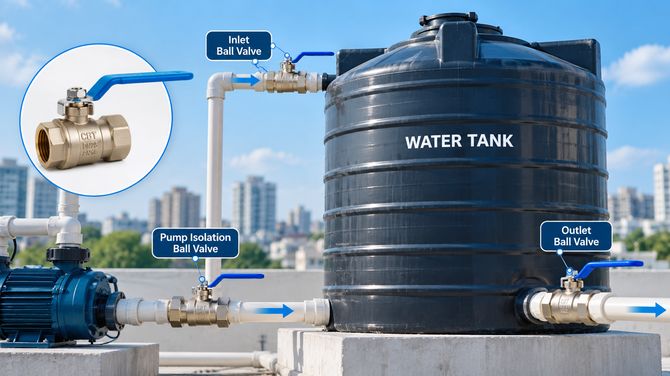
For a water tank, a ball valve may be installed on the inlet pipe, outlet pipe or another suitable connection, depending on the plumbing arrangement.
An inlet valve can be used to isolate the water supply when maintenance is required. An outlet valve can shut off the flow from the tank to the building or connected equipment.
Industrial installations may also use ball valves on water-storage tanks, utility lines and process-water pipelines.
CBT Flow Solutions Pvt. Ltd. supplies several ball valve designs, including bronze, forged brass and stainless-steel options. You can explore the CBT Zoloto valve range to review the available products.
How Does a Ball Valve Work?
The working principle is straightforward.
A typical ball valve contains a valve body, a spherical ball, a stem, seats and a handle.
When the handle is turned to the open position, the ball’s internal passage aligns with the pipe. Water flows through the valve.
When the handle is turned to the closed position, the ball rotates and blocks the passage.
The seats provide the sealing surfaces around the ball. Their material and condition influence the valve’s shut-off performance.
Most manual ball valves are designed for quick opening and closing. They are not generally intended for continuous flow regulation unless the manufacturer specifically approves that use.
For a water tank, this means the valve can be used to isolate the tank connection when needed without repeatedly turning a handwheel through several rotations.
Where Should You Install a Ball Valve on a Water Tank?
The correct location depends on what you need the valve to control.
1. Water Tank Inlet
The inlet is the pipe through which water enters the tank.
An isolation ball valve can be installed on the inlet line so the water supply can be shut off during tank cleaning or maintenance.
However, a manually operated ball valve does not automatically stop the tank from filling. If automatic shut-off is required, a suitable float valve or level-control arrangement must be provided.
2. Water Tank Outlet
The outlet is the pipe through which stored water leaves the tank.
An outlet ball valve allows the water supply to the connected plumbing or equipment to be isolated when required.
For example, if a tank outlet pipe needs repair, a properly installed isolation valve can help stop the flow from the tank, provided the valve arrangement allows effective isolation.
3. Drain Connection
Some tanks have a separate drain connection for cleaning or removing stored water.
A suitable valve may be used to control this discharge. The valve material, size and pressure rating must match the installation.
The arrangement should also allow safe drainage without creating unnecessary leakage risks.
4. Industrial Water Storage Systems
Industrial water tanks may supply process equipment, cooling circuits, utility lines or water-treatment systems.
In these applications, the correct ball valve depends on the operating pressure, temperature, medium, required flow and connection type.
Industrial valves should always be selected according to the system specification rather than assuming that a valve suitable for household plumbing will also suit an industrial installation.
Types of Ball Valves to Consider for Water Tanks
Different materials and body designs are available. The right choice depends on the application.
1. Brass Ball Valve
Brass ball valves are commonly used in plumbing and general water-control applications where the material and pressure rating are suitable.
They are available with threaded connections in a variety of sizes.
When selecting a brass valve for a water tank, check the water quality, pipe connection, operating pressure and any requirements for drinking-water contact.
CBT lists the 1008B Forged Brass Ball Valve. It is a two-piece, full-bore valve with screwed female ends, a hard-chrome-plated forged brass ball and PTFE seating.
This is an industrial product listing, so its suitability for a specific water tank or potable-water system must be checked before use.
2. Bronze Ball Valve
Bronze ball valves are another option for suitable water and utility applications.
Material selection should reflect the water quality and conditions in which the valve will operate.
CBT’s 1008A Bronze Ball Valve E-Model is listed as a full-bore, two-piece, lever-operated valve with screwed female connections, a stainless-steel ball and PTFE seats.
Its published size range is from 1/2 inch to 2 inches. Confirm the product’s current specification and suitability for the intended tank connection before ordering.
3. Stainless Steel Ball Valve
Stainless-steel ball valves may be considered for applications requiring suitable corrosion resistance or a particular material specification.
SS304 and SS316 are common stainless-steel grades, but the choice depends on the water quality, surrounding environment and operating requirements.
For example, CBT lists the 1081 SS304 Three-Piece Ball Valve, with a three-piece design, screwed connection options and PTFE seats.
This is an industrial valve with published pressure and temperature ratings. It may be appropriate for some industrial water-line applications, but it should not automatically be treated as a dedicated household water-tank fitting.
4. Electric-Actuated Ball Valve
An electric-actuated ball valve combines a ball valve with an electric actuator.
Instead of turning the handle manually, a control system operates the valve using an electrical signal.
This type of arrangement may be useful in industrial tanks or utility systems that require remote operation.
CBT lists the 2570F Electric-Actuated Ball Valve, a three-piece ball-valve design with an electric rotary actuator.
The product is intended for specified industrial applications. For an automatic tank installation, confirm that the actuator, valve and level-control system are compatible.
Ball Valve vs Float Valve for Water Tanks
This is one of the most important differences to understand when buying a tank valve.
A ball valve and a float valve do different jobs, even though both may be described using the word “ball.”
Ball Valve
A standard ball valve uses a rotating ball inside the valve body.
Its main purpose is to start or stop flow. It is usually operated with a lever or an actuator.
For example, you can close a ball valve on the inlet pipe when you need to stop the water supply manually.
Float Valve
A float valve uses a floating component that rises and falls with the water level.
As the tank fills, the float moves upwards. At the designed level, the mechanism closes the water inlet. When the water level falls, the valve can reopen and allow more water into the tank.
A float valve is therefore useful when automatic tank filling and shut-off are required.
Which One Do You Need?
Choose a standard ball valve when you need to isolate the water supply or outlet manually.
Consider a float valve or suitable automatic level-control system when you want the tank to stop filling automatically at a defined water level.
Some systems may require both: a float valve for automatic filling and a separate isolation ball valve for maintenance.
How to Choose the Right Ball Valve for a Water Tank
Before buying a water tank ball valve, check the following points.
1. Pipe Size
Identify the connection size of the inlet or outlet pipe.
Common plumbing connections vary by installation. Do not select a valve based only on the apparent pipe diameter; confirm the actual nominal size and connection standard.
2. Valve Material
Choose the body and internal materials according to the water quality and operating environment.
Brass, bronze and stainless steel are used in different valve applications. The correct material depends on the specific conditions.
3. Pressure Rating
Check the normal and maximum pressure in the pipeline.
For an elevated tank, the static pressure depends on the water height above the valve. Pump-fed systems may operate at higher pressure.
The selected valve must be rated for the actual system pressure, including relevant pressure surges.
4. Connection Type
Confirm whether the installation uses BSP, NPT, another threaded standard or a different connection type.
Connections that appear similar may not be interchangeable. Using the correct thread and suitable sealing method helps prevent leakage.
5. Water Quality
If the tank stores drinking water, check that the valve and every relevant wetted component meet the applicable requirements for potable-water contact.
Do not assume that a valve is approved for drinking water simply because it is brass, bronze or stainless steel.
6. Flow Requirement
A full-bore ball valve has a passage designed to provide a relatively unrestricted flow path when open.
Other valve designs may have a smaller passage. Consider the required flow and any pressure drop that could affect the system.
7. Manual or Automatic Operation
Decide whether an operator will control the valve manually or whether an automatic control system is needed.
A manual ball valve is generally suitable for isolation. Automatic filling requires a compatible float valve, level sensor and actuated valve arrangement, or another properly designed control system.
Common Ball Valve Problems in Water Tanks
Even a correctly selected valve can develop problems if it is installed poorly or used outside its rating.
Water Leakage Around the Connection
Leakage may occur because of incompatible threads, damaged seals, incorrect installation or unsuitable sealing materials.
Check the connection standard and follow the manufacturer’s installation instructions.
Leakage Through a Closed Valve
A valve that continues to pass water when fully closed may have worn or damaged seats, contamination inside the body or another internal fault.
The valve should be inspected and serviced according to the manufacturer’s instructions.
Handle Becomes Difficult to Turn
Deposits, corrosion, damage or long periods without operation can make a valve difficult to operate.
Do not apply excessive force to the handle. Inspect the valve and replace or service it when necessary.
Valve Is Too Small for the Required Flow
An undersized valve can restrict flow and increase filling or draining time.
Check the pipe size, valve passage and required flow before purchasing a replacement.
Tank Continues to Overflow
If a tank keeps filling after reaching the desired level, the problem may be related to the float valve, level sensor, control wiring or automatic shut-off system.
A standard manual ball valve will not detect the water level and close automatically.
Why Choose CBT Flow Solutions for Ball Valve Requirements?
CBT Flow Solutions Pvt. Ltd. supplies industrial valves and flow-control products from established manufacturers.
Its product portfolio includes bronze, forged brass and stainless-steel ball valves, as well as actuated ball valves for suitable industrial applications.
For example, the Zoloto 1008A and 1008B models provide bronze and forged-brass options, while the 1081 product is a three-piece SS304 industrial ball valve.
These products have different constructions and ratings, so buyers should select the right model according to the intended use.
For household plumbing, drinking-water systems and industrial tank connections, it is important to check the application, required approvals, material compatibility, pressure rating and connection before purchasing.
You can explore CBT’s Zoloto ball valve range or contact the team through the CBT Flow Solutions contact page.
Frequently Asked Questions
Which ball valve is best for a water tank?
The best option depends on the tank connection, water quality, pipe size, pressure and intended function. Brass, bronze or stainless-steel ball valves may suit different applications, but the product specification must be checked.
Can I use a ball valve for an overhead water tank?
A suitable ball valve can be installed on an overhead tank’s inlet or outlet line for manual isolation. Check the pressure rating, connection and material before installation.
Does a ball valve automatically stop water when the tank is full?
No. A standard manual ball valve does not automatically detect water level. A float valve or suitable automatic level-control system is needed for automatic filling and shut-off.
What size ball valve is required for a water tank?
The size depends on the existing pipe connection and the required flow. Confirm the nominal pipe size, thread standard and connection dimensions before ordering.
Is a brass ball valve suitable for drinking water?
It depends on the valve’s material specification and applicable potable-water requirements. Confirm the relevant certification or approval for the exact product rather than assuming all brass valves are suitable.
Why does a ball valve leak after closing?
Possible causes include worn seats, debris, internal damage or incorrect installation. The valve may require inspection, maintenance or replacement.
Can I use a stainless-steel ball valve for a water tank?
A stainless-steel ball valve can be considered for suitable water applications if its material, rating, connection and intended service match the installation. Drinking-water approval must be verified separately.
Conclusion
A ball valve for a water tank provides a simple way to control water flow through an inlet, outlet or other suitable pipeline connection.
However, the right choice depends on what you want the valve to do. A standard ball valve is useful for manual isolation, while a float valve or automatic level-control system is required when the tank must stop filling automatically.
Before purchasing, check the pipe size, valve material, pressure rating, connection type and water quality requirements. For industrial water tanks, also consider the operating conditions and whether manual or automated operation is required.
Selecting the correct valve can help make maintenance easier and reduce the risk of leakage caused by an unsuitable product or connection.
Looking for a Ball Valve for Your Water Tank?
CBT Flow Solutions Pvt. Ltd. supplies ball valves and industrial flow-control products for suitable water and utility applications.
Share your pipe size, water application, pressure requirements and preferred material with the team so that an appropriate product can be evaluated.
CBT Flow Solutions Pvt. Ltd.
Valves | Automation | Flow Control
Reliable Flow for a Better Tomorrow
Explore Bronze Ball Valve E-Model
Explore Forged Brass Ball Valve