


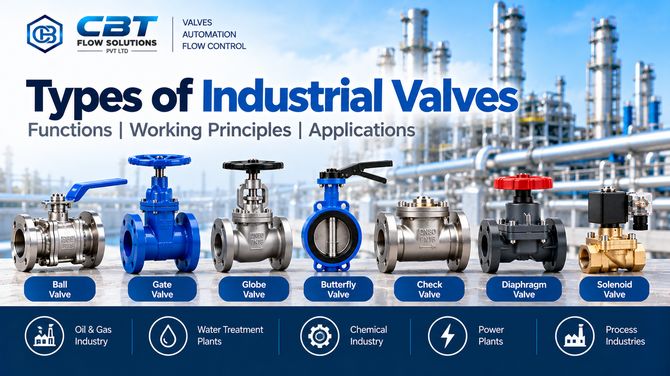
Types of Industrial Valves: Functions, Working Principles and Applications
Industrial valves are essential components in almost every process industry. They control the movement of liquids, gases, steam and other fluids through pipelines and equipment. From water treatment plants and chemical factories to oil refineries and power stations, valves help keep industrial processes operating safely and efficiently.
However, not every valve performs the same function. Some valves are designed to start or stop flow, while others regulate pressure, control flow rate or prevent fluid from moving in the wrong direction.
Understanding the different types of industrial valves helps engineers, maintenance teams and procurement professionals select the right product for their applications.
In this guide, we will explain the major types of industrial valves, how they work, where they are used and what to consider before purchasing one.
CBT Flow Solutions Pvt. Ltd. supplies industrial valves, actuators and flow-control products for a variety of industrial applications. You can explore its complete industrial valve range to review relevant product options.
What Is an Industrial Valve?
An industrial valve is a mechanical device used to control the flow of a fluid through a pipeline or industrial system.
Depending on its design, a valve can open, close, restrict or redirect the flow. Some valves operate manually using a handwheel or lever, while others use pneumatic actuators, electric actuators or solenoid coils.
For example, a water treatment plant may use butterfly valves to isolate large pipelines and check valves to prevent reverse flow. A chemical plant may require a suitable diaphragm valve for a corrosive medium, while a power plant may use gate and globe valves in applications involving water or steam.
The correct valve depends on the fluid, operating pressure, temperature, flow rate, material compatibility and the function required.
1. Ball Valve
A ball valve uses a spherical ball with a passage through its centre to control the flow of a medium.
When the passage aligns with the pipeline, fluid can flow through the valve. When the ball rotates approximately 90 degrees, the passage closes.
This quarter-turn operation makes ball valves convenient for applications requiring quick opening and closing.
Applications of Ball Valves
Ball valves are commonly used in:
- Oil and gas pipelines.
- Chemical and petrochemical plants.
- Water and utility systems.
- Process equipment.
- Industrial fluid-transfer systems.
- Automated on-off applications.
Ball valves are available in different designs, including floating ball, trunnion-mounted, two-piece and three-piece constructions. Material, pressure rating and seat design vary according to the model.
For industrial applications requiring specialised high-pressure or high-temperature performance, the valve specification should be checked carefully.
CBT Flow Solutions offers metal-seated ball valves designed for demanding applications, including abrasive media and high-temperature services. Its range also includes floating ball valves in various configurations.
2. Gate Valve
A gate valve controls flow by moving a gate or wedge up and down inside the valve body.
When the gate is raised, the flow passage opens. When it moves down onto the seating surfaces, the valve closes.
Gate valves are primarily designed for isolation rather than continuous flow regulation. They are generally operated in the fully open or fully closed position.
Applications of Gate Valves
Gate valves are commonly considered for:
- Water supply and distribution.
- Oil and gas pipelines.
- Power plants.
- Refineries.
- Chemical processing.
- Industrial utility systems.
When fully open, a suitable gate valve can provide a relatively direct flow path with low flow resistance.
The selected material, pressure rating, temperature limit and connection type must match the application.
CBT Flow Solutions supplies a cast steel gate valve for industrial flow-isolation duties. It also lists forged steel gate valves for specified industrial applications.
3. Globe Valve
A globe valve uses a disc or plug that moves towards or away from a seat to regulate flow.
Unlike a gate valve, the flow path in a globe valve changes direction inside the body. This design creates a pressure drop, but it can provide better flow-regulation characteristics in suitable applications.
Globe valves are often selected when operators need to adjust the flow rather than simply open or close a pipeline.
Applications of Globe Valves
Typical applications include:
- Steam systems.
- Cooling-water circuits.
- Industrial process lines.
- Flow-control duties.
- Utility pipelines.
- Selected high-pressure services.
The actual suitability depends on the valve design, pressure class, temperature and medium.
CBT’s forged steel gate, globe and check valve range includes products designed for industrial applications, with different connection and pressure-rating options.
4. Butterfly Valve
A butterfly valve controls flow using a disc mounted inside the pipeline. The disc rotates approximately 90 degrees to move between open and closed positions.
Butterfly valves have a relatively compact design and are often considered for larger pipeline sizes.
Depending on the design, they can be operated manually, through a gearbox or using a pneumatic or electric actuator.
Applications of Butterfly Valves
Butterfly valves are commonly used in:
- Water treatment plants.
- Wastewater systems.
- HVAC installations.
- Chemical processing.
- Cooling-water lines.
- Industrial process automation.
The seat, disc and body materials must suit the medium and operating conditions.
For corrosive applications, specialised designs such as PTFE-lined butterfly valves can be evaluated where compatible with the fluid and temperature.
CBT supplies PTFE-lined butterfly valves for chemical process applications requiring suitable corrosion resistance. It also offers wafer-type butterfly valves with gear operation for specified industrial duties.
5. Check Valve or Non-Return Valve
A check valve allows a fluid to move in one direction and helps prevent reverse flow.
Unlike manually operated valves, many check valves work automatically in response to flow and pressure conditions.
When the fluid moves in the intended direction, the internal mechanism opens. When flow reverses or the required opening conditions are no longer present, the valve closes.
Applications of Check Valves
Check valves are used in:
- Pump discharge pipelines.
- Water distribution systems.
- Wastewater treatment plants.
- Industrial fluid-transfer systems.
- Oil and gas facilities.
- Steam and utility systems, where appropriate.
The correct design depends on pressure, flow rate, installation orientation and the potential for water hammer.
CBT lists forged steel gate, globe and check valves for industrial services, along with other valve options in its product range.
6. Diaphragm Valve
A diaphragm valve uses a flexible diaphragm to control the flow passage. The diaphragm moves towards or away from a weir or seat to close or open the valve.
Depending on the design, the diaphragm can separate the operating mechanism from the process fluid.
These valves are useful in applications where fluid compatibility, isolation or the handling of corrosive, abrasive or solids-containing media is important.
Applications of Diaphragm Valves
Typical applications include:
- Chemical processing.
- Water and wastewater treatment.
- Mining.
- Pulp and paper industries.
- Industrial process systems.
- Selected fluid-handling applications containing solids.
The valve body, lining and diaphragm material must be suitable for the medium and operating conditions.
CBT supplies weir-type diaphragm valves for applications involving corrosive, erosive or solids-containing media. The listed product range includes several body and diaphragm material options.
7. Plug Valve
A plug valve uses a cylindrical or tapered plug with a passage through it. When the plug rotates, the passage aligns with or moves away from the pipeline, allowing or stopping flow.
Many plug valves operate through a quarter-turn movement.
Their suitability depends on the design, sealing system, material and fluid conditions.
Applications of Plug Valves
Plug valves may be considered for:
- Industrial process lines.
- Oil and gas applications.
- Chemical processing.
- Fluid-transfer systems.
- Selected slurry or solids-handling duties.
For abrasive or corrosive service, the lining and construction must be chosen carefully.
CBT’s valve product range provides a useful starting point for exploring industrial valve categories and related products.
8. Needle Valve
A needle valve uses a narrow, tapered stem that moves towards or away from a small seat to regulate flow.
Because the closing element can make fine adjustments, needle valves are useful where precise control of a small flow rate is required.
They are not normally chosen for large pipeline isolation where high flow capacity is the main requirement.
Applications of Needle Valves
Common applications include:
- Instrumentation lines.
- Pressure-measurement connections.
- Sampling systems.
- Small flow-control circuits.
- Hydraulic and pneumatic instrumentation.
Needle valves are available in different body materials and pressure ratings, so the selection should reflect the medium and operating conditions.
CBT’s Zoloto product range lists needle valves alongside other industrial valve products.
9. Solenoid Valve
A solenoid valve is an electrically operated valve that uses an electromagnetic coil to change the position of an internal mechanism.
Depending on the design, it can open, close or redirect the flow of liquids or gases. Pneumatic solenoid valves are also used to control compressed air supplied to cylinders and actuators.
Solenoid valves are important in automated systems because they allow a control signal to operate a compatible valve circuit.
Applications of Solenoid Valves
They are commonly used in:
- Pneumatic automation.
- Chemical dosing.
- Water treatment.
- Air compressor control circuits.
- Process equipment.
- Pneumatic actuator control.
The correct model depends on the medium, pressure, flow rate, voltage, port configuration and seal material.
CBT Flow Solutions supplies a wide solenoid valve range with different port configurations and operating arrangements for industrial automation and flow-control applications.
10. Safety Relief Valve
A safety relief valve is designed to protect equipment against excessive pressure by releasing the medium when specified operating conditions are reached.
The exact operation depends on the valve type and application.
These valves are important where equipment or pipelines need protection against pressure exceeding their permitted limits.
Applications of Safety Relief Valves
They may be used in:
- Boilers and steam systems.
- Pressure vessels.
- Compressed-gas systems.
- Industrial process equipment.
- Selected liquid-pressure systems.
Safety relief valves require careful sizing, suitable pressure settings and compliance with the relevant design and installation requirements.
They should not be treated as ordinary manual isolation valves. The type of protection, applicable standards and required certification must be confirmed for the specific installation.
Industrial Valves by Function
Understanding valve types is easier when you also understand their main functions.
| Function | Common Valve Types |
|---|---|
| Start and stop flow | Ball valve, gate valve, butterfly valve |
| Regulate flow | Globe valve, control valve, suitable diaphragm valve |
| Prevent reverse flow | Check valve |
| Control small flow rates | Needle valve |
| Electrical switching | Solenoid valve |
| Protect against excessive pressure | Safety relief valve |
| Support automated valve operation | Actuated ball and butterfly valves |
The table provides a general guide. The final choice depends on the particular valve design, operating conditions and required function.
Manual vs Automated Industrial Valves
Industrial valves may be manually operated or automated.
A manual valve uses a handwheel, lever or gearbox. It is useful where an operator needs to open or close the valve directly.
An automated valve uses an actuator to operate the valve from a control panel or process-control system.
Pneumatic actuators use compressed air, while electric actuators use electrical power to create the required movement.
Automation is particularly useful when valves must operate repeatedly, respond to remote commands or follow a programmed sequence.
For example, an industrial plant may use automated butterfly valves to control the movement of water through a process line. A suitable actuator and control accessories can allow these valves to be operated remotely.
CBT provides remote-operated butterfly valve systems with actuator and control accessories configured for different industrial requirements.
The valve, actuator and accessories must be selected together to ensure compatibility.
How to Select the Right Industrial Valve
Selecting an industrial valve involves more than matching the pipeline diameter. A suitable selection should account for the entire operating environment.
1. Identify the Medium
First, identify whether the valve will handle water, air, steam, oil, gas, chemicals or a mixture containing solids.
The medium affects the required body, seat and seal materials.
2. Check Pressure and Temperature
Confirm the normal operating conditions and any expected maximum pressure or temperature.
The selected valve must remain within its specified pressure-temperature rating.
3. Understand the Required Function
Decide whether you need isolation, throttling, backflow prevention, electrical switching or overpressure protection.
This step helps narrow down the suitable valve types.
4. Select the Material
Valve materials can include cast iron, carbon steel, stainless steel, bronze and specialised alloys.
The correct material depends on the fluid, corrosion risk, temperature and applicable engineering standards.
5. Confirm Size and Connection
Match the valve size and end connection to the piping specification. Common arrangements include threaded, flanged, wafer, socket-weld and butt-weld designs, depending on the valve type.
6. Consider Maintenance
Check the availability of spare parts, access for inspection and the manufacturer’s recommended maintenance requirements.
For demanding process applications, documentation and inspection requirements should also be confirmed before ordering.
7. Decide Whether Automation Is Needed
If the valve must operate remotely, determine whether a pneumatic or electric actuator is required. Confirm actuator torque, the control signal, operating speed and any required position feedback.
For more detailed guidance, read CBT’s Industrial Valve Selection Guide.
Common Mistakes When Selecting Industrial Valves
A few common mistakes can be avoided with proper technical planning.
Choosing a valve only by size. The valve must also meet pressure, temperature, flow and material requirements.
Using a gate valve for continuous throttling. Gate valves are primarily intended for isolation. A suitable globe or control valve may be better for regulating flow.
Ignoring the effect of fluid compatibility. A material suitable for water may not be suitable for a chemical or high-temperature medium.
Choosing an actuator without checking the valve. Actuator torque and mounting compatibility must match the valve design.
Ignoring documentation requirements. Some projects require test certificates, material certificates or compliance documents for the particular product.
Providing complete application details helps reduce selection errors and makes it easier to identify the correct product.
Industrial Valve Supplier in India
CBT Flow Solutions Pvt. Ltd. supplies industrial valves, actuators and flow-control products for a range of industrial applications.
The company’s product range includes ball valves, butterfly valves, gate valves, globe valves, check valves, diaphragm valves, solenoid valves and related automation solutions.
For example, you can explore:
- Industrial Ball Valves
- Cast Steel Gate Valves
- Butterfly Valves
- Diaphragm Valves
- Solenoid Valves
- Remote-Operated Butterfly Valve Systems
The right product should always be selected according to the operating medium, pressure, temperature, size, connection and intended duty.
Frequently Asked Questions
What are the main types of industrial valves?
Common types include ball valves, gate valves, globe valves, butterfly valves, check valves, diaphragm valves, plug valves, needle valves, solenoid valves and safety relief valves.
Which industrial valve is best for isolation?
Ball, gate and butterfly valves are commonly used for isolation. The appropriate choice depends on the pipeline size, pressure, temperature, medium and operating requirements.
Which valve is best for flow regulation?
Globe valves and suitable control valves are commonly used for flow regulation. Certain diaphragm and specialised valve designs may also be used for suitable control duties.
What is the difference between a gate valve and a globe valve?
A gate valve is primarily intended for opening and closing a pipeline. A globe valve uses a disc that moves towards or away from a seat and is commonly used for flow regulation.
Why is a check valve required?
A check valve helps prevent reverse flow and is commonly used in suitable pump discharge and fluid-transfer systems.
What is an automated industrial valve?
An automated industrial valve uses a pneumatic or electric actuator to open, close or position a compatible valve according to a control signal.
How do I choose an industrial valve supplier?
Check whether the supplier can offer suitable valve types, technical specifications, compatible materials, required connections and relevant documentation. Technical support and the availability of suitable products are also important considerations.
Conclusion
Industrial valves perform different functions in process plants. Ball valves provide quarter-turn operation, gate valves are used mainly for isolation, globe valves are suitable for many flow-regulation duties, butterfly valves offer compact operation, and check valves help prevent reverse flow.
Diaphragm, plug, needle, solenoid and safety relief valves serve other specialised purposes.
The right valve is not necessarily the most expensive or the most complicated one. It is the valve that matches the application and meets the required technical specifications.
Before purchasing, confirm the medium, pressure, temperature, flow rate, material, connection and operating method. When automation is required, check the compatibility of the valve, actuator and control accessories together.
Need Industrial Valves for Your Application?
CBT Flow Solutions Pvt. Ltd. supplies industrial valves, actuators and flow-control products for different industrial requirements.
Share your application, fluid medium, pipeline size, operating pressure and temperature with our team to help identify a suitable valve configuration.
CBT Flow Solutions Pvt. Ltd.
Valves | Automation | Flow Control
Reliable Flow for a Better Tomorrow
Explore Industrial Valve Products
Read the Industrial Valve Selection Guide
Contact CBT Flow Solutions