


3 Way Ball Valve vs 2 Way Ball Valve: Differences, Working and Applications
Ball valves are widely used in industrial pipelines because they offer simple operation and reliable flow isolation when correctly selected. They are found in water systems, chemical plants, manufacturing facilities, oil and gas installations and many other industrial applications.
However, not every ball valve controls flow in the same way.
A 2 way ball valve is generally used to start or stop flow through a single passage. A 3 way ball valve has three ports and can direct flow between different connections, depending on its internal design.
This difference can affect how a pipeline is arranged, how a process operates and how many valves are required for a particular application.
So, when comparing a 3 way ball valve vs 2 way ball valve, which one should you choose?
The answer depends on whether your system needs simple flow isolation or the ability to divert or combine flow paths.
In this guide, we will explain the differences, how each valve works, the functions of L-port and T-port designs, and what to check before selecting an industrial ball valve.
CBT Flow Solutions Pvt. Ltd. supplies two-way and three-way ball valves, including pneumatic and electric-actuated configurations for suitable industrial applications.
What Is a 2 Way Ball Valve?
A 2 way ball valve has two ports: one inlet and one outlet.
Inside the valve is a spherical ball with a hole through its centre. When the hole lines up with the pipeline, fluid can pass through. When the ball rotates approximately 90 degrees, the hole moves away from the flow path and the valve closes.
This simple quarter-turn arrangement makes the 2 way ball valve suitable for many on-off applications.
For example, imagine a water pipeline supplying an industrial machine. If the machine needs maintenance, the operator can close the ball valve to isolate the water supply. Once the work is completed and the system is ready, the valve can be opened again.
How Does a 2 Way Ball Valve Work?
The operating process is straightforward.
Open position: The handle or actuator turns the ball so the internal passage aligns with the inlet and outlet.
Closed position: The ball rotates approximately 90 degrees, blocking the passage and stopping the flow.
Automated operation: If an actuator is fitted, an electrical or pneumatic control system can operate the valve remotely.
Two-way ball valves are mainly used for isolation. They should not automatically be treated as control valves for continuous flow regulation unless the particular design is suitable for that duty.
Applications of 2 Way Ball Valves
Common applications include:
- Water supply and utility pipelines.
- Oil and gas systems.
- Chemical processing.
- Industrial machinery.
- Pump and equipment isolation.
- Compressed-air systems.
- Automated on-off flow control.
The correct valve depends on the operating pressure, temperature, medium, material compatibility and required connection.
CBT Flow Solutions offers the 2370F 2 Way Full-Port Ball Valve with Pneumatic Rotary Actuator. Its published specification includes a three-piece design, sizes from 15 mm to 100 mm, and screwed or flanged connection options.
For electric operation, CBT also lists the 2570F 2 Way Ball Valve with Electric Rotary Actuator.
What Is a 3 Way Ball Valve?
A 3 way ball valve has three ports rather than two.
Its internal ball is designed to direct fluid between different connections. Depending on the ball passage, port arrangement and operating position, the valve can divert flow from one line to another or combine flow from two lines into one.
This makes three-way ball valves useful when a process needs more than a simple open-or-closed flow path.
For example, a machine may need to receive water from one of two supply lines. A suitable three-way valve can switch the connection between those lines.
In another application, a suitable three-way arrangement may direct fluid towards different equipment or allow mixing from two sources.
The exact function depends on the valve’s internal port design.
How Does a 3 Way Ball Valve Work?
A 3 way ball valve also uses a rotating ball, but its internal passage connects three ports in a particular arrangement.
When the handle or actuator changes the ball position, the internal passage changes which ports are connected.
For example, an L-port valve can connect a common port to one of two other ports, then switch to the alternative connection.
A T-port valve can provide different connection patterns and, where the design permits, connect all three ports in one position.
The available flow paths depend on the specific valve design. The port diagram should always be checked before installation.
Applications of 3 Way Ball Valves
Three-way ball valves are commonly considered for:
- Diverting flow between two lines.
- Switching between alternative fluid sources.
- Selecting a supply line for process equipment.
- Mixing or combining streams where the valve design permits.
- Industrial process systems.
- Automated fluid-handling applications.
A three-way ball valve can simplify piping in suitable systems, but it is not automatically a replacement for every two-valve or control-valve arrangement. The required flow paths, isolation requirements and operating conditions must be checked.
CBT Flow Solutions lists the 2530F/2531R Three-Way Metal Body Ball Valves with Electric Actuators. The product specification identifies full-port L-port and T-port designs, stainless steel AISI 316 ball and stem components, and screwed or flanged connections.
The company also lists the 2330F/2331F Three-Way Ball Valves with Pneumatic Actuators.
3 Way Ball Valve vs 2 Way Ball Valve: Key Differences
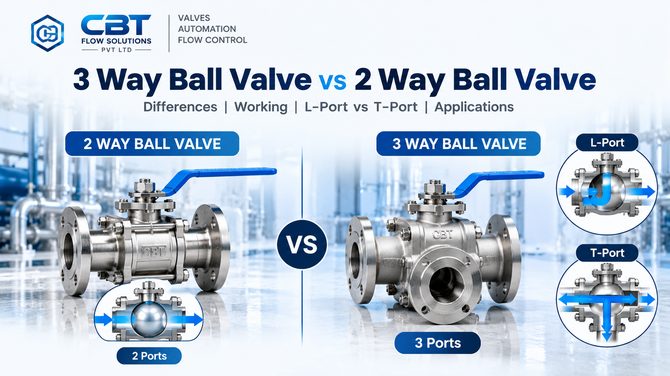
The most important difference is the number of ports and the flow path each valve can provide.
| Feature | 2 Way Ball Valve | 3 Way Ball Valve |
|---|---|---|
| Number of ports | 2 | 3 |
| Main function | Start or stop flow | Divert, select or combine flow paths, depending on design |
| Internal ball passage | Usually a straight passage | L-port or T-port arrangement, depending on model |
| Typical flow arrangement | One inlet and one outlet | Three connected ports with selectable flow paths |
| Common use | Pipeline isolation | Flow switching or diversion |
| Operating method | Manual, pneumatic or electric | Manual, pneumatic or electric, depending on product |
| Piping arrangement | Generally simpler | May simplify a system that needs alternative flow paths |
| Selection priority | Isolation duty and flow requirements | Required port connections and switching sequence |
The table provides a general comparison. Always use the manufacturer’s flow-path diagram for the exact model, particularly when choosing an L-port or T-port valve.
What Is the Difference Between L-Port and T-Port Ball Valves?
When buying a three-way ball valve, one of the most important decisions is selecting the correct port configuration.
L-Port Ball Valve
An L-port ball valve has an internal passage shaped like the letter L.
Its passage normally connects two ports at a time, allowing the valve to direct flow from a common port to one of two alternative ports, depending on the design.
For example, a process might need to receive fluid from supply line A or supply line B. An appropriate L-port arrangement can switch the connection between those sources.
The switching sequence and available positions depend on the valve’s design.
T-Port Ball Valve
A T-port ball valve has an internal passage shaped like the letter T.
Depending on the construction and handle position, it may connect different combinations of the three ports. Certain designs can connect all three ports simultaneously.
This makes T-port designs useful for some mixing, diverting or flow-selection applications.
However, the precise flow path must be confirmed from the valve diagram. Do not assume that every T-port ball valve provides every possible flow combination.
CBT’s 2530F/2531R electric-actuated three-way ball valve and 2330F/2331F pneumatic-actuated three-way ball valve are listed with L-port and T-port options.
Which Ball Valve Is Better for Industrial Applications?
Neither valve type is always better. Each serves a different purpose.
Choose a 2 Way Ball Valve When:
You need to open or close a pipeline, isolate equipment, or control one straightforward flow path.
A two-way design is generally easier to specify when the system needs only one inlet-to-outlet connection.
It may be suitable for water, air, oil, gas and other compatible media, depending on the model.
Choose a 3 Way Ball Valve When:
Your system needs to switch between alternative lines, divert flow or combine streams through an appropriate port arrangement.
A three-way design may be useful when the piping arrangement requires multiple flow paths and the selected valve can provide them.
Before ordering, make sure the valve’s port diagram matches the intended process operation.
Manual vs Pneumatic vs Electric Ball Valves
Both two-way and three-way ball valves can be operated manually or through an actuator, depending on the product.
Manual Ball Valve
A manual valve uses a lever or another operating mechanism. It is often suitable when an operator needs to change the valve position occasionally.
Pneumatic Ball Valve
A pneumatic actuator uses compressed air to turn the valve.
Pneumatic operation is useful in suitable automated systems where compressed air is available and the control arrangement supports it.
CBT’s 2370F two-way pneumatic-actuated ball valve is one example. For three-way operation, see the 2330F/2331F series.
Electric Ball Valve
An electric actuator uses electrical power to move the valve between its required positions.
Electric operation may be appropriate where a control panel or automation system needs to operate the valve remotely.
CBT lists the 2570F two-way electric-actuated ball valve and the 2530F/2531R three-way electric-actuated ball valves.
The choice of actuator should consider valve torque, operating time, control signal, available utilities, required position feedback and the desired response to power or air loss.
How to Select the Right 2 Way or 3 Way Ball Valve
Before purchasing a valve, review the following factors.
1. Define the Flow Path
Start by identifying what the valve needs to do.
If the requirement is to open or close one pipeline, a two-way valve may be suitable.
If the requirement is to switch or divert flow between connections, evaluate a three-way design and confirm its port arrangement.
2. Check the Medium
Identify the fluid that will pass through the valve.
Water, air, oil, gas, steam and chemicals can have different material and sealing requirements.
3. Confirm Pressure and Temperature
Check the normal and maximum operating pressure and temperature.
The selected valve must meet the relevant pressure-temperature rating for the actual service.
4. Choose the Valve Size
The valve size must match the piping and required flow conditions.
Also check whether the application needs a full-port or reduced-port design.
5. Select Suitable Materials
Valve bodies can be made from carbon steel, stainless steel, brass, bronze and other specified materials.
The correct body, ball, stem and seat materials depend on the medium, corrosion risk and operating conditions.
6. Check the End Connection
Confirm whether the pipeline needs a screwed, flanged, socket-weld or other connection.
The connection standard must match the piping specification.
7. Decide on the Operating Method
Choose manual, pneumatic or electric operation based on the control requirement.
If the valve will be automated, check actuator compatibility and any required control accessories.
8. Confirm the Three-Way Port Diagram
For a three-way valve, this is especially important.
Identify the common port and confirm how the L-port or T-port connects the other ports in each position.
Incorrect port orientation can send fluid to the wrong line or interrupt the intended process sequence.
Common Mistakes When Choosing Ball Valves
A few common mistakes can be avoided with proper planning.
Choosing a three-way valve without checking the port diagram. The flow pattern must match the process requirement.
Using a two-way valve when flow diversion is required. A simple on-off valve cannot provide the same set of flow paths as a correctly selected three-way valve.
Assuming every three-way valve can mix fluids. The available flow combinations depend on the valve’s port design and operating positions.
Selecting a valve only by pipe size. Pressure, temperature, flow capacity and materials must also match the application.
Ignoring automation requirements. The actuator, control signal, mounting and available power or air supply must all be considered.
Choosing an unsuitable material. The valve’s wetted parts and seat material should be compatible with the medium.
These checks can help avoid unnecessary modifications and improve the likelihood that the selected valve will perform its intended function.
2 Way and 3 Way Ball Valves from CBT Flow Solutions
CBT Flow Solutions Pvt. Ltd. supplies industrial ball valves and automated valve assemblies for different applications.
For two-way operation, you can review:
For three-way operation, you can review:
- 2530F/2531R Three-Way Electric-Actuated Ball Valves
- 2330F/2331F Three-Way Pneumatic-Actuated Ball Valves
The listed three-way models are available in L-port and T-port arrangements. Product specifications include different body material, pressure rating and connection options, depending on the selected configuration.
Review the CBT Zoloto valve range for additional industrial valve products.
The appropriate product should be selected according to the medium, pressure, temperature, size, flow path, connection and operating requirements.
Frequently Asked Questions
What is the difference between a 3 way ball valve and a 2 way ball valve?
A two-way ball valve has two ports and is generally used to start or stop flow through a single passage. A three-way ball valve has three ports and can switch or direct flow between connections, depending on its L-port or T-port design.
What is a 3 way ball valve used for?
A three-way ball valve is used for flow diversion, line selection and certain mixing applications. The exact function depends on the internal port configuration and the valve’s available operating positions.
Can a 3 way ball valve replace two 2 way ball valves?
In some applications, a three-way valve can simplify a piping arrangement that would otherwise need multiple valves. However, the decision depends on the required isolation, flow paths, operating sequence and maintenance requirements.
Which is better, an L-port or a T-port ball valve?
An L-port valve is commonly selected to switch flow between two alternative connections. A T-port valve may provide additional connection combinations, including connecting all three ports in certain positions. Confirm the specific flow diagram before choosing.
Are three-way ball valves available with actuators?
Yes. CBT Flow Solutions lists pneumatic-actuated and electric-actuated three-way ball valves, including the 2330F/2331F and 2530F/2531R series.
Can a 2 way ball valve regulate flow?
A standard two-way ball valve is primarily used for isolation. Continuous throttling should only be considered when the specific valve is designed and approved for that duty.
What information should I provide when requesting a ball valve quotation?
Provide the required flow path, valve size, medium, pressure, temperature, connection, material, operating method and quantity. For a three-way valve, also provide the required L-port or T-port arrangement and the intended port connections.
Conclusion
The difference between a 3 way ball valve vs 2 way ball valve comes down to the number of ports and the flow paths the valve needs to provide.
A two-way ball valve is generally the appropriate choice when the job is to open or close a single flow path.
A three-way ball valve is worth evaluating when the system needs to switch or divert flow between different connections. The choice between L-port and T-port designs depends on the exact piping and control requirements.
Before purchasing, confirm the flow diagram, medium, pressure, temperature, valve size, material, end connection and operating method. For automated applications, check the valve and actuator as a complete assembly.
Need a 2 Way or 3 Way Ball Valve for Your Application?
CBT Flow Solutions Pvt. Ltd. supplies industrial ball valves, actuators and flow-control products for a range of industrial applications.
Share your application, required flow path, line size, operating conditions and actuation requirements with our team to help identify a suitable valve configuration.
CBT Flow Solutions Pvt. Ltd.
Valves | Automation | Flow Control
Reliable Flow for a Better Tomorrow
Explore Two-Way Pneumatic Ball Valves