


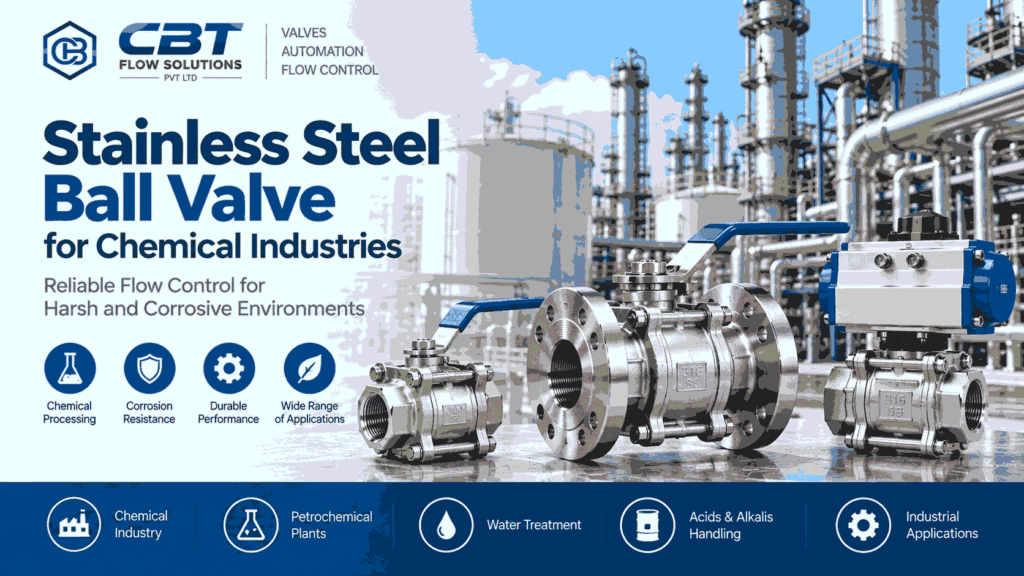
Stainless Steel Ball Valve for Chemical Industries: Selection Guide
In a chemical plant, even a small valve can become a very important part of the process.
A valve may be used to isolate a pipeline, control the movement of a process fluid, connect equipment or shut down a section of the plant during maintenance. When the fluid is corrosive or the operating conditions are demanding, choosing the right valve material becomes even more important.
This is one of the reasons stainless steel ball valves are widely used for chemical industry applications.
A stainless steel ball valve combines the simple quarter-turn operation of a ball valve with stainless steel construction that can be suitable for many industrial environments. Depending on the process, engineers may consider SS304, SS316 or another suitable material grade.
But there is an important point that should not be overlooked.
A stainless steel valve is not automatically suitable for every chemical.
The correct selection depends on the actual chemical or process fluid, concentration, temperature, pressure, valve construction, seat material, sealing material and connection type.
For chemical plants, the right question is not simply, “Which stainless steel ball valve should we buy?” The better question is, “Which valve construction is suitable for our exact service conditions?”
That is where proper technical selection becomes important.
What Is a Stainless Steel Ball Valve?
A stainless steel ball valve is a quarter-turn valve that uses a spherical ball with a passage through it to start or stop flow.
When the ball is aligned with the pipeline, the fluid can pass through.
When the ball turns by approximately 90 degrees, the passage closes and flow is stopped.
This simple design gives ball valves a major advantage in many industrial applications. They are compact, quick to operate and commonly used where reliable on-off isolation is required.
A stainless steel ball valve can be manufactured in different configurations, including two-piece and three-piece designs, screwed and flanged connections, manual and automated versions, and different material combinations for the body, ball, stem, seats and seals.
CBT Flow Solutions currently lists SS304 and SS316 three-piece ball valves in both screwed and flanged configurations through its Zoloto range. CBT Flow Solutions Pvt. Ltd.
Explore CBT’s Solenoid and Valve Products
Why Are Stainless Steel Ball Valves Used in Chemical Industries?
Chemical plants deal with a wide variety of fluids. Some are relatively mild, while others can be corrosive, high-temperature, pressurized or chemically aggressive.
The valve material therefore has to be selected carefully.
Stainless steel may be considered because it offers a useful combination of mechanical strength, corrosion resistance and industrial durability in many services.
CBT’s current automated stainless-steel ball-valve products are listed for applications involving air, water, oil, gas and corrosive chemicals, along with chemical and petrochemical industries. CBT Flow Solutions Pvt. Ltd.
That does not mean every stainless steel grade or every seal material is suitable for every chemical. Compatibility still needs to be checked.
For example, a valve used for one chemical may perform very differently from the same valve used with another chemical at a different temperature and concentration.
This is why experienced chemical-process engineers look at the complete specification rather than selecting a valve based on material name alone.
SS304 vs SS316 Ball Valve for Chemical Applications
When a buyer searches for a stainless steel ball valve for chemical industries, one of the first material questions is usually SS304 versus SS316.
Both are common stainless steel grades, but the correct choice depends on the actual service.
CBT’s current Zoloto range includes 1081 and 1081A in CF8 / SS304, and 1080A and 1080B in CF8M / SS316. The range includes screwed and flanged versions. CBT Flow Solutions Pvt. Ltd.
SS304 Ball Valve
SS304 is widely used for industrial equipment and piping applications where its material characteristics are suitable.
CBT’s 1081 is listed as a three-piece SS304 ball valve with a Class 150 design and screwed ends, while the 1081A is the flanged version. The product information identifies CF8 stainless steel construction and Type 304 stainless steel components. CBT Flow Solutions Pvt. Ltd.
A buyer considering SS304 should still confirm whether the process chemical and operating environment are compatible with this grade.
SS316 Ball Valve
SS316 is often considered where the process environment requires a higher level of resistance to certain corrosive conditions.
CBT’s 1080A is listed as a three-piece SS316 ball valve with screwed connections, while 1080B is the flanged version. The product information specifies CF8M / SS316 construction. CBT Flow Solutions Pvt. Ltd.
For chemical plants, SS316 can therefore be an important option to evaluate, especially when the process conditions are more demanding.
The final decision should always be made using the actual chemical compatibility and operating specification.
Recommended CBT product links
SS316 Three-Piece Ball Valve 1080A – Screwed
SS316 Three-Piece Ball Valve 1080B – Flanged
SS304 Three-Piece Ball Valve 1081 – Screwed
Why Three-Piece Ball Valves Are Popular in Industrial Piping
A three-piece ball valve has a body design that can make servicing more convenient compared with some other constructions.
This matters in industrial plants because maintenance teams need to inspect, service and replace components without unnecessarily disturbing the entire piping arrangement.
For chemical plants, maintenance access can be particularly important because unplanned shutdowns can affect production.
CBT’s current 1080A, 1080B, 1081 and 1081A products are three-piece Class 150 ball-valve designs. CBT Flow Solutions Pvt. Ltd.
The suitable construction still depends on the installation and process requirements.
Screwed vs Flanged Stainless Steel Ball Valve
The pipeline connection is another important part of valve selection.
Screwed Ball Valve
A screwed or threaded ball valve is typically selected where the piping system is designed for threaded connections.
CBT’s 1080A and 1081 models are listed with screwed female connection options, including BSPT and NPT configurations. CBT Flow Solutions Pvt. Ltd.
This type of connection can be convenient for appropriate piping systems and smaller line sizes.
Flanged Ball Valve
A flanged ball valve uses flanges for pipeline connection.
Flanged designs are widely considered for industrial piping, particularly where larger line sizes, maintenance requirements or specific piping standards make flanged connections appropriate.
CBT’s 1080B and 1081A models are listed as flanged versions of the SS316 and SS304 three-piece ball-valve designs respectively. CBT Flow Solutions Pvt. Ltd.
When deciding between screwed and flanged connections, the piping standard, pressure class, line size and maintenance requirements should all be considered.
Full Port vs Reduced Port Ball Valve
Another technical point that is often missed is the difference between full-port and reduced-port designs.
A full-port ball valve generally has a flow passage that is closer to the internal pipe diameter.
A reduced-port valve has a smaller flow passage through the ball.
The selection depends on the process and flow requirements.
For example, CBT’s 2370F is described as a 2-way full-port, 3-piece ball valve with pneumatic rotary actuator, with available screwed and flanged connections. Its listed applications include corrosive chemicals, chemical and petrochemical industries and water-treatment applications. CBT Flow Solutions Pvt. Ltd.
For chemical applications where the pressure drop and flow characteristics matter, the port design should therefore be considered during valve selection.
Important Factors When Selecting a Ball Valve for Chemical Plants
Choosing a stainless steel valve only by size is not enough.
Before purchasing, the following factors should be checked.
1. Chemical Compatibility
The first and most important question is the process fluid.
You should know:
- Chemical name
- Concentration
- Temperature
- Pressure
- Flow conditions
- Whether the fluid contains solids or contaminants
The valve body may be suitable while the seat or seal material is not. The complete wetted-part construction must therefore be reviewed.
2. Material Grade
The common decision may be SS304 versus SS316, but that is only the starting point.
The valve specification should clearly identify the material of the body, ball, stem and other relevant components.
CBT’s current SS316 models are identified with CF8M / SS316 construction. CBT Flow Solutions Pvt. Ltd.
3. Pressure Rating
The valve must be capable of handling the required operating pressure.
For example, CBT’s 1080A and 1080B product information lists Class 150 design and pressure specifications for those particular models. CBT Flow Solutions Pvt. Ltd.
Never assume that every stainless steel ball valve has the same pressure rating.
4. Temperature
Temperature directly affects the valve’s body, seats and seals.
CBT’s 2370F pneumatic ball-valve specification lists continuous and intermittent temperature values for the particular product, while other models have their own limits. CBT Flow Solutions Pvt. Ltd.
Always verify the exact product datasheet for the operating temperature.
5. Seat and Seal Material
This is particularly important for chemical service.
A stainless steel body may be suitable for the process, but the seat material still needs to withstand the chemical and temperature.
Depending on the valve model, materials such as reinforced PTFE may be specified. CBT’s 2370F and 2570F products list reinforced PTFE seats. CBT Flow Solutions Pvt. Ltd.
6. Valve Size
Choose the valve according to the actual line size and required flow conditions.
An oversized or undersized valve can create practical problems in the system.
7. Manual or Automated Operation
A manual valve may be perfectly adequate for an isolation point that an operator opens occasionally.
But when the process requires remote or automatic operation, an actuated ball valve can be a better solution.
Pneumatic Stainless Steel Ball Valves for Chemical Plants
Automation is increasingly important in modern process plants.
Instead of manually opening and closing every valve, plants can use pneumatic actuators to operate process valves from a remote control system.
CBT’s 2370F combines a full-port three-piece ball valve with a pneumatic rotary actuator. The product is listed for air, water, oil, steam, gas and corrosive chemicals, as well as chemical and petrochemical industries. CBT Flow Solutions Pvt. Ltd.
The product can also be supplied with accessories such as a local position indicator, rotary limit switch box, air lock relay, solenoid valve and valve positioner, depending on the application. CBT Flow Solutions Pvt. Ltd.
You can view the product here:
2370F Pneumatic Actuated Ball Valve
For broader automation requirements, CBT also supplies pneumatic actuators suitable for ball valves, butterfly valves and other quarter-turn applications.
Pneumatic Actuators – CBT Flow Solutions
Electric Actuated Stainless Steel Ball Valves
Not every chemical plant uses pneumatic automation.
Some installations use electric actuators, especially where electrical control is more practical for the application.
CBT’s 2570F is a two-way full-port, three-piece ball valve with an electric rotary actuator. The listed specification includes stainless steel AISI 316 ball construction, reinforced PTFE seating, Class 150 and Class 300 pressure ratings, and applications including corrosive chemicals, chemical and petrochemical industries, power stations and water treatment. CBT Flow Solutions Pvt. Ltd.
2570F Electric Actuated Ball Valve
The choice between pneumatic and electric actuation depends on factors such as plant utilities, control philosophy, fail-action requirements, operating frequency and installation conditions.
Common Applications of Stainless Steel Ball Valves in Chemical Industries
A suitable stainless steel ball valve can be used in many sections of a chemical plant.
Chemical Processing Lines
Ball valves can be used for isolation of process lines where the selected materials are compatible with the process fluid.
Chemical Storage Systems
Storage and transfer systems may use ball valves to isolate tanks, pipelines and equipment.
Dosing and Transfer Lines
Chemical transfer systems often require reliable isolation during loading, unloading and maintenance.
Water Treatment
Chemical plants frequently have utility and water-treatment systems alongside the main process.
CBT’s automated ball-valve range lists water treatment and RO-plant applications for selected products. CBT Flow Solutions Pvt. Ltd.
Petrochemical Plants
CBT’s 2370F and 2570F product information includes petrochemical industries among the stated applications. CBT Flow Solutions Pvt. Ltd.
Common Mistakes When Buying a Chemical Service Ball Valve
There are a few mistakes that repeatedly appear in industrial valve purchasing.
Choosing only by valve size
A 2-inch valve is not automatically suitable just because the pipeline is 2 inches.
Pressure, temperature, chemical compatibility and connection all matter.
Assuming SS316 always solves corrosion problems
SS316 is an important material option, but it does not mean it is compatible with every chemical.
Always check the actual process conditions.
Ignoring seat material
The body might be compatible while the seat is not.
This can lead to premature failure or leakage.
Selecting an actuator without checking the valve
For automated valves, actuator torque must match the valve requirements.
CBT offers complete automated valve assemblies and actuator-related solutions, which can help avoid compatibility problems between components. CBT Flow Solutions Pvt. Ltd.
Focusing only on price
The lowest purchase price is not always the lowest overall cost.
A valve that is difficult to maintain, incorrectly specified or unsuitable for the process can create much higher costs later.
Why Choosing the Right Supplier Matters
For chemical-industry applications, the supplier should understand more than just valve sales.
A reliable stainless steel ball valve supplier should be able to discuss material grade, connection type, pressure rating, temperature, seat material, actuation and application requirements.
CBT Flow Solutions supplies industrial valves, actuators and flow-control products and currently serves chemical, petrochemical, power, water-treatment and other industries. Its FAQ states that the company supplies industrial products across India and works with multiple industrial valve and automation brands. CBT Flow Solutions Pvt. Ltd.
For buyers, this can make sourcing easier, particularly when the project requires both the valve and automation components.
Stainless Steel Ball Valve for Chemical Industries: Final Selection Checklist
Before sending a purchase enquiry, it is useful to prepare the following information:
Medium: Chemical name and concentration
Size: Required valve size
Pressure: Normal and maximum operating pressure
Temperature: Normal and maximum operating temperature
Material: SS304, SS316 or required material
Connection: Screwed, NPT, BSP or flanged
Port: Full port or reduced port
Operation: Manual, pneumatic or electric
Seat/Seal: Required material, where specified
Quantity: Number of valves required
Providing these details helps the supplier understand the actual requirement instead of guessing from the valve size alone.
Explore Stainless Steel Ball Valves from CBT Flow Solutions
CBT Flow Solutions Pvt. Ltd. supplies stainless steel ball valves and automated valve solutions for industrial and process applications.
The company’s current Zoloto range includes SS304 and SS316 three-piece ball valves, available in screwed and flanged configurations. CBT Flow Solutions Pvt. Ltd.
For chemical and petrochemical automation, CBT also offers pneumatic and electric-actuated stainless steel ball-valve configurations. CBT Flow Solutions Pvt. Ltd.
Relevant CBT Products
1080A SS316 Three-Piece Ball Valve – Screwed
1080B SS316 Three-Piece Ball Valve – Flanged
1081 SS304 Three-Piece Ball Valve – Screwed
1081A SS304 Three-Piece Ball Valve – Flanged
2370F Pneumatic Actuated Ball Valve
2570F Electric Actuated Ball Valve
Complete CBT Solenoid Valve Range
Frequently Asked Questions
Which stainless steel ball valve is best for chemical industries?
There is no single valve that is best for every chemical application. The selection depends on the chemical, concentration, pressure, temperature and material compatibility. SS316 is one option commonly evaluated for demanding corrosive services, but the complete valve construction must be checked.
Is SS316 better than SS304 for chemical applications?
SS316 may be preferred for some more demanding corrosive environments, but it is not automatically suitable for every chemical. The process fluid and service conditions should determine the selection.
Can stainless steel ball valves be used for corrosive chemicals?
Yes, selected stainless steel ball valves are designed for corrosive chemical applications. CBT’s pneumatic and electric actuated stainless-steel ball-valve products specifically list corrosive chemicals among their applications. CBT Flow Solutions Pvt. Ltd.
What is the difference between SS304 and SS316 ball valves?
The main difference is the stainless-steel grade used in the relevant valve components. SS304 and SS316 have different material compositions and suitability depending on the service environment.
Are stainless steel ball valves available with pneumatic actuators?
Yes. CBT currently lists the 2370F as a pneumatic-actuated, three-piece ball-valve configuration suitable for selected industrial and chemical applications. CBT Flow Solutions Pvt. Ltd.
Are flanged stainless steel ball valves available?
Yes. CBT’s current range includes flanged SS304 and SS316 three-piece ball valves, including the 1081A and 1080B models. CBT Flow Solutions Pvt. Ltd.
Get the Right Valve for Your Chemical Process
A stainless steel ball valve can be an excellent choice for many chemical-industry applications, but the right valve is always the one that matches the actual process.
Start with the fluid.
Then check the material grade, pressure, temperature, seat material, connection, size and operating method.
For manual isolation, a suitable three-piece stainless steel ball valve may be enough. For remote process control, a pneumatic or electric actuated stainless steel ball valve may be more appropriate.
CBT Flow Solutions Pvt. Ltd. provides Valves | Automation | Flow Control solutions for industrial applications.
Need help selecting a stainless steel ball valve for your chemical plant?
Share your chemical/media, valve size, pressure, temperature, connection type and required operation with the CBT Flow Solutions team for the appropriate product recommendation.
CBT Flow Solutions Pvt. Ltd.
Valves | Automation | Flow Control
Industrial Flow-Control Solutions Since 1966