


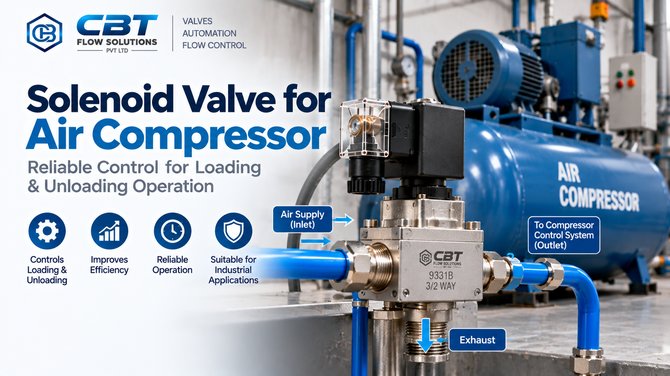
Solenoid Valve for Air Compressor: Working, Types and Selection Guide
An air compressor is an important part of many industrial operations. Manufacturing plants, workshops, packaging lines and process industries rely on compressed air to operate tools, pneumatic cylinders, automation equipment and other machinery.
For an air compressor to work efficiently, its pressure and operating cycle must be controlled properly. Depending on the compressor design, this may require a solenoid valve to control loading and unloading, operate a pneumatic control circuit or manage another air-related function.
A solenoid valve for an air compressor uses an electrical signal to open, close or redirect the flow of air or another compatible medium. It can be connected to a control panel, pressure switch, PLC or compressor controller, depending on the system design.
However, not every compressor solenoid valve performs the same job. A loading and unloading valve, a condensate drain valve and a valve controlling a pneumatic actuator have different functions.
Choosing the correct valve starts with understanding how the compressor operates and what the valve needs to control.
CBT Flow Solutions Pvt. Ltd. supplies industrial solenoid valves, including a dedicated 3/2-way compressor loading and unloading solenoid valve. This guide explains how these valves work, where they are used and what to check before selecting one.
What Is a Solenoid Valve for an Air Compressor?
A solenoid valve is an electrically operated valve that controls the movement of a fluid or gas through a passage. In a compressor system, it may control compressed air, pilot air or another specified medium, depending on the design.
The valve contains a solenoid coil and an internal operating mechanism. When the coil receives an electrical signal, it creates a magnetic field that moves the plunger or another internal component.
This movement changes the valve position.
Depending on the valve design, the passage may open, close or redirect the flow. When the electrical signal changes, the valve may return to its original position through a spring or switch to another position through a second control signal.
In an air compressor installation, the solenoid valve may be used to control the compressor’s loading and unloading mechanism. It can also operate a pneumatic control circuit or perform another function specified by the equipment manufacturer.
The key point is that the valve must match the compressor’s control arrangement. A general-purpose solenoid valve should not be substituted for a dedicated compressor loading and unloading valve without checking compatibility.
How Does an Air Compressor Solenoid Valve Work?
The working principle depends on the compressor and valve configuration, but the electrical switching process is straightforward.
Step 1: The compressor controller sends a signal
The compressor controller, pressure switch or another control device determines when the valve needs to operate. The control signal depends on the system’s operating sequence.
Step 2: The solenoid coil is energised
When the coil receives the required voltage, it produces a magnetic field. This magnetic force moves the internal plunger or valve mechanism.
Step 3: The valve changes position
The movement opens, closes or redirects the relevant passage. In a loading and unloading circuit, this change operates the pneumatic control mechanism according to the compressor design.
Step 4: The compressor changes operating state
The compressor may switch between loaded and unloaded operation when the control arrangement commands it to do so. The precise response depends on the compressor type and control circuit.
Step 5: The control system continues monitoring operation
The compressor controller uses the configured pressure and operating logic to determine the next action.
This process helps automate compressor operation without requiring someone to operate a manual valve for every cycle.
What Is Compressor Loading and Unloading?
Loading and unloading are operating states used by many compressed-air systems.
During loaded operation, the compressor supplies compressed air to meet demand.
During unloaded operation, the compressor reduces or stops effective compression according to its design, even though the drive motor may continue running. This can happen when compressed-air demand falls or the system reaches a configured pressure condition.
The exact unloading method varies between compressor designs.
In some systems, a solenoid valve controls a pilot or pneumatic circuit associated with the unloader mechanism. In other designs, the controller operates different components to achieve the same result.
The purpose is to coordinate compressor output with air demand and the control strategy.
For this reason, a solenoid valve used for compressor loading and unloading must have the correct port arrangement, operating pressure, electrical coil and internal construction for the specific compressor.
Types of Solenoid Valves Used in Air Compressor Systems
Different compressor applications require different valve arrangements. The most suitable type depends on the function being controlled.
1. 3/2-Way Solenoid Valve
A 3/2-way solenoid valve has three ports and two operating positions.
Depending on its design, the ports are used for a supply, a working connection and an exhaust. Changing the valve position alters the connections between these ports.
This configuration is common in pneumatic control circuits and can be used in suitable compressor loading and unloading arrangements.
CBT Flow Solutions lists the 9331B 3/2 Way Compressor Loading and Unloading Solenoid Valve specifically for compressor loading and unloading.
The product page lists a 6 mm (1/4-inch) size, a stainless-steel body, manual override and multiple electrical coil options. These details make it a relevant product to evaluate for compatible compressor control systems.
2. Direct Acting Solenoid Valve
In a direct acting solenoid valve, the coil directly operates the main sealing element.
This arrangement may be suitable when the application requires direct mechanical switching and the model’s pressure and flow ratings match the system.
Direct acting valves are used across various industrial applications, but a general direct acting valve should not automatically be considered suitable for compressor loading and unloading. The required function and product specification must match.
3. Pilot Operated Solenoid Valve
A pilot operated valve uses the solenoid to control a smaller pilot passage. The pressure of the medium then assists the movement of the main valve element.
These designs are commonly considered for applications that require larger flow passages, provided the necessary minimum operating pressure is available.
For compressor use, confirm the minimum operating pressure and whether the valve is specifically suitable for the control function.
4. Normally Closed and Normally Open Valves
A normally closed valve remains closed when its coil is de-energised, while a normally open valve remains open when de-energised.
The correct configuration depends on the compressor’s control circuit and the required state when the electrical signal is removed.
Do not choose between normally open and normally closed based on the compressor’s operating state alone. The valve’s internal port connections and the complete control design must also be considered.
CBT 9331B Compressor Loading and Unloading Solenoid Valve
For buyers specifically searching for a compressor loading and unloading valve, CBT Flow Solutions lists the 9331B 3/2 Way model.
According to the product page, its specifications include:
- Product configuration: 3/2-way compressor loading and unloading solenoid valve
- Size: 6 mm (1/4 inch)
- Body construction: Stainless steel, ASTM A351 Grade CF8/CF8M
- Listed fluids: Air, water, gas and oil
- Standard coil: 230 V AC, 50 Hz
- Optional coil voltages: 24 V, 110 V and 240 V, with AC/DC options as specified
- Manual override: Side-mounted manual override
- End connections: G-ISO-228 (BSP female) or NPT
- Differential pressure specification: Listed from 0 to 20 bar
- Enclosure options: Standard IP20, with optional waterproof protection up to IP67 and a flameproof coil option as listed
These are product-page specifications, not universal ratings for all compressor solenoid valves. Confirm the current manufacturer’s datasheet and exact ordered configuration before installation.
View the product: 9331B 3/2 Way Compressor Loading and Unloading Solenoid Valve
Where Are Solenoid Valves Used in Air Compressor Systems?
Solenoid valves can serve several functions in compressed-air installations.
Compressor Loading and Unloading
A suitable valve can operate the pneumatic control circuit used by the compressor’s loading and unloading mechanism. The correct model depends on the compressor’s design.
Pneumatic Control Systems
Compressed-air equipment may use solenoid valves to switch pilot air or control the movement of pneumatic components.
Automated Production Lines
Manufacturing equipment frequently uses compressed air to operate cylinders, clamps, actuators and other machinery. Solenoid valves provide electrical switching for compatible pneumatic circuits.
Air Preparation and Auxiliary Equipment
Some compressed-air installations include valves for auxiliary functions. Condensate drains, for example, may use specialised solenoid valves designed for that duty. A compressor loading/unloading valve should not automatically be used for condensate drainage.
Industrial Process Automation
Compressed air can power pneumatic actuators connected to ball valves, butterfly valves and other process valves. The solenoid valve selected for that system must match the actuator’s single-acting or double-acting configuration.
For broader industrial requirements, you can explore the CBT Solenoid Valve Range.
How to Select the Right Solenoid Valve for an Air Compressor
Selecting a suitable valve requires more than checking the port size.
1. Identify the Exact Function
Determine whether you need a loading and unloading valve, a pilot-control valve, a condensate drain valve or a valve for another pneumatic application.
This is the first step because different functions may require different valve constructions.
2. Check the Compressor Type
Identify the compressor make, model and control arrangement. A valve suitable for one compressor may not be compatible with another.
Where possible, refer to the original component number or compressor manufacturer’s documentation.
3. Confirm the Operating Pressure
Check the normal, minimum and maximum pressure at the valve connection.
The selected valve must operate correctly within its specified pressure range. Do not assume every solenoid valve can work at zero differential pressure simply because it has an electrical coil.
4. Match the Coil Voltage
Check the electrical supply before ordering.
A coil designed for 230 V AC should not be connected to a 24 V DC output. Confirm the voltage, AC or DC supply, frequency where applicable and electrical connection.
5. Check the Port Configuration
Determine whether the system requires a 2-way, 3/2-way or another configuration.
The number of ports affects how the valve directs or releases air. The configuration must match the compressor’s control logic.
6. Check the Connections
Confirm the connection standard and size. A valve may use BSP, NPT or another connection, depending on the design.
A connection that appears similar may not be interchangeable. Verify the thread specification before installation.
7. Consider the Operating Environment
Check ambient temperature, moisture, dust, vibration and any hazardous-area requirements.
If the valve is installed in a potentially explosive atmosphere, the required protection and certification must be confirmed for the exact model and complete installation.
8. Confirm the Materials
The body, seat and seal materials must be suitable for the medium and operating conditions.
Even when the main medium is compressed air, moisture, oil carryover or other contaminants may affect component suitability.
Common Problems With Air Compressor Solenoid Valves
A compressor that does not load or unload correctly may have a problem with the solenoid valve, but the valve is not always the cause.
The Coil Does Not Operate
Check the power supply, coil voltage, wiring and control signal. Also inspect the coil for damage and verify that the correct coil is installed.
Electrical troubleshooting should be performed safely by a qualified person.
The Valve Switches but the Compressor Does Not Change State
The problem may be related to the pneumatic circuit, blocked passages, pressure conditions, control settings or the compressor’s unloader mechanism.
Check the complete system rather than replacing the valve immediately.
Air Leakage
Leakage may result from damaged seals, contamination, worn internal parts or an incorrect installation.
The valve should be inspected and serviced according to the manufacturer’s instructions.
Slow or Unreliable Operation
Restricted supply passages, unsuitable operating pressure, contaminated air or an incorrect valve specification can affect performance.
Check the required flow, pressure and air quality before assuming that the valve itself is defective.
Before servicing a compressor system, isolate the equipment, release stored pressure where required and follow the manufacturer’s safety procedure.
Why Choose an Appropriate Compressor Solenoid Valve?
The right valve helps the compressor’s control circuit perform its intended function. The wrong configuration can lead to unreliable switching, unnecessary downtime or compatibility problems.
When comparing products, focus on technical suitability rather than price alone.
Check the operating pressure, voltage, port configuration, material, connections, enclosure and intended application. Also confirm whether the product is designed for your particular loading and unloading circuit.
A dedicated compressor solenoid valve is often a better starting point than adapting a general-purpose product without checking its specifications.
Solenoid Valve Supplier for Air Compressors in India
CBT Flow Solutions Pvt. Ltd. supplies industrial solenoid valves for pneumatic and process-control applications.
For compressor loading and unloading, the company lists the 9331B 3/2 Way Solenoid Valve.
You can also review the complete solenoid valve range to explore other configurations for compatible applications.
When requesting a quotation, provide the compressor make and model, existing valve part number, pressure range, coil voltage, connection size and required quantity. A photograph of the existing valve and its nameplate can also help the supplier identify the correct replacement.
Frequently Asked Questions
What is a solenoid valve used for in an air compressor?
A solenoid valve can control the loading and unloading mechanism, switch a pneumatic control circuit or perform another specified function in a compressor installation. The exact purpose depends on the compressor design.
Which solenoid valve is used for compressor loading and unloading?
The required configuration depends on the compressor’s control circuit. CBT Flow Solutions lists the 9331B 3/2 Way Compressor Loading and Unloading Solenoid Valve for this application.
What voltage does an air compressor solenoid valve use?
Voltage varies by model. CBT’s 9331B product page lists 230 V AC, 50 Hz as standard, with optional voltage configurations. Always match the ordered coil to the compressor’s electrical supply.
Can the same solenoid valve work with every air compressor?
No. Compressors use different control systems and valve requirements. Check the compressor model, existing part number, pressure range, port configuration and electrical specifications before selecting a replacement.
What is the difference between a 2-way and a 3/2-way solenoid valve?
A typical 2-way valve has two ports and controls flow through a single passage. A 3/2-way valve has three ports and two positions, allowing it to connect a supply, working port and exhaust in different ways. The required configuration depends on the circuit.
How can I identify the correct replacement valve?
Check the manufacturer’s part number, compressor model, valve markings, voltage, connections and pressure rating. When specifications are unclear, share photographs and the equipment details with a qualified supplier before ordering.
Conclusion
A solenoid valve plays an important role in many air compressor control systems. Depending on its design, it can manage loading and unloading, switch pilot air or operate an auxiliary pneumatic function.
The most important step is to identify what the valve needs to control. Then check the compressor model, port arrangement, operating pressure, coil voltage, connections and material specifications.
For compressor loading and unloading applications, CBT Flow Solutions offers the 9331B 3/2 Way Compressor Loading and Unloading Solenoid Valve, with technical specifications available on its product page.
Choosing a compatible valve helps avoid unnecessary installation changes and supports reliable operation of the compressor control system.
Need a Solenoid Valve for Your Air Compressor?
CBT Flow Solutions Pvt. Ltd. supplies solenoid valves and industrial flow-control products for automation and compressed-air applications.
Share your compressor model, existing valve details, working pressure, voltage and connection size with the team to help identify the appropriate product.
CBT Flow Solutions Pvt. Ltd.
Valves | Automation | Flow Control
Reliable Flow for a Better Tomorrow
View the 9331B Compressor Loading and Unloading Solenoid Valve