


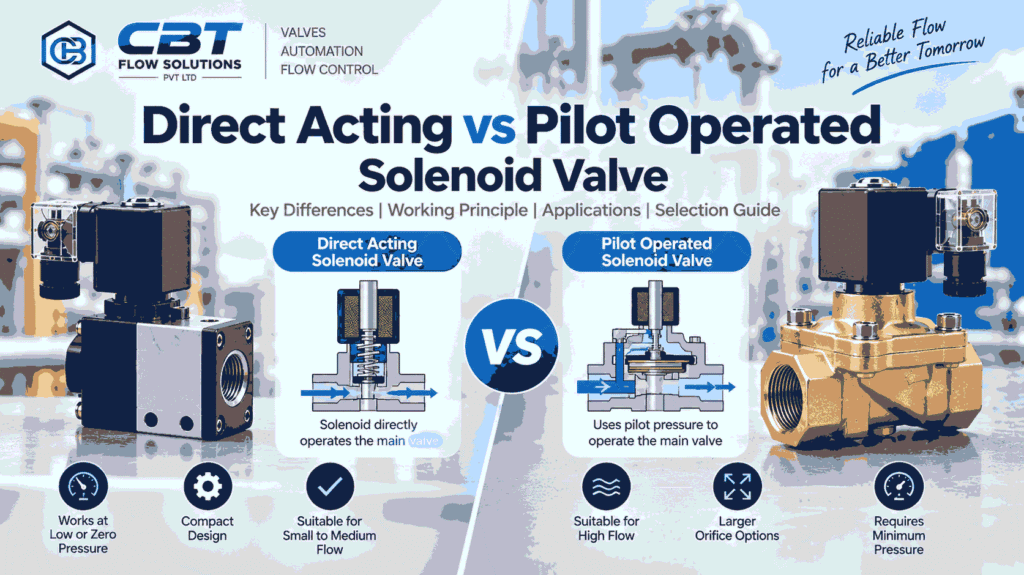
Direct Acting vs Pilot Operated Solenoid Valve: Key Differences, Working and Selection Guide
When selecting a solenoid valve for an industrial application, one of the first technical decisions is choosing between a direct acting solenoid valve and a pilot operated solenoid valve.
Both types use an electrical signal to operate a valve, but the way they control flow is different.
That difference becomes important when you are dealing with low pressure, high flow, larger orifices, pneumatic automation, water systems, gases, or other industrial services.
A direct acting valve uses the magnetic force generated by the solenoid coil to operate the main valve mechanism directly. A pilot operated valve uses a smaller pilot mechanism and the pressure of the flowing medium to help operate the main valve.
So, which one is better?
There is no single answer.
The right choice depends on the application.
CBT Flow Solutions Pvt. Ltd. currently supplies solenoid valves in both direct acting and pilot operated configurations, along with 2-port, 3-port, 5-port, NAMUR and other industrial designs. (cbtindia.com)
Let us look at the difference in a practical way.
What Is a Direct Acting Solenoid Valve?
A direct acting solenoid valve is designed so that the solenoid directly operates the main sealing element.
Inside the valve, you will typically find a coil, plunger, spring, valve seat, seals and an orifice.
When the coil receives electrical power, it creates a magnetic field. The magnetic force moves the plunger directly.
In a normally closed design, the plunger moves away from the valve seat and opens the passage.
When power is removed, the spring returns the plunger to the seat and closes the valve.
The key point is simple:
The solenoid itself moves the main valve element.
It does not need the line pressure to open the main passage in the same way a pilot operated valve does.
This is why direct acting designs are useful in applications where the available pressure may be very low or where a pressure differential cannot be guaranteed.
CBT’s own solenoid valve documentation describes direct acting valves as suitable where zero differential pressure operation is required, including low-pressure and vacuum-related applications. (cbtindia.com)
You can also read the detailed Direct Acting Solenoid Valve guide from CBT Flow Solutions.
What Is a Pilot Operated Solenoid Valve?
A pilot operated solenoid valve works on a different principle.
Instead of using the solenoid coil to directly lift the main valve element, the coil operates a small pilot opening.
The pressure of the fluid then helps move the main diaphragm or piston and opens the larger flow passage.
Think of it as a small control action managing a much larger flow path.
This design becomes useful when the application requires a larger orifice or higher flow capacity than would be practical for a direct acting valve of similar size.
But there is one condition that matters:
A pilot operated valve needs the required pressure difference to operate correctly.
If the pressure conditions are not suitable, the valve may not open or close as intended.
CBT’s current range includes several internal pilot operated valves, including 3-port, 5-port, high-pressure and large-orifice configurations. (cbtindia.com)
Direct Acting vs Pilot Operated Solenoid Valve: Basic Difference
The easiest way to understand the difference is to look at how the main valve opens.
| Feature | Direct Acting | Pilot Operated |
|---|---|---|
| Main operating force | Solenoid magnetic force | Solenoid pilot + line pressure |
| Minimum differential pressure | Can operate at zero differential pressure, depending on model | Requires a suitable pressure differential |
| Typical flow capacity | Small to moderate | Moderate to high |
| Large orifice applications | Less common | More suitable |
| Low-pressure service | Very suitable for applicable models | May be unsuitable if minimum pressure is not available |
| Vacuum applications | Commonly considered | Model dependent |
| Construction | Relatively simple | Uses pilot and main diaphragm/piston mechanism |
| Typical applications | Low pressure, small flow, vacuum, automation | Higher flow, larger ports, pressurized systems |
| Pressure dependency | Low | Higher |
This table gives you the basic idea, but valve selection should always be based on the actual product specification.
How Does a Direct Acting Solenoid Valve Work?
Let us take a normally closed direct acting valve as an example.
When the coil is de-energized, a spring keeps the plunger against the valve seat.
The flow path is closed.
Now an electrical signal is sent to the coil.
The coil generates a magnetic field and pulls the plunger away from the seat.
The orifice opens.
Fluid can now pass through the valve.
When the electrical signal stops, the magnetic force disappears. The spring pushes the plunger back onto the seat.
The valve closes.
The entire process is direct. There is no requirement for line pressure to lift a separate main diaphragm.
That is the main reason direct acting solenoid valves are commonly selected for low-pressure applications.
CBT currently lists direct acting products including 2/2 port, 3-port and NAMUR configurations. (cbtindia.com)
How Does a Pilot Operated Solenoid Valve Work?
Now consider a pilot operated valve.
When the solenoid is energized, the plunger opens a small pilot passage.
This changes the pressure balance across the main diaphragm or piston.
The fluid pressure then helps move the main sealing element away from the seat.
The larger main opening opens, allowing a greater volume of fluid to pass.
When the solenoid is de-energized, the pilot passage closes and the pressure balance returns to its normal state. The diaphragm or piston then moves back and closes the main valve.
This approach allows the solenoid to control a larger flow path without the coil having to provide all the force required to move the main valve element directly.
That is why pilot operated designs are commonly considered for larger flow requirements.
However, sufficient pressure is necessary for the pilot mechanism to work.
Why Choose a Direct Acting Solenoid Valve?
A direct acting valve has a few important advantages.
Works at Low or Zero Differential Pressure
This is perhaps the biggest reason to consider direct acting technology.
If the application does not reliably provide a minimum pressure difference, a direct acting valve can be more suitable.
The exact zero-pressure capability depends on the individual model.
Suitable for Low-Pressure Systems
Direct acting designs are useful where pressure is low and the valve still needs reliable electrical operation.
Suitable for Vacuum Applications
Certain direct acting valve designs can also be used in vacuum systems. CBT lists a high-orifice direct acting model with suitability for vacuum applications down to the specified vacuum level on its product page. (cbtindia.com)
Quick and Straightforward Operation
The electrical signal directly controls the main valve mechanism, creating a relatively simple operating arrangement.
Compact Design
Direct acting valves are often compact, which can be useful in equipment where space is limited.
Why Choose a Pilot Operated Solenoid Valve?
Pilot operated valves also have clear advantages.
Larger Flow Capacity
Because line pressure helps operate the main valve, pilot operated designs can be used for larger flow paths.
Larger Orifice Options
When the application requires a larger orifice, pilot operation is often a practical approach.
Suitable for Pressurized Systems
When the system consistently provides suitable pressure differential, a pilot operated valve can be a strong choice for larger-flow applications.
CBT’s current range includes 5-port internal pilot operated large-orifice valves, internal pilot operated 3-port valves and high-pressure pilot operated configurations. (cbtindia.com)
Direct Acting vs Pilot Operated Solenoid Valve for Air
Pneumatic systems are a good example of where the difference becomes practical.
For a small pneumatic control circuit operating at low or unstable pressure, a direct acting valve may be more suitable when the specific model is rated for the conditions.
For a larger air-flow requirement where sufficient pressure is available, a pilot operated valve may be considered.
The choice depends on:
- Air pressure
- Required flow
- Orifice size
- Cylinder or actuator requirements
- Response time
- Available voltage
- Valve configuration
- Installation space
CBT’s solenoid range includes both direct acting and pilot operated pneumatic configurations, including 3-port and 5-port valves. (cbtindia.com)
Direct Acting vs Pilot Operated Solenoid Valve for Water
Water applications can be quite different from pneumatic systems.
A water-control valve may require a larger flow path, making pilot operation attractive where adequate pressure is consistently available.
However, direct acting valves can also be useful where the system operates at low pressure or where zero differential pressure operation is important.
CBT’s current range includes direct acting and diaphragm/piston-operated solenoid valves for water-related applications. (cbtindia.com)
For example, the site lists a 2 Way Diaphragm Type Solenoid Valve for Water Application alongside direct acting models. (cbtindia.com)
The important point is that water service should not be selected purely by the word “water.” Pressure, temperature, flow, orifice and seal material still need to be checked.
Direct Acting vs Pilot Operated: Which Is Better for Large Flow?
If your system needs high flow through a relatively large valve orifice, a pilot operated design is often worth considering.
The reason is simple.
A larger main valve element requires more force to move against fluid pressure. Instead of asking the solenoid coil to provide all that force directly, the pilot mechanism uses the pressure in the line to assist the main opening.
This makes pilot operation practical for many larger-flow applications.
But there is an important limitation.
If the system does not provide enough differential pressure, the pilot valve may not operate correctly.
That is where direct acting designs have an advantage.
Direct Acting vs Pilot Operated for Low Pressure
When the pressure difference is very small, direct acting technology usually deserves closer attention.
Because the solenoid directly moves the sealing element, the valve does not depend on the same pilot-pressure mechanism.
This is particularly useful in:
- Low-pressure air systems
- Vacuum systems
- Small flow circuits
- Laboratory equipment
- Dispensing systems
- Compact automation equipment
- Systems where pressure can fall to zero
CBT states that its direct acting solenoid valve configurations can operate without relying on differential pressure, subject to the individual model specification. (cbtindia.com)
How to Select Between Direct Acting and Pilot Operated
Before choosing a valve, answer these questions.
1. What Is the Operating Pressure?
This should be the first check.
Find both the minimum and maximum pressure.
If pressure can fall to zero, direct acting may be the better starting point for evaluation.
2. What Flow Do You Need?
High-flow applications may point toward pilot operation.
Small-flow applications may be well suited to direct acting designs.
3. What Orifice Size Is Required?
A small orifice can often be handled by direct acting designs.
A larger orifice may make pilot operation more practical.
4. What Is the Media?
Identify whether you are controlling:
Air, water, oil, gas, steam, vacuum or another fluid.
The body and seal materials must be compatible with the media.
5. What Is the Temperature?
Operating temperature can affect seals, diaphragm materials and overall valve suitability.
6. What Voltage Is Available?
The coil voltage should match the control system.
CBT lists various AC and DC voltage configurations across its solenoid valve range, depending on the model. (cbtindia.com)
7. What Valve Configuration Do You Need?
The selection is not only about direct versus pilot operation.
You may also need to choose between:
- 2/2
- 3/2
- 5/2
- Normally closed
- Normally open
- Single solenoid
- Double solenoid
- Inline
- Sub-base
- NAMUR
This is why the application should be defined before selecting the exact valve model.
Direct Acting vs Pilot Operated: Common Mistakes
A few mistakes can easily be avoided.
Choosing a pilot valve for zero pressure
If the system cannot maintain the required differential pressure, a pilot operated valve may not function properly.
Choosing a small direct acting valve for a high-flow application
The valve may technically operate but fail to provide the flow capacity required by the system.
Ignoring the minimum pressure
Buyers often check only maximum pressure.
Minimum operating pressure is equally important for pilot operated designs.
Selecting only by connection size
A 1-inch valve is not automatically suitable simply because the pipe is 1 inch.
Flow, pressure, orifice and media must also be checked.
Ignoring the seal material
The valve body may be suitable while the seal material is not.
Always check the complete material specification.
CBT Flow Solutions Solenoid Valve Range
CBT Flow Solutions Pvt. Ltd. offers a broad range of solenoid valves covering direct acting and pilot operated designs.
The current product range includes:
3 Port Direct Acting Solenoid Valve for suitable pneumatic and actuator-control applications. (cbtindia.com)
3 Port Direct Acting High Orifice Universal Solenoid Valve with listed applications including air, water, vacuum, inert gas, oil and other specified media. (cbtindia.com)
For pilot operation, CBT lists 3 Port 2 Position Internal Pilot Operated Normally Closed/Open Poppet Solenoid Valve and other internal pilot-operated configurations. (cbtindia.com)
The complete CBT Solenoid Valve Range includes 2-port, 3-port, 5-port and NAMUR configurations, providing options for different pneumatic and industrial control requirements. (cbtindia.com)
Frequently Asked Questions
What is the main difference between direct acting and pilot operated solenoid valves?
A direct acting solenoid valve uses the solenoid coil to move the main valve element directly. A pilot operated valve uses a small pilot mechanism and line pressure to help operate the main valve.
Which solenoid valve works without differential pressure?
A direct acting solenoid valve can operate at zero differential pressure, depending on the model. Pilot operated valves generally require the minimum pressure differential specified by the manufacturer.
Which is better for high flow?
Pilot operated solenoid valves are commonly considered for higher flow and larger orifice applications when sufficient operating pressure is available.
Which is better for low pressure?
Direct acting solenoid valves are generally more suitable for low-pressure applications, especially where the system cannot guarantee a minimum pressure differential.
Can a pilot operated solenoid valve work without pressure?
Generally, a conventional internally pilot operated valve requires a suitable pressure differential to operate correctly. Always check the minimum operating-pressure specification for the exact model.
Are direct acting solenoid valves suitable for pneumatic systems?
Yes. Direct acting solenoid valves are used in pneumatic systems, especially for low-pressure or small-flow control applications. CBT’s current range includes 3-port direct acting and NAMUR solenoid valves for pneumatic applications. (cbtindia.com)
How do I choose the right type?
Start with the media, minimum and maximum pressure, required flow, orifice size, temperature, voltage and valve configuration. Then decide whether direct acting or pilot operation matches those conditions.
Need Help Selecting the Right Solenoid Valve?
Choosing the correct solenoid valve can save time, avoid installation problems and help keep the pneumatic or fluid-control system running properly.
CBT Flow Solutions Pvt. Ltd. supplies industrial solenoid valves and automation solutions for different pneumatic and flow-control applications.
Share your media, pressure, temperature, flow requirement, connection size, voltage and application with our team, and we can help you identify the appropriate valve configuration.
CBT Flow Solutions Pvt. Ltd.
Valves | Automation | Flow Control
Reliable Flow for a Better Tomorrow