


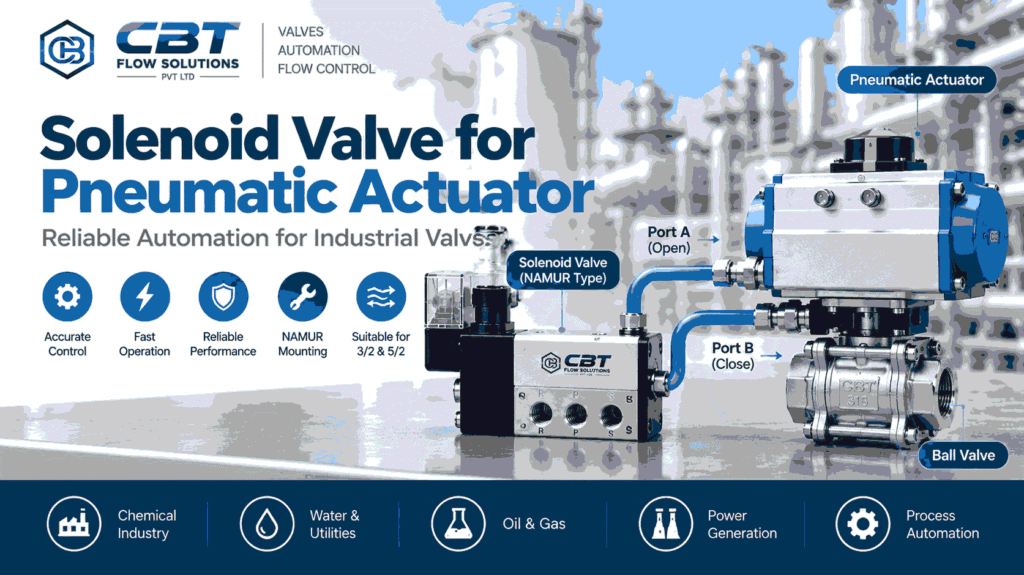
Solenoid Valve for Pneumatic Actuator: Working, Types and Selection Guide
SEO Title: Solenoid Valve for Pneumatic Actuator: Types & Selection Guide
Meta Description: Learn how a solenoid valve for a pneumatic actuator works, compare 3/2 and 5/2 valves, understand NAMUR mounting and select the right valve.
Primary Keyword: solenoid valve for pneumatic actuator
Secondary Keywords: pneumatic actuator solenoid valve, solenoid valve for actuator, NAMUR solenoid valve, 3/2 solenoid valve, 5/2 solenoid valve, pneumatic valve automation, actuator control solenoid valve, pneumatic actuator control system, solenoid valve supplier in India
Solenoid Valve for Pneumatic Actuator: Working, Types and Selection Guide
In industrial automation, opening and closing a valve manually is not always practical. Many plants need valves that can operate automatically in response to a signal from a control panel, PLC or process-control system.
This is where a solenoid valve for a pneumatic actuator becomes important.
A pneumatic actuator uses compressed air to create mechanical movement. A solenoid valve controls the flow and direction of that compressed air, allowing the actuator to open, close or change the position of an industrial valve.
This arrangement is widely used in chemical plants, water treatment facilities, manufacturing units, power plants and process industries.
However, choosing the correct solenoid valve requires more than selecting a product with the right connection size. The actuator type, air pressure, required airflow, coil voltage, mounting arrangement and fail-safe operation must all be considered.
CBT Flow Solutions Pvt. Ltd. supplies solenoid valves, pneumatic actuators and related industrial automation products for a range of valve-control applications.
In this guide, we will explain how the system works, which solenoid valve configuration is appropriate for different actuators, and what to check before purchasing.
What Is a Solenoid Valve for a Pneumatic Actuator?
A solenoid valve for a pneumatic actuator is an electrically controlled directional valve that manages the compressed air supplied to the actuator.
The valve contains a solenoid coil and an internal switching mechanism. When the coil receives an electrical signal, the mechanism changes position and redirects compressed air through the required ports.
This movement controls the pneumatic actuator.
For example, imagine a butterfly valve installed in a water-treatment pipeline. The butterfly valve needs to open when the control system sends an instruction and close when the system requires it.
A pneumatic actuator is mounted on the butterfly valve. The solenoid valve directs compressed air to the actuator, causing it to rotate and move the butterfly valve into the required position.
The same principle can be used with compatible ball valves and other quarter-turn industrial valves.
It is important to understand that the solenoid valve does not usually control the process fluid directly in this arrangement. Instead, it controls the compressed air that operates the actuator.
How Does a Pneumatic Actuator Solenoid Valve Work?
The operation involves a sequence of electrical and mechanical actions.
Step 1: The control system sends a signal.
A PLC, control panel or other electrical control device sends a signal to the solenoid coil.
Step 2: The solenoid valve changes position.
The coil generates a magnetic field, moving the internal mechanism and changing the airflow path.
Step 3: Compressed air enters the actuator.
The valve directs air to the relevant actuator port. Depending on the actuator design, air pressure moves a piston or turns an internal mechanism.
Step 4: The industrial valve moves.
The actuator transfers mechanical movement to the connected ball valve, butterfly valve or other compatible valve.
Step 5: The system confirms the position.
Where position feedback is installed, a limit switch or position sensor can send an open or closed status signal to the control system.
This process allows industrial valves to operate remotely without requiring an operator to turn a handle manually.
The actual sequence depends on the valve configuration, actuator design and control arrangement.
Why Is a Solenoid Valve Required for Pneumatic Actuators?
A pneumatic actuator needs a controlled supply of compressed air. The solenoid valve provides the switching function that allows this air to be directed automatically.
Without an appropriate directional control arrangement, the actuator cannot follow the required electrical commands reliably.
A suitable solenoid valve can help with:
- Remote opening and closing of industrial valves.
- Automatic operation through a PLC or control panel.
- Switching between actuator positions.
- Coordinating valve movement with production sequences.
- Integrating pneumatic equipment into process automation.
- Reducing the need for manual valve operation.
For example, a manufacturing line may need several valves to open and close in a particular order. Solenoid valves allow the control system to operate the relevant pneumatic actuators according to that sequence.
For automated valve assemblies, the solenoid valve, actuator and process valve should be selected together rather than treated as unrelated components.
3/2 vs 5/2 Solenoid Valve for Pneumatic Actuators
One of the most important decisions is whether the actuator requires a 3/2 or a 5/2 solenoid valve.
The correct configuration primarily depends on whether the pneumatic actuator is single acting or double acting.
1. 3/2 Solenoid Valve for a Single-Acting Actuator
A 3/2 solenoid valve has three ports and two operating positions.
The ports typically provide compressed-air supply, a working connection to the actuator and an exhaust connection.
A single-acting pneumatic actuator generally uses compressed air to move in one direction and an internal spring to return it in the opposite direction.
The 3/2 valve supplies air to move the actuator. When the valve changes position, it allows the actuator air to exhaust so that the spring can return the actuator.
This arrangement is commonly used when a spring-return actuator is required.
CBT Flow Solutions lists a 3 Port Regulating NAMUR Solenoid Valve designed for single-acting actuator operation.
2. 5/2 Solenoid Valve for a Double-Acting Actuator
A 5/2 solenoid valve has five ports and two operating positions.
It is commonly used with double-acting pneumatic actuators, which use compressed air for movement in both directions.
In one position, the valve supplies air to one side of the actuator while exhausting the other side. When the valve changes position, the airflow paths reverse.
This allows the actuator to rotate in either direction under pneumatic pressure.
A 5/2 valve may be suitable for applications where the actuator requires powered opening and powered closing, subject to the actuator and valve specifications.
CBT’s 5/2 and 3/2 Convertible Spool Type NAMUR Solenoid Valve is a relevant product to review when selecting a compatible actuator-mounted arrangement.
Quick Comparison
| Feature | 3/2 Solenoid Valve | 5/2 Solenoid Valve |
|---|---|---|
| Ports | 3 | 5 |
| Positions | 2 | 2 |
| Common actuator type | Single acting | Double acting |
| Air connections to actuator | Usually one working connection | Two working connections |
| Return movement | Commonly provided by an actuator spring | Commonly controlled by reversing the air supply |
| Typical application | Spring-return valve automation | Double-acting valve automation |
These are common arrangements, not universal rules. Always confirm the required configuration for the specific actuator and control system.
What Is a NAMUR Solenoid Valve?
A NAMUR solenoid valve is designed to mount directly onto a compatible pneumatic actuator through a standardised mounting interface.
In a traditional arrangement, the solenoid valve may be installed separately, with pneumatic tubing connecting it to the actuator.
With compatible NAMUR-mounted equipment, the valve can attach directly to the actuator interface. This can reduce external tubing, simplify installation and create a more compact assembly.
NAMUR solenoid valves are widely used in industrial valve automation, particularly for pneumatic ball valves and butterfly valves.
CBT Flow Solutions offers a 3 Port Regulating NAMUR Solenoid Valve. The listed specifications include a 1/4-inch connection, a 5 mm orifice, aluminium or SS316 body options, NBR or Viton seals, and an operating pressure range of 0–10 kg/cm². The product is specified for air and inert gases and for single-acting actuator operation.
Always verify the actual actuator interface, electrical coil, operating pressure and other product specifications before ordering.
Single-Acting vs Double-Acting Pneumatic Actuators
Understanding the actuator is essential before selecting a solenoid valve.
Single-Acting Pneumatic Actuator
A single-acting actuator uses compressed air to produce movement in one direction. A spring provides the return movement when the air supply is released.
These actuators are useful when the application requires a defined spring-return position.
For example, an automated process valve may need to return to a predetermined position when the control arrangement releases the actuator air. The appropriate arrangement must be selected according to the process safety requirement.
A compatible 3/2 NAMUR solenoid valve is commonly considered for this type of actuator.
Double-Acting Pneumatic Actuator
A double-acting actuator uses compressed air for movement in both directions.
It does not normally depend on an internal return spring for its standard opening and closing movement.
This arrangement is useful where powered movement is required in both directions. A compatible 5/2 solenoid valve is commonly used to switch the actuator’s air supply.
For either design, the required actuator torque, available air pressure, valve operating torque and control sequence must be considered.
Applications of Solenoid Valves for Pneumatic Actuators
Solenoid-operated pneumatic actuators are used in many industrial applications.
Water Treatment Plants
Automated ball valves and butterfly valves can help control flow through treatment, filtration and distribution systems.
Chemical and Petrochemical Plants
Pneumatic actuator assemblies can provide remote valve operation in process lines, subject to the suitability of the valve, actuator and accessories for the environment.
Manufacturing and Production Lines
Automated valves can control utility systems, compressed air, cooling circuits and process equipment.
Power Plants
Pneumatic valve automation can support the operation of compatible isolation and process valves in utility and plant systems.
Pharmaceutical and Process Industries
Automated valve assemblies can support controlled production sequences where repeatable valve operation and position feedback are required.
The valve and actuator must be selected according to the medium, temperature, pressure, cleanliness and environmental requirements of each application.
How to Select the Right Solenoid Valve for a Pneumatic Actuator
Before placing an order, review the following points.
1. Identify the Actuator Type
Confirm whether the actuator is single acting or double acting. This will help determine whether a 3/2 or 5/2 arrangement is appropriate.
2. Check the Required Fail Position
Decide what the process valve should do if electrical power or the control-air supply is lost.
A spring-return actuator may provide a defined return position, but the final result depends on the actuator design, solenoid configuration and installation.
Do not assume that every solenoid valve automatically makes the complete system fail-safe.
3. Confirm Operating Air Pressure
Check the minimum and maximum pressure available at the actuator.
The selected solenoid valve must operate within its specified pressure range, and the actuator must have enough air pressure to provide the required torque.
4. Check Airflow and Orifice Size
An undersized solenoid valve can restrict airflow and affect actuator operating time.
The required flow depends on actuator air consumption, piping, available pressure and the desired opening or closing time.
5. Match the Coil Voltage
The electrical coil must match the control system. Common options vary by model and may include 24 V DC and different AC voltages.
Confirm the coil specification before ordering.
6. Confirm NAMUR Compatibility
If you intend to mount the solenoid valve directly on the actuator, check that both products use compatible mounting interfaces.
Also confirm whether an adaptor or mounting accessory is required.
7. Review Environmental Protection
Check the required enclosure protection, ambient temperature, humidity, vibration and any hazardous-area certification required by the plant.
The correct requirements depend on the installation location and applicable safety standards.
8. Consider Position Feedback
For applications where the control system needs to verify the valve position, a limit switch box or position transmitter may be required.
A command to open the valve does not by itself confirm that the valve has reached the open position.
Why Consider a Complete Automated Valve Assembly?
Buying the solenoid valve, actuator and process valve separately can create compatibility challenges.
The actuator must provide sufficient torque for the valve, the solenoid valve must match the actuator’s pneumatic arrangement, and the mounting accessories must fit correctly.
A complete automated valve assembly can simplify this process.
Depending on the application, the assembly may include:
- Industrial ball or butterfly valve.
- Pneumatic actuator.
- Compatible solenoid valve.
- Limit switch box for position feedback.
- Air filter regulator.
- Mounting hardware and accessories.
CBT Flow Solutions also supplies pneumatic actuator solutions and associated valve-automation components. Visit the Pneumatic Actuators page to review the available options.
The exact package, specifications and testing requirements should be confirmed with the supplier before ordering.
Solenoid Valve for Pneumatic Actuator Supplier in India
CBT Flow Solutions Pvt. Ltd. supplies solenoid valves, pneumatic actuators and industrial valve-automation products.
Its solenoid valve range includes 3-port, 5-port and NAMUR configurations for different pneumatic control applications. You can review the complete solenoid valve range or explore the Rotex solenoid valve collection.
For single-acting actuator applications, the 3 Port Regulating NAMUR Solenoid Valve is one option to evaluate.
For applications where a convertible actuator-mounted valve is required, review the 5/2 and 3/2 Convertible Spool Type NAMUR Solenoid Valve.
The final selection should be based on the actuator type, air pressure, flow requirement, mounting interface, coil voltage and operating conditions.
Frequently Asked Questions
What is a solenoid valve used for in a pneumatic actuator?
It controls the supply and exhaust of compressed air to the actuator. This allows an electrical control signal to operate an industrial valve automatically.
Which solenoid valve is used for a single-acting actuator?
A compatible 3/2 solenoid valve is commonly used with a spring-return, single-acting actuator. The exact configuration should be checked against the actuator manufacturer’s requirements.
Which solenoid valve is used for a double-acting actuator?
A 5/2 solenoid valve is commonly used with a double-acting pneumatic actuator because it switches the air supply between the actuator’s two working ports.
What is a NAMUR solenoid valve?
A NAMUR solenoid valve is designed to mount directly onto a compatible pneumatic actuator, which can reduce external tubing and simplify assembly.
Can a solenoid valve operate a pneumatic butterfly valve?
Yes. A solenoid valve can direct compressed air to a compatible pneumatic actuator mounted on a butterfly valve. The correct valve configuration depends on whether the actuator is single acting or double acting.
What information should I provide when buying a solenoid valve?
Provide the actuator model, single- or double-acting arrangement, required port configuration, air pressure, desired airflow, coil voltage, mounting type and environmental requirements.
A solenoid valve is an important part of a pneumatic actuator control system. It receives an electrical command and directs compressed air to move the actuator, allowing an industrial valve to operate automatically.
For many spring-return actuators, a 3/2 solenoid valve is a suitable starting point. For double-acting actuators, a 5/2 valve is commonly used. Where a direct-mounted solution is required, a compatible NAMUR solenoid valve can help create a compact assembly.
The most important step is to select the solenoid valve and actuator together. Pressure, airflow, torque, voltage, mounting compatibility and the required fail position should all be confirmed before installation.
Need a Solenoid Valve for Your Pneumatic Actuator?
CBT Flow Solutions Pvt. Ltd. provides industrial valves, solenoid valves, pneumatic actuators and automation solutions.
Share your actuator type, pressure, voltage, mounting requirement and application with our team to identify a suitable configuration.
CBT Flow Solutions Pvt. Ltd.
Valves | Automation | Flow Control
Reliable Flow for a Better Tomorrow