


How Does a Gate Valve Work? Working Principle, Types and Applications
Gate valves are commonly used in industrial pipelines to start or stop the flow of liquids and gases. They are found in water supply systems, power plants, oil and gas facilities, chemical plants, refineries and other industrial installations.
Although gate valves are widely used, their working principle is often misunderstood. Some people assume that a gate valve can regulate flow in the same way as a control valve. In reality, a gate valve is primarily designed for isolation, which means allowing flow when fully open and stopping it when fully closed.
So, how does a gate valve work?
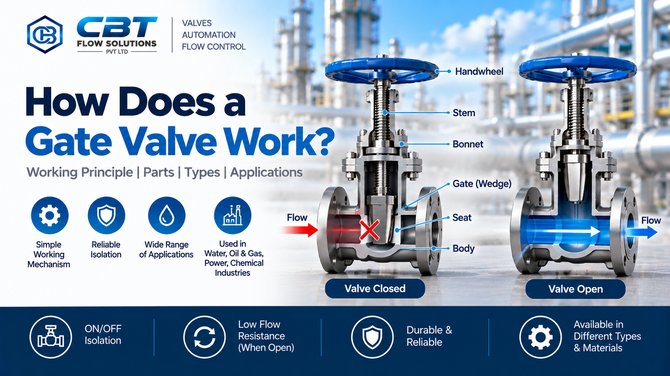
A gate valve works by moving a flat or wedge-shaped gate up or down inside the valve body. When the gate moves away from the flow passage, the valve opens and fluid can pass through. When the gate moves down between the seats, it blocks the passage and stops the flow.
The gate is usually operated through a handwheel, stem or actuator, depending on the valve design.
In this guide, we will explain the gate valve working principle, its main components, different types, applications and factors to consider before selecting a valve for an industrial system.
What Is a Gate Valve?
A gate valve is a mechanical valve used to start or stop the flow of a medium through a pipeline.
Its main closing element is called the gate or wedge. This element moves across the flow passage rather than rotating like the ball inside a ball valve.
When the valve is fully open, the gate is lifted out of the main flow path. This allows fluid to pass through with relatively little obstruction in a suitable full-bore design.
When the valve is closed, the gate moves down and contacts the seating surfaces, blocking the flow.
Gate valves are available in different sizes, pressure classes, materials and connection arrangements. Depending on the application, they may have cast iron, cast steel, forged steel, bronze or other specified construction.
CBT Flow Solutions Pvt. Ltd. supplies several gate valve options, including cast steel gate valves, forged steel gate valves and gate or sluice valves listed in its Zoloto product range.
The correct design depends on the operating pressure, temperature, medium, pipeline size and required service conditions.
How Does a Gate Valve Work?
The gate valve working principle is based on the linear movement of the gate inside the valve body.
Let us understand the process step by step.
Step 1: The Valve Is in the Closed Position
When the valve is closed, the gate moves down until it contacts the seating surfaces.
These surfaces form the sealing area between the gate and the valve body. When the valve is correctly selected and operated, the contact helps prevent fluid from passing through the closed valve.
The sealing performance depends on the valve design, seat condition, pressure, medium and operating requirements.
Step 2: The Operator Turns the Handwheel
In a manually operated gate valve, the operator turns the handwheel.
The handwheel is connected to a stem that transfers the rotational movement into linear movement. A threaded stem mechanism moves the gate upward or downward.
The number of turns required depends on the valve design and size.
Step 3: The Gate Moves Upward
As the handwheel turns in the opening direction, the stem lifts the gate away from the seats.
The flow passage gradually becomes clear.
When the gate reaches the fully open position, it is lifted sufficiently to allow fluid to pass through the designed opening.
Step 4: Fluid Flows Through the Valve
In the fully open position, a suitable gate valve offers a relatively direct flow path.
Because the gate is moved out of the main passage, the obstruction to flow can be low compared with some other valve designs.
This is one reason gate valves are widely used for pipeline isolation where the valve normally remains fully open or fully closed.
Step 5: The Operator Closes the Valve
To close the valve, the operator turns the handwheel in the opposite direction.
The stem moves the gate downward toward the seats.
Once the gate reaches its closed position, the flow passage is blocked.
The operator should follow the manufacturer’s operating instructions and avoid applying excessive force, which can damage internal components.
In short, a gate valve controls flow by moving a gate linearly across the passage.
Main Parts of a Gate Valve
Understanding the main components helps when selecting, inspecting or maintaining a gate valve.
1. Valve Body
The body is the main pressure-containing component. It houses the gate and provides the flow passage and connection points for the pipeline.
The body material must be suitable for the fluid, operating pressure and temperature.
2. Gate or Wedge
The gate is the main closing element. It moves between the open and closed positions.
Depending on the design, it may be a solid wedge, flexible wedge, split wedge or another specified arrangement.
3. Valve Seat
The seat provides the sealing surface against which the gate closes.
Seat design and material influence shut-off performance, wear resistance and suitability for different operating conditions.
4. Stem
The stem transfers movement from the handwheel or actuator to the gate.
Depending on the valve design, the stem may rise visibly as the valve opens or remain largely within the valve body and bonnet area.
5. Bonnet
The bonnet covers the upper part of the valve body and supports or encloses the stem arrangement.
A bonnet joint must provide suitable pressure containment and sealing.
6. Packing and Gland
The packing surrounds the stem and helps prevent leakage along the stem during operation.
The gland applies pressure to the packing according to the valve design. Packing may require inspection or adjustment as part of maintenance.
7. Handwheel or Actuator
A handwheel allows manual operation.
For larger valves or automated applications, a suitable gearbox or motor actuator may be used to move the gate.
CBT’s cast steel gate valve range notes that motor operation can be provided where required, subject to the selected valve configuration.
Different Types of Gate Valves
Gate valves are available in several designs. The right option depends on the application, pressure class, installation and maintenance requirements.
1. Wedge Gate Valve
A wedge gate valve uses a wedge-shaped closing element that fits between the seats when the valve is closed.
This design is common in industrial pipeline applications because it provides a straightforward isolation mechanism.
The wedge may be solid, flexible or split, depending on the valve’s design.
2. Rising Stem Gate Valve
In a rising stem gate valve, the stem moves upward as the valve opens.
The change in stem position makes it easier to see whether the valve is open or closed, provided the stem is accessible.
However, the installation must allow adequate clearance above the valve for the stem’s movement.
CBT’s Zoloto range includes cast iron sluice valves with rising-stem configurations, alongside other gate and sluice valve options.
3. Non-Rising Stem Gate Valve
In a non-rising stem design, the stem rotates while the gate moves internally. The overall stem height does not rise in the same way as it does in a rising stem design.
This can be useful where vertical clearance is limited.
The valve’s position may require an indicator or other method of confirmation because the stem movement is not as visually obvious.
4. Cast Steel Gate Valve
Cast steel gate valves are used in industrial systems where the selected body material, design and pressure rating meet the application requirements.
They may be specified for water, steam, oil, gas and other services, subject to the valve’s actual construction and rating.
CBT Flow Solutions lists a cast steel gate valve for flow isolation and ON/OFF duty. The product page also describes applicable design, pressure and temperature standards.
5. Forged Steel Gate Valve
Forged steel gate valves are commonly considered for smaller-bore, higher-pressure industrial applications, depending on the design.
CBT’s Expert forged steel gate valve range lists sizes from 15 mm to 50 mm, materials including A105, F304, F316, F11 and F22, screwed, socket-weld and butt-weld connections, and Class 150, 300 and 600 ratings.
These are the specifications published for the listed range. The exact product and pressure class should be verified before ordering.
6. Sluice Valve
A sluice valve is a gate-type valve commonly used in water supply and distribution systems.
Its gate moves across the flow path to isolate the pipeline.
CBT lists several Zoloto gate and sluice valve products, including cast iron sluice valves in different pressure ratings and configurations.
The correct product depends on pipeline size, pressure, installation conditions and the intended water service.
Where Are Gate Valves Used?
Gate valves are used in many industries because isolation is a basic requirement in most fluid-handling systems.
Water Supply and Treatment
Gate valves can isolate sections of water distribution networks, pumping systems and suitable treatment pipelines.
In these applications, material compatibility, pressure rating and installation requirements should be checked.
Oil and Gas Industry
Gate valves are used for isolation in suitable oil and gas pipelines and process systems.
The selection must account for the medium, pressure, temperature, material requirements and applicable industry standards.
For services involving sour environments or other demanding conditions, the required materials and compliance details should be specified clearly.
Power Plants
Power-generation facilities use valves in various water, steam and utility systems.
Gate valves may be specified where isolation is required and the selected design meets the operating conditions.
For high-temperature steam service, the body material, trim, pressure-temperature rating and applicable boiler or industry requirements are especially important.
Chemical and Petrochemical Plants
Gate valves can be used for isolation in selected process and utility lines.
The material must be compatible with the fluid, and the pressure and temperature ratings must suit the process.
Manufacturing Industries
Factories may use gate valves in utility-water systems, process pipelines and other suitable services.
The right valve depends on the fluid, operating conditions, required maintenance access and connection type.
Advantages of a Gate Valve
Gate valves offer several benefits when used for the right purpose.
Relatively low flow resistance when fully open. In a suitable design, the gate moves clear of the main flow path.
Straightforward isolation. The valve is designed to provide open and closed positions.
Wide range of designs. Gate valves are available in different materials, sizes, pressure classes and connections.
Manual or powered operation. Depending on the model, a valve can be operated using a handwheel, gearbox or suitable actuator.
Suitable for many industrial services. Correctly specified gate valves can be used in water, steam, oil, gas and other applications.
These advantages depend on correct sizing, material selection, installation and maintenance. No single gate valve is suitable for all fluids or operating conditions.
Can a Gate Valve Be Used to Control Flow?
A gate valve is primarily designed for ON/OFF isolation, not continuous flow regulation.
When a gate valve is partly open, the flow can create high local velocities and turbulence around the gate and seats. Depending on the medium and operating conditions, this can lead to vibration, erosion or damage to the seating surfaces.
For this reason, a gate valve should generally be operated in its fully open or fully closed position.
If a process requires frequent adjustment of flow, a suitable globe valve or control valve may be a better choice.
The correct valve depends on whether the main duty is isolation, throttling or automatic process control.
Gate Valve vs Globe Valve vs Ball Valve
These three valve types perform different functions.
| Feature | Gate Valve | Globe Valve | Ball Valve |
|---|---|---|---|
| Main purpose | Isolation | Flow regulation and isolation | Quick isolation |
| Operating movement | Gate moves linearly | Disc moves linearly | Ball rotates |
| Typical operation | Multiple handwheel turns | Multiple handwheel turns | Quarter-turn |
| Flow resistance when open | Usually low in suitable designs | Generally higher | Usually low in suitable full-port designs |
| Continuous throttling | Generally not recommended | Suitable for many regulating duties | Depends on design; not ideal for every throttling duty |
| Common use | Pipeline isolation | Flow control | Quick shut-off |
The best choice depends on the required function, pressure, temperature, medium, operating frequency and control needs.
How to Select the Right Gate Valve
Before purchasing a gate valve, review the following factors.
1. Medium
Identify the fluid passing through the valve, such as water, steam, oil, gas or a chemical.
The body, trim, packing and seals must be suitable for the medium.
2. Pressure Rating
Check the normal and maximum operating pressure, including relevant operating transients.
The selected valve must meet the required pressure-temperature rating.
3. Temperature
Operating temperature can influence the body material, stem, trim, packing and other components.
Always check the manufacturer’s pressure-temperature limits.
4. Size
Select a valve that matches the pipeline and required flow conditions. Confirm the actual nominal size and end-to-end dimensions.
5. Material
Cast iron, cast steel, forged steel, bronze and stainless steel are used in different gate valve designs.
The correct material depends on the service, pressure, temperature, corrosion requirements and applicable standards.
6. Connection Type
Check whether the pipeline requires flanged, screwed, socket-weld or butt-weld connections.
The connection must match the piping specification and installation arrangement.
7. Operating Method
Decide whether manual operation is sufficient or whether a gearbox or motor actuator is needed.
For powered valves, verify the actuator’s suitability and the complete operating arrangement.
8. Applicable Standards
Industrial valves may be designed, manufactured and tested to different standards depending on the product and service.
For example, CBT’s cast steel gate valve page lists standards including API 600, ASME B16.34, ASME B16.10, ASME B16.5, ASME B16.25 and API 598 for the relevant design requirements.
Confirm which standards apply to the specific valve being offered.
Common Gate Valve Problems
Like other mechanical equipment, gate valves can develop problems through wear, incorrect operation or unsuitable service conditions.
Leakage When Closed
Possible causes include damaged seats, debris caught between the gate and seats, wear or an incorrect operating procedure.
The valve should be inspected according to the manufacturer’s maintenance instructions.
Leakage Around the Stem
Worn or incorrectly adjusted packing can allow leakage around the stem.
A qualified technician should inspect the packing and gland arrangement before making any adjustments.
Difficult Operation
High operating torque can be caused by internal deposits, corrosion, damaged components or unsuitable operating conditions.
Avoid applying excessive force to the handwheel because it can damage the stem or operating mechanism.
Valve Does Not Fully Open or Close
Possible causes include obstruction, internal damage or a problem with the stem mechanism.
For automated valves, the gearbox or actuator may also require inspection.
Before maintenance, isolate the pipeline, release stored pressure where required and follow the applicable safety procedures.
Gate Valve Supplier in India
Selecting the right valve is important, but selecting an appropriate supplier also matters.
Buyers should confirm the valve’s construction, size, pressure class, material, connection type, applicable standards and test documentation.
CBT Flow Solutions Pvt. Ltd. supplies industrial valve and flow-control products across India. Its gate valve selection includes cast steel, forged steel and Zoloto gate or sluice valve options.
You can explore the available products here:
- Cast Steel Gate Valve
- Forged Steel Gate Valves
- Forged Steel Gate, Globe and Check Valves
- Zoloto Gate and Sluice Valve Range
Before requesting a quotation, provide the medium, pressure, temperature, valve size, material requirement and connection type. This helps the supplier identify a suitable option based on the application.
Frequently Asked Questions
How does a gate valve work?
A gate valve works by moving a gate or wedge up and down inside the valve body. Raising the gate opens the flow passage, while lowering it blocks the passage and stops the flow.
What is the main purpose of a gate valve?
The main purpose of a gate valve is to isolate a pipeline by starting or stopping flow. It is generally intended for fully open or fully closed service rather than continuous throttling.
Does a gate valve reduce pressure when fully open?
A suitable, fully open gate valve usually creates relatively little flow resistance because the gate moves clear of the main passage. Actual pressure loss depends on the valve design, size, flow rate and system conditions.
What is the difference between a rising stem and a non-rising stem gate valve?
In a rising stem gate valve, the stem moves upward as the valve opens. In a non-rising stem valve, the stem rotates while the gate moves internally, so the overall stem height does not rise in the same way.
Can a gate valve be used for gas and steam?
Yes, certain gate valve designs can be used for gas and steam. The selected valve must meet the required pressure, temperature, material and applicable industry standards.
Is a gate valve better than a ball valve?
Neither is automatically better. Gate valves are commonly used for pipeline isolation, while ball valves offer quarter-turn operation. The appropriate choice depends on the application, operating frequency, medium and technical requirements.
Conclusion
A gate valve works by moving a gate across the flow passage. When the gate is raised, fluid can pass through. When the gate is lowered onto the seating surfaces, the valve closes and isolates the pipeline.
This design makes gate valves useful in many industrial isolation applications, including water supply, oil and gas, power generation, chemical processing and manufacturing.
However, gate valves should generally not be used for continuous throttling. The material, pressure rating, temperature, connection type and operating method must also match the application.
Understanding these points helps buyers select the right valve and avoid unnecessary maintenance problems.
Need a Gate Valve for Your Industrial Application?
CBT Flow Solutions Pvt. Ltd. supplies industrial valves, actuators and flow-control products for different industrial requirements.
Whether you need a cast steel gate valve, forged steel gate valve or a gate/sluice valve for a suitable water service, share your application details with the CBT team.
CBT Flow Solutions Pvt. Ltd.
Valves | Automation | Flow Control
Reliable Flow for a Better Tomorrow
Explore Cast Steel Gate Valves
Explore Forged Steel Gate Valves
Explore Zoloto Valves
Contact CBT Flow Solutions