


Lever Operated Butterfly Valve vs Gear Operated Butterfly Valve: Differences, Uses and Selection Guide
Butterfly valves are widely used in industrial pipelines to control the flow of liquids and gases. They are common in water treatment plants, HVAC systems, chemical industries, power plants and other process applications.
However, selecting the right butterfly valve involves more than choosing its size, material or pressure rating. You also need to consider how the valve will be operated.
Two common options are lever operated butterfly valves and gear operated butterfly valves. Both use a rotating disc to control flow, but their operating mechanisms are different.
A lever operated butterfly valve uses a direct handle to turn the valve disc. A gear operated butterfly valve uses a gearbox and handwheel to turn the disc with greater mechanical advantage.
This difference affects operating effort, speed, installation space and suitability for different valve sizes and operating conditions.
So, which should you choose?
The answer depends on the valve’s operating torque, pipeline size, frequency of operation and the requirements of your application.
In this guide, we will compare both designs, explain how they work and help you identify the right butterfly valve for your industrial system.
CBT Flow Solutions Pvt. Ltd. supplies both lever operated and gear operated butterfly valves. You can explore the CBT butterfly valve range to review available product options.
What Is a Lever Operated Butterfly Valve?
A lever operated butterfly valve is a manually operated valve that uses a handle connected directly to the valve stem.
The stem turns a disc positioned inside the valve body. When the handle rotates the disc into the open position, the disc aligns more closely with the direction of flow, allowing the medium to pass through. When the handle turns the disc towards the closed position, the disc restricts and then blocks the flow passage.
Most lever operated butterfly valves use approximately 90 degrees of rotation between fully open and fully closed positions.
The handle is usually fitted with a locking or notched positioning mechanism, depending on the design. This allows the operator to secure the handle at the intended position.
How Does a Lever Operated Butterfly Valve Work?
The operating process is straightforward.
Step 1: The operator moves the lever. The handle transfers rotational force directly to the valve stem.
Step 2: The stem rotates the disc. The disc changes position inside the pipeline.
Step 3: The flow passage opens or closes. The disc’s angle determines the available flow area.
Step 4: The operator secures the position. The locking mechanism, if fitted, holds the lever in the selected position.
Because there is no gearbox between the handle and valve stem, the operation is direct and usually quick.
Advantages of Lever Operated Butterfly Valves
Lever operation offers several practical benefits.
- Quick operation: A quarter-turn movement can open or close the valve quickly.
- Simple mechanism: The operating arrangement is straightforward, with no separate gearbox.
- Compact installation: The handle mechanism generally requires less height than a gear operator.
- Lower initial cost: The valve does not require an additional manual gearbox.
- Easy visual indication: The handle position helps the operator identify the disc position.
These benefits make lever operated valves suitable for many applications where the operating torque is manageable and quick manual operation is required.
CBT Product Example: 1078 Butterfly Valve
CBT lists the 1078 Wafer Type Butterfly Valve with S.G. Iron Disc.
Its published specifications include:
- Wafer-type construction.
- Lever-operated mechanism.
- S.G. iron body and disc.
- PN 1.6 rating.
- Maximum working pressure of 1.6 MPa.
- Maximum working temperature of 90°C.
- EPDM and nitrile lining options, subject to configuration.
The product page lists sizes from 40 mm to 150 mm for this model. It also notes that a gear arrangement can be provided for valves up to 150 mm at additional cost.
These specifications apply to the listed model and should be checked against the latest datasheet before selection.
What Is a Gear Operated Butterfly Valve?
A gear operated butterfly valve uses a gearbox between the handwheel and the valve stem.
Instead of applying force directly to a lever, the operator turns a handwheel connected to a gear mechanism. The gearbox reduces the operating effort required at the handwheel and transfers the resulting torque to the valve stem.
This arrangement is particularly useful when the valve requires more operating torque than an operator can comfortably apply through a direct handle.
Gear operators also allow the disc position to be changed progressively through multiple handwheel turns. The degree of positioning control depends on the gearbox design and valve characteristics.
How Does a Gear Operated Butterfly Valve Work?
The process works as follows.
Step 1: The operator turns the handwheel. The handwheel drives the internal gearing.
Step 2: The gearbox multiplies the available output torque. The mechanical advantage reduces the handwheel effort needed to operate the valve.
Step 3: The gearbox rotates the valve stem. The disc moves towards the open or closed position.
Step 4: The operator reaches the desired position. The valve may be fully open, fully closed or at an intermediate position where the specific valve and application permit it.
A position indicator, where fitted, helps the operator identify the valve’s approximate position.
Advantages of Gear Operated Butterfly Valves
Gear operation offers several advantages for demanding manual applications.
- Reduced operating effort: The gearbox provides mechanical advantage.
- Suitable for higher torque requirements: It can make larger or more difficult-to-operate valves manageable.
- Gradual movement: The handwheel allows slower, controlled movement.
- Position holding: Many worm-gear operators are designed to resist back-driving, but this should be verified for the actual model.
- Convenient operation: A handwheel can be easier to use than a long lever when access or operating force is a concern.
A gear operator adds cost, weight, installation height and additional components that may need inspection or maintenance. It should therefore be selected when its benefits justify the additional mechanism.
CBT Product Example: 1078C Gear Operated Butterfly Valve
CBT lists the 1078C Wafer Type Butterfly Valve with SS304 Disc – Gear Operated.
Its published specifications include:
- Wafer-type construction.
- Gear-operated mechanism.
- S.G. iron body.
- Stainless steel disc.
- PN 1.6 rating.
- Maximum working pressure of 1.6 MPa.
- Maximum working temperature of 90°C.
- Lining options including EPDM and nitrile, depending on the configuration.
The product page lists dimensions for the 200 mm, 250 mm and 300 mm sizes. Other gear-operated models in the CBT portfolio have different listed size ranges and specifications.
Always confirm the exact model, rating, materials and dimensions when requesting a quotation.
Lever Operated vs Gear Operated Butterfly Valve: Key Differences
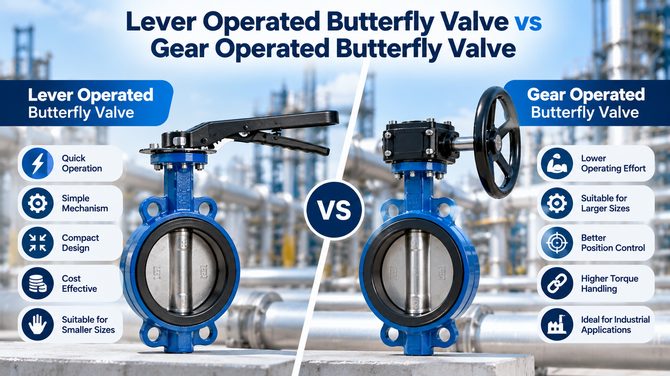
The most important difference is the mechanism used to turn the valve disc.
| Feature | Lever Operated Butterfly Valve | Gear Operated Butterfly Valve |
|---|---|---|
| Operating mechanism | Direct handle connected to stem | Handwheel connected through a gearbox |
| Opening and closing | Fast quarter-turn movement | Slower movement through handwheel rotation |
| Operating effort | Depends directly on valve torque and lever length | Reduced handwheel effort through mechanical advantage |
| Typical suitability | Applications with manageable operating torque | Applications requiring greater operating torque |
| Installation space | Generally compact, but handle sweep requires clearance | Usually requires additional height and space for the gearbox |
| Initial cost | Generally lower | Generally higher because of the gearbox |
| Position adjustment | May include a locking plate with indexed positions | Allows gradual movement; positioning depends on gearbox and valve design |
| Maintenance | Handle, locking mechanism and valve components | Gearbox, handwheel, stem connection and valve components |
| Common uses | Smaller or easier-to-operate valves | Larger valves or duties with higher torque requirements |
These are general differences. Neither operating style has a universal size or pressure limit. The manufacturer’s torque data and the valve’s operating conditions should guide selection.
Which Butterfly Valve Is Better for Large Pipe Sizes?
Gear operated butterfly valves are often considered for larger pipe sizes because the torque required to operate a butterfly valve generally increases with valve size and can also increase with pressure, flow conditions, seat friction and other factors.
A gearbox makes manual operation easier by providing mechanical advantage.
However, pipe diameter alone should not determine the selection. A smaller valve may still require significant torque because of its pressure, seat design or operating conditions. Similarly, a larger valve may be available with more than one operating option.
For example, CBT’s 1078 lever-operated valve page lists sizes from 40 mm to 150 mm, while the 1078C gear-operated model page lists dimensions for 200 mm to 300 mm sizes. CBT also lists other lever and gear variants with different configurations.
Use these product examples as a starting point, not as a universal rule that every valve below a particular size must have a lever and every larger valve must have a gearbox.
The correct operator is the one that satisfies the manufacturer’s torque requirements and the site’s operating needs.
Lever vs Gear Operation: What About Pressure and Flow?
A common misunderstanding is that a gear operated butterfly valve automatically supports higher pressure or provides better flow control simply because it uses a gearbox.
The gearbox changes the operating mechanism. It does not, by itself, change the pressure rating or internal flow characteristics of the valve.
Pressure capability depends on the valve’s body, disc, stem, seat and overall design. Flow performance depends on the valve design, disc position and system conditions.
Likewise, both lever operated and gear operated butterfly valves use a disc to regulate the available flow area. A gear operator allows more gradual manual adjustment, but the valve must still be suitable for throttling duty if it will be operated at intermediate positions.
If your application involves frequent regulation, check the manufacturer’s guidance on permitted throttling, flow characteristics, cavitation risk and seat wear.
Applications of Lever Operated Butterfly Valves
Lever operated butterfly valves may be suitable when the required operating torque is manageable and direct manual operation is convenient.
Water Supply and Utility Lines
They may be considered for smaller water lines where manual isolation is required.
HVAC Systems
Suitable lever operated butterfly valves can isolate water circuits in building services and HVAC installations.
Industrial Machinery
Compact manual valves can be useful on equipment skids and utility connections where the operator can access the lever safely.
Maintenance Isolation
The direct quarter-turn operation can be convenient when the valve needs to be opened or closed occasionally.
The selected valve must match the required pressure rating, medium, temperature and connection.
Applications of Gear Operated Butterfly Valves
Gear operated valves are often preferred when the torque required for direct manual operation becomes difficult to manage.
Water Treatment Plants
Gear operators may be used on larger pipelines and equipment isolation points where the selected valve and rating suit the application.
Pumping Stations
Pumping systems can contain valves that require higher operating torque. The operator should be selected based on actual torque data and pressure conditions.
Power and Process Plants
Gear operated butterfly valves may be considered for suitable utility and process lines in which gradual manual movement is useful.
Large Industrial Pipelines
The gearbox makes manual operation more manageable on valves that would otherwise need excessive force through a direct lever.
For every application, confirm the valve rating, connection, materials, installation clearance and operating requirements.
Can a Gear Operated Butterfly Valve Replace a Lever Operated Valve?
In some applications, a gear-operated arrangement may be a suitable alternative to a lever-operated valve. However, it is not always a direct replacement.
Before changing the operator, check:
- Whether the valve body and disc design meet the application requirements.
- Whether the gearbox fits the valve stem and mounting arrangement.
- Whether the flange-to-flange dimensions remain suitable.
- Whether the operator has enough torque for the valve.
- Whether the installation has enough clearance for the handwheel.
- Whether the required position indication and locking arrangements are available.
An operator change should follow the manufacturer’s recommendations. Do not assume that a gearbox can be installed on any butterfly valve without confirming compatibility.
How to Choose Between Lever Operated and Gear Operated Butterfly Valves
Before placing an order, review these factors.
1. Valve Size
Identify the nominal diameter of the pipeline and the available valve options for that size.
Use the manufacturer’s product range rather than choosing the operator only from a general size guideline.
2. Operating Torque
Ask for the required operating torque under the actual service conditions.
Consider pressure, differential pressure, seat material, flow conditions and the expected frequency of operation.
3. Operating Frequency
If the valve needs occasional, fast manual operation and the handle force is manageable, a lever may be suitable.
If the valve needs more controlled movement or requires high operating effort, a gear operator may be preferable.
4. Space and Accessibility
Check whether the lever can rotate through its full travel without hitting nearby piping, walls or equipment.
For a gear operator, check the required handwheel clearance and the space needed for access.
5. Pressure and Temperature Ratings
Confirm the maximum working pressure and temperature for the exact valve configuration.
A change in operator does not automatically increase the valve’s pressure or temperature rating.
6. Materials and Medium
The body, disc, stem, lining and seals must be compatible with the fluid and operating environment.
CBT’s listed 1078 and 1078C models, for example, have different disc constructions. Select the appropriate material according to the application.
7. Maintenance Requirements
Consider the availability of spare parts and the manufacturer’s recommended inspection procedures.
Gear operators introduce additional components that may need attention, while lever operators have their own handle and locking mechanisms to inspect.
Common Mistakes When Selecting Butterfly Valve Operators
Choosing by size alone. Two valves of the same nominal size may require different operating torque.
Assuming gear operation increases the pressure rating. The gearbox provides mechanical advantage; the valve’s construction determines its pressure capability.
Ignoring installation clearance. Both lever sweep and handwheel access must be considered.
Using intermediate positions without checking suitability. Not every butterfly valve is intended for continuous throttling duty.
Selecting only by purchase price. Consider operating effort, accessibility, maintenance and the demands of the application.
Failing to verify the exact product model. Body, disc, lining, pressure rating and size may vary between model variants.
A suitable technical specification helps avoid unnecessary changes after installation.
Lever and Gear Operated Butterfly Valves from CBT Flow Solutions
CBT Flow Solutions Pvt. Ltd. supplies manual, gear-operated and actuated butterfly valves for different industrial applications.
The following product pages provide relevant options to compare.
Lever operated butterfly valves
Gear operated butterfly valves
- 1078A Wafer Butterfly Valve with S.G. Iron Disc – Gear Operated
- 1078C Wafer Butterfly Valve with SS304 Disc – Gear Operated
Other operating options
Compare the exact size, body and disc material, lining, pressure rating, temperature limit, connection and operator before selecting the final model.
Frequently Asked Questions
What is the difference between a lever operated and gear operated butterfly valve?
A lever operated butterfly valve uses a direct handle to turn the disc, providing quick quarter-turn operation. A gear operated butterfly valve uses a gearbox and handwheel, reducing the manual effort required to turn the disc.
Which butterfly valve is better for large pipe sizes?
A gear operated butterfly valve is often easier to operate when the valve requires high torque. However, the right choice depends on the manufacturer’s torque data, operating conditions and available product options.
Is a gear operated butterfly valve more expensive?
A gear operated valve generally costs more than a comparable lever-operated version because it includes a gearbox. Actual pricing depends on size, materials, pressure rating, manufacturer and configuration.
Does a gear operator increase the butterfly valve’s pressure rating?
No. The gearbox changes how the valve is operated. The pressure rating depends on the valve’s design, materials and specified service conditions.
Can lever operated butterfly valves regulate flow?
Some lever-operated butterfly valves can be held in indexed intermediate positions if their design permits it. For continuous regulation, confirm that the valve is suitable for throttling and that its locking mechanism can safely maintain the required position.
What is the difference between a gear operated and an actuated butterfly valve?
A gear-operated butterfly valve normally uses a handwheel and gearbox for manual operation. An actuated butterfly valve uses a powered actuator, such as a pneumatic or electric actuator, to operate the disc according to a control command.
How do I choose the right butterfly valve operator?
Check the valve size, required operating torque, pressure, medium, temperature, operating frequency, space and maintenance requirements. Compare these details with the manufacturer’s specifications before selecting the lever or gear option.
Conclusion
The choice between a lever operated butterfly valve vs gear operated butterfly valve comes down to operating effort, control requirements, available space and the actual valve conditions.
A lever operated butterfly valve offers direct, quick operation and a simple mechanism when the required torque is manageable.
A gear operated butterfly valve uses a gearbox to reduce the effort required at the handwheel. It is often more practical for applications where the valve needs greater operating torque or where slower, more controlled movement is preferred.
Neither option is automatically better for every installation. The correct selection depends on the valve size, torque requirement, pressure, temperature, materials and operating conditions.
By checking these factors before purchasing, engineers and procurement teams can select a suitable valve operator and avoid unnecessary installation changes.
Need a Lever or Gear Operated Butterfly Valve?
CBT Flow Solutions Pvt. Ltd. supplies industrial butterfly valves, actuators and flow-control products for a range of applications.
Share your valve size, operating pressure, medium, temperature, disc and lining requirements with the team to help identify a suitable configuration.
CBT Flow Solutions Pvt. Ltd.
Valves | Automation | Flow Control
Reliable Flow for a Better Tomorrow
Explore Lever Operated Butterfly Valves
Explore Gear Operated Butterfly Valves