


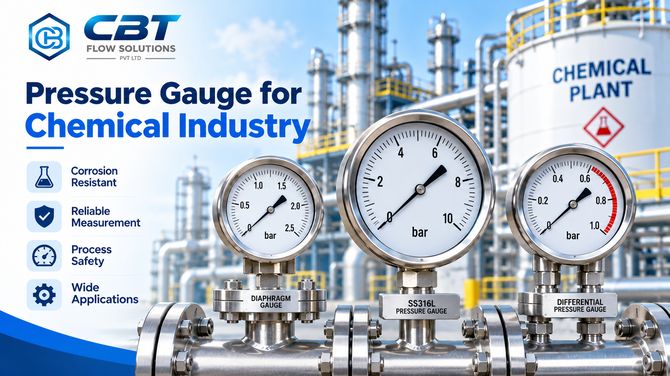
Pressure Gauge for Chemical Industry: Types, Applications and Selection Guide
Chemical manufacturing involves several processes where pressure must be monitored carefully. From chemical reactors and storage tanks to pumps, compressors and industrial pipelines, maintaining the correct pressure is important for safe and consistent plant operation.
A pressure gauge helps operators monitor the pressure inside these systems. It provides a reading that allows engineers to understand operating conditions, identify unusual pressure changes and take corrective action when required.
However, choosing a pressure gauge for the chemical industry requires more attention than selecting a standard industrial pressure gauge.
Chemical plants handle different liquids, gases and process media. Some chemicals are highly corrosive, while others operate at high temperatures or pressures. A pressure gauge with unsuitable wetted materials may experience corrosion, leakage or measurement failure.
For this reason, material compatibility, sensing-element construction, pressure range and process connections are important considerations.
CBT Flow Solutions Pvt. Ltd. supplies industrial pressure gauges from Baumer and Dwyer, including stainless steel, diaphragm-type, differential and specialised process gauges.
In this guide, we will explain the different pressure gauges used in chemical industries, their applications and how to select the right instrument for your process.
What Is a Pressure Gauge for the Chemical Industry?
A pressure gauge is an instrument used to measure the pressure of a liquid or gas inside a pipeline, vessel or industrial system.
In chemical manufacturing, pressure gauges are installed at different points to monitor process conditions.
For example, a chemical reactor may operate within a specified pressure range. A pressure gauge allows the operator to monitor the pressure during the manufacturing process.
Similarly, pumps and chemical transfer pipelines require pressure monitoring to help identify abnormal operating conditions.
Depending on the application, chemical plants may use Bourdon tube, diaphragm, differential or digital pressure gauges.
The important difference is that a gauge used in chemical service must have suitable materials for the process medium. The external stainless steel case alone does not guarantee chemical compatibility. The sensing element, process connection, seals and other wetted components must also be checked.
Why Are Specialised Pressure Gauges Required in Chemical Plants?
Chemical plants deal with different operating conditions, and a standard pressure gauge may not be suitable for every application.
There are several reasons why specialised pressure gauges are required.
1. Corrosive Chemicals
Some chemicals can react with ordinary metals and damage the sensing element or process connection.
A suitable stainless steel or specialised alloy construction may be required, depending on the chemical composition and concentration.
2. High Operating Pressure
Chemical reactors, storage systems and process pipelines may operate at different pressure levels.
The selected pressure gauge must have an appropriate pressure rating and safety construction for the application.
3. High Temperature
Certain chemical processes involve elevated temperatures. Excessive process temperature can affect the sensing element, seals and instrument accuracy.
Suitable temperature protection, siphons or diaphragm seals may be required.
4. Viscous and Crystallising Media
Some process fluids may be thick, contain suspended material or crystallise when exposed to certain conditions.
These substances can block small pressure passages and affect measurement.
A suitable diaphragm seal or isolating arrangement can help protect the pressure instrument from direct exposure to the process medium.
5. Hazardous Process Environments
Chemical manufacturing may involve hazardous gases, liquids and operating conditions.
A pressure gauge must have the appropriate mechanical construction, pressure rating and any required hazardous-area protection.
Choosing the correct instrument helps support reliable measurement and reduce unnecessary maintenance.
Types of Pressure Gauges Used in the Chemical Industry
Different pressure gauge designs are available for different process requirements. The correct choice depends on the medium, pressure, temperature and required accuracy.
1. Stainless Steel Pressure Gauge
Stainless steel pressure gauges are widely considered for industrial applications where corrosion resistance and durable construction are important.
Depending on the design, the case, sensing element and process connection may use different stainless steel grades.
AISI 304 and AISI 316 are commonly specified for different components, while AISI 316L may be selected for wetted parts in suitable chemical applications.
These gauges can be used in compatible chemical and petrochemical processes where the specified material construction meets the requirements.
Applications:
- Chemical processing plants.
- Petrochemical facilities.
- Industrial pipelines.
- Chemical transfer systems.
- Pumps and compressors.
- Process equipment.
CBT Flow Solutions offers Stainless Steel Pressure Gauges with the following published options:
- Case material: AISI 304 SS, optional AISI 316 SS.
- Sensing element: AISI 316L SS, optional Monel.
- Process connection material: AISI 316L SS, optional Monel.
- Dial sizes: 40 mm to 250 mm, depending on the configuration.
- Accuracy options: 0.5%, 1%, 1.6% and 2.5%.
Its listed applications include chemical and petrochemical industries.
The exact wetted-material combination should be selected according to the chemical being measured.
2. Diaphragm Pressure Gauge
A diaphragm pressure gauge uses a flexible metal diaphragm as its sensing element.
When pressure is applied, the diaphragm moves slightly. This movement is transferred to the indicating mechanism to display the pressure reading.
Diaphragm gauges are useful for selected applications involving low pressure, corrosive media or process fluids where a conventional Bourdon tube arrangement may not be suitable.
The diaphragm material must be compatible with the process fluid.
Applications:
- Chemical processing.
- Fertilizer manufacturing.
- Pharmaceutical plants.
- Low-pressure process systems.
- Gas measurement.
- Selected viscous or contaminated media.
CBT lists the SS Low/High Pressure Diaphragm Type Pressure Gauge.
Its published specifications include:
- Model: AP.
- Case material: AISI 304 stainless steel.
- Standard diaphragm: AISI 316L stainless steel.
- Optional diaphragm materials: Hastelloy C and Monel.
- Accuracy: 1.6%.
- Process connection options: BSP, NPT and flanged.
The listed service includes clean air, corrosive environments and compatible gaseous or non-crystallising liquid media that will not obstruct the pressure system.
This makes it an important product to evaluate for suitable chemical-process measurement duties.
3. Diaphragm Seal Pressure Gauge
A diaphragm seal is an additional protective component fitted between the process pipeline and pressure instrument.
It separates the measuring instrument from direct contact with the process fluid while transmitting pressure through a suitable filling system.
This arrangement is useful when the process medium is corrosive, viscous, crystallising or likely to block a conventional pressure connection.
The diaphragm and lower housing are exposed to the process medium, so their materials must be selected carefully.
Applications:
- Highly corrosive chemical pipelines.
- Viscous process fluids.
- Chemical dosing systems.
- Crystallising liquids.
- High-temperature process connections.
Depending on the application, diaphragm seals may use stainless steel, Hastelloy, Monel or other specialised materials.
A diaphragm seal assembly must be specified together with the pressure gauge. The fill fluid, temperature limits, pressure range and response characteristics must also be checked.
4. SS Solid Front Pressure Gauge
A solid front pressure gauge is designed with a safety-oriented case construction for specified demanding applications.
Its design generally directs pressure-related case failure effects away from the front of the instrument and towards a designated rear relief arrangement, subject to the manufacturer’s construction.
This makes it useful to evaluate where high-pressure gas or hazardous process service requires a suitable safety-pattern gauge.
It is important to understand that solid-front construction is a safety feature. It does not automatically make the wetted components resistant to every chemical.
CBT supplies SS Solid Front Pressure Gauges.
Its published model AI specifications include:
- Dial sizes: 100 mm and 150 mm.
- Pressure range: -1 to 0 and 0 to 1600 bar, depending on configuration.
- Case material: AISI 304 stainless steel.
- Sensing element: AISI 316L stainless steel.
- Process connection: AISI 316L stainless steel.
- Accuracy: 1.0%, optional 0.5%.
- Protection class: IP65.
The product is listed for high-pressure gas and corrosive or hazardous environments.
The exact chemical compatibility and pressure rating must be confirmed for the selected model.
5. Differential Pressure Gauge
A differential pressure gauge measures the pressure difference between two points in a system.
Instead of measuring only the pressure at one location, it compares the pressure at two separate connections.
For example, a chemical plant may use a filter to remove unwanted particles from a process fluid. Pressure is measured on both sides of the filter.
As the filter becomes blocked, the pressure difference may increase. A differential pressure gauge helps operators identify this change.
Applications:
- Chemical process filters.
- Pumps and hydraulic systems.
- Heat exchangers.
- Water treatment equipment.
- Industrial filtration systems.
- Selected petrochemical processes.
CBT lists the following relevant products:
SS Differential Pressure Gauge
Diaphragm Type Differential Pressure Gauge
The stainless steel differential gauge range includes AISI 316L sensing elements and process connections, with chemical and petrochemical applications listed.
The diaphragm-type differential gauge also lists chemical plants among its applications.
6. Ammonia Pressure Gauge
An ammonia pressure gauge is designed for specified ammonia-related applications, including suitable industrial refrigeration and chemical-process systems.
Because ammonia has particular material-compatibility requirements, the sensing element and process connections must be specified for the intended service.
These gauges should not be treated as universal instruments for all chemical applications.
CBT offers an Ammonia Pressure Gauge with the following published specifications:
- Model: AQ.
- Dial sizes: 100 mm and 150 mm.
- Case material: AISI 304 SS, optional AISI 316 SS.
- Sensing element: AISI 316L SS double diaphragm, optional Monel.
- Process connection material: AISI 316 SS, with optional AISI 316L SS and Monel.
- Protection class: IP65, with optional higher protection configurations.
Its listed applications include chemicals, refineries, petrochemicals, fertilizer and pharmaceutical industries.
The instrument must be checked against the actual ammonia pressure, temperature and installation requirements.
7. Glycerine-Filled Pressure Gauge
Chemical plants often have pumps, compressors and machinery that generate vibration and pressure pulsation.
A glycerine-filled pressure gauge contains a filling liquid inside the case to help dampen pointer movement.
This makes the pressure reading easier to observe and can reduce wear on the internal moving mechanism.
Glycerine filling is a case-fill option rather than a separate sensing principle.
Applications:
- Chemical transfer pumps.
- Industrial compressors.
- Process machinery.
- Vibrating pipeline installations.
- Utility systems.
The pressure-sensing element and wetted materials must still be compatible with the process medium. Also check the filling liquid’s temperature limitations and suitability for the installation.
How to Choose the Right Pressure Gauge for Chemical Industry Applications
Selecting the correct pressure gauge requires a detailed understanding of the process conditions.
Here are the main factors to consider.
1. Chemical Compatibility
This is one of the most important factors.
Identify the exact chemical, its concentration, temperature and operating conditions.
The wetted components must be compatible with the medium.
For example, AISI 316L may be appropriate for some applications but may not be suitable for every chemical concentration or operating temperature.
For more demanding services, optional materials such as Hastelloy C or Monel may need to be evaluated.
Do not select a gauge only by looking at its external case material.
2. Pressure Range
The gauge must cover the normal operating pressure and expected maximum pressure.
As a general guideline, normal operating pressure is often selected around 50–60% of the full-scale range, subject to the manufacturer’s recommendations.
For example, if a process normally operates at 10 bar, a 0–16 bar gauge may be a suitable starting point for evaluation.
However, pressure surges and pulsations must also be considered.
3. Operating Temperature
High process temperatures can affect the sensing element, seals and pressure transmission system.
Check both the process-fluid temperature and the ambient temperature.
Where required, consider a suitable siphon, cooling arrangement or diaphragm seal.
4. Wetted Material
The wetted parts are the components that directly contact the process medium.
These may include:
- Sensing element.
- Process connection.
- Diaphragm.
- Seal or gasket.
- Diaphragm-seal components, where fitted.
Choose materials that are compatible with the actual chemical and its operating conditions.
5. Accuracy Requirement
Different applications require different levels of measurement accuracy.
General process monitoring may use a suitable industrial accuracy class, while testing, calibration or more critical operations may require a higher-accuracy instrument.
Check the accuracy specification and full-scale range before purchasing.
6. Process Connection
Confirm the required connection size and standard.
Common options include BSP and NPT threaded connections, as well as flanged connections.
The process connection should match the pipeline or equipment specification.
7. Vibration and Pressure Pulsation
If the installation involves pumps or reciprocating machinery, vibration can cause the pointer to fluctuate.
A suitable liquid-filled gauge, pulsation dampener or snubber may help, depending on the process.
8. Safety and Protection
Check whether the application requires a solid-front gauge, specific enclosure protection or hazardous-area certification.
The selected instrument must meet the relevant project and safety requirements.
Common Applications of Pressure Gauges in Chemical Plants
Pressure measurement is required at several stages of chemical manufacturing.
Chemical Reactors
Pressure gauges help operators monitor reactor pressure during chemical processing.
The instrument must be suitable for the process medium, operating temperature and pressure.
Chemical Storage Tanks
Pressure monitoring may be required in tanks that operate under pressure or vacuum conditions.
The gauge must be selected according to the tank design and measurement requirement.
Chemical Transfer Pumps
Pressure gauges monitor pump suction and discharge conditions.
A suitable instrument can help identify unusual pressure changes and support maintenance activities.
Filtration Systems
Differential pressure gauges monitor the pressure difference across filters.
An increasing differential pressure may indicate filter blockage or an operating issue.
Pipeline and Distribution Systems
Pressure gauges help monitor operating conditions across chemical transfer pipelines and utility circuits.
For corrosive media, wetted-material compatibility is particularly important.
Fertilizer and Petrochemical Plants
Different process units use pressure gauges to monitor gas, liquid and utility systems.
The selected material, pressure range and connection must match the particular service.
Why Choose CBT Flow Solutions for Chemical Industry Pressure Gauges?
CBT Flow Solutions Pvt. Ltd. supplies industrial pressure gauges from Baumer and Dwyer for a range of process industries.
The company’s portfolio includes stainless steel pressure gauges, diaphragm-type gauges, differential pressure gauges, solid front gauges and specialised process instruments.
For chemical applications, relevant product options include:
- Stainless Steel Pressure Gauges
- SS Low/High Pressure Diaphragm Gauges
- SS Solid Front Pressure Gauges
- SS Differential Pressure Gauges
- Ammonia Pressure Gauges
CBT Flow Solutions was established in 1966 as C.B. Trading Corporation and has been supplying industrial valves, instrumentation and flow-control products for several decades.
Its Mumbai-based team supports enquiries for different industrial pressure-measurement requirements across India.
To identify a suitable instrument, share the chemical name, concentration, pressure, temperature, required material, dial size and process connection with the team.
Frequently Asked Questions
Which pressure gauge is suitable for the chemical industry?
Stainless steel pressure gauges with suitable wetted materials, diaphragm gauges and diaphragm-seal assemblies are commonly considered for chemical applications. The final choice depends on the chemical composition, concentration, temperature and operating pressure.
Why are SS316L pressure gauges used in chemical plants?
SS316L offers corrosion resistance in many industrial environments. It is commonly considered for pressure-gauge sensing elements and process connections where its compatibility with the particular chemical has been confirmed.
Can a normal Bourdon tube pressure gauge be used for chemicals?
Yes, in some applications, provided the Bourdon tube and process connection materials are compatible with the medium. A standard brass-wetted gauge should not automatically be selected for corrosive chemical service.
What is the purpose of a diaphragm pressure gauge?
A diaphragm pressure gauge uses a flexible membrane to sense pressure. It can be useful in low-pressure applications and certain corrosive or contaminated services, depending on the diaphragm material and construction.
What is a diaphragm seal in pressure measurement?
A diaphragm seal isolates the pressure gauge from direct contact with the process fluid while transferring pressure through a filling system. It is useful for selected corrosive, viscous, crystallising or high-temperature applications.
What pressure range is suitable for a chemical pressure gauge?
There is no single pressure range for all chemical plants. The correct range depends on normal operating pressure, maximum expected pressure, surges and the requirements of the process.
Are glycerine-filled pressure gauges suitable for chemical industries?
They may be suitable where machinery vibration or pressure pulsation is present. However, the wetted components must still be compatible with the chemical being measured.
Which pressure gauge is suitable for highly corrosive chemicals?
A diaphragm-seal arrangement with an appropriately selected diaphragm and lower housing material may be required. Material selection should be based on the chemical concentration, temperature and pressure.
What information is required when ordering a chemical pressure gauge?
Provide the chemical name, concentration, operating pressure, temperature, dial size, accuracy requirement, process connection and required wetted materials. Also mention any hazardous-area or documentation requirements.
Conclusion
Selecting the right pressure gauge for the chemical industry requires careful consideration of the process conditions.
Stainless steel pressure gauges may be suitable for many industrial services, while diaphragm gauges and diaphragm-seal assemblies can be considered for selected corrosive or demanding applications. Solid-front and differential pressure gauges serve additional requirements.
The most important factor is chemical compatibility. The sensing element, process connection, diaphragm and other wetted components must be suitable for the actual medium.
Before purchasing, check the pressure range, temperature, material, accuracy, connection and safety requirements.
A properly selected pressure gauge helps operators monitor process conditions and supports reliable pressure measurement throughout the plant.
Looking for a Pressure Gauge for Your Chemical Plant?
CBT Flow Solutions Pvt. Ltd. supplies industrial pressure gauges from Baumer and Dwyer for chemical, petrochemical, fertilizer, pharmaceutical and other process industries.
Whether you require an SS316L pressure gauge, diaphragm-type gauge, differential pressure gauge or solid-front pressure gauge, our team can help evaluate the right product for your application.
Share your chemical medium, concentration, pressure, temperature, required material and connection details for product selection assistance.
CBT Flow Solutions Pvt. Ltd.
Valves | Automation | Flow Control
Reliable Flow for a Better Tomorrow
Explore Stainless Steel Pressure Gauges
Explore Diaphragm Pressure Gauges
Explore Differential Pressure Gauges