


Pneumatic Valves and Actuators: Types, Working Principles and Industrial Applications
Industrial automation depends on equipment that can control the movement of fluids and operate machinery reliably. In many manufacturing plants, compressed air is used to operate valves, move components and control different stages of a production process.
This is where pneumatic valves and actuators play an important role.
Pneumatic valves control the supply, direction or release of compressed air. Pneumatic actuators convert the energy of compressed air into mechanical movement. When these components work together, they can automate industrial valves and help operators control processes remotely.
You will commonly find pneumatic valve and actuator systems in chemical plants, oil and gas facilities, water treatment plants, pharmaceutical manufacturing, power stations and general industrial automation.
However, choosing the right equipment requires an understanding of how each component works and what the application demands.
In this guide, we will explain the different types of pneumatic valves and actuators, how they work together, where they are used and what to consider before purchasing them.
What Are Pneumatic Valves and Actuators?
Although they are often discussed together, pneumatic valves and actuators perform different functions.
What Is a Pneumatic Valve?
A pneumatic valve controls the movement of compressed air through a system. Depending on its design, it can start or stop airflow, change its direction, control pressure or regulate the flow supplied to a pneumatic device.
For example, a directional solenoid valve can send compressed air to either side of a pneumatic cylinder. This allows the cylinder to extend or retract when an electrical signal is received.
Pneumatic control valves are available in different configurations, including 3/2-way and 5/2-way valves, depending on the number of ports, operating positions and intended function.
What Is a Pneumatic Actuator?
A pneumatic actuator converts compressed-air energy into mechanical movement.
Depending on its design, the movement may be linear or rotary.
A linear actuator moves in a straight line and can push, pull or position a component. A rotary pneumatic actuator produces turning movement and is commonly used to operate quarter-turn industrial valves, such as ball valves and butterfly valves.
CBT Flow Solutions Pvt. Ltd. supplies pneumatic actuators and solenoid valves for different industrial automation requirements.
Explore the pneumatic actuator range and solenoid valve range for relevant products.
How Do Pneumatic Valves and Actuators Work Together?
Consider an industrial pipeline that uses a butterfly valve to control water flow.
Operating the valve manually may be inconvenient if it needs to open and close frequently or respond to a signal from a control room.
A pneumatic actuator can be mounted on the butterfly valve to provide automatic operation. A pneumatic solenoid valve then controls the compressed air supplied to the actuator.
Here is how the arrangement generally works.
Step 1: A control signal is sent. A PLC, control panel or other control device sends an electrical signal to the solenoid valve.
Step 2: The solenoid valve changes position. Its internal mechanism redirects compressed air according to the control arrangement.
Step 3: Air enters the actuator. The actuator converts the air pressure into rotary or linear movement.
Step 4: The connected valve moves. The actuator turns the butterfly or ball valve towards the required position.
Step 5: Position feedback may be provided. A limit switch box or position sensor can indicate whether the valve has reached its intended position.
The exact sequence depends on the actuator type, solenoid configuration and control system.
A complete automated assembly may also include an air filter regulator, mounting accessories and a position indicator.
Types of Pneumatic Valves
Different pneumatic valve designs control airflow in different ways. The correct choice depends on the equipment being operated and the required control function.
1. 3/2-Way Solenoid Valve
A 3/2-way solenoid valve has three ports and two operating positions.
It is commonly used to control single-acting pneumatic cylinders or spring-return actuators. Depending on the design, it connects the air supply, working port and exhaust in different positions.
For example, the valve may supply air to extend an actuator and then release the air to allow the actuator’s spring to return it.
CBT lists a 3 Port Regulating NAMUR Solenoid Valve for compatible single-acting actuator applications.
2. 5/2-Way Solenoid Valve
A 5/2-way solenoid valve has five ports and two operating positions.
It is commonly used with double-acting pneumatic cylinders and actuators. The valve directs compressed air to one working port while allowing air to exhaust from the other. When the valve changes position, these connections reverse.
This allows controlled movement in both directions.
CBT supplies a 5/2 and 3/2 Convertible Spool Type NAMUR Solenoid Valve for applications where the actuator and installation requirements match its specifications.
3. Direct-Acting Solenoid Valve
A direct-acting solenoid valve uses the magnetic force generated by its coil to move the main sealing element directly.
It may be suitable for low-pressure or zero-differential-pressure applications, depending on the particular model.
The exact pressure range, fluid compatibility and flow capacity must be checked before selecting the valve.
4. Pilot-Operated Solenoid Valve
A pilot-operated solenoid valve uses a small pilot mechanism to control a larger main opening. The pressure of the medium assists the movement of the main valve component.
These valves are commonly considered for applications requiring larger flow passages, provided sufficient operating pressure is available.
5. NAMUR Solenoid Valve
A NAMUR solenoid valve is designed to mount directly onto a compatible pneumatic actuator through a standardised mounting interface.
This arrangement can reduce external tubing and simplify installation.
NAMUR valves are commonly used for industrial valve automation, particularly with compatible quarter-turn actuators.
You can explore the CBT Rotex solenoid valve range for additional configurations.
Types of Pneumatic Actuators
The actuator type determines how compressed air produces movement. Different designs are available for different valve sizes, operating torque requirements and machine movements.
1. Rack and Pinion Pneumatic Actuator
A rack and pinion actuator uses pistons connected to a rack mechanism. Compressed air moves the pistons, and the rack turns a central pinion shaft.
This converts linear piston movement into rotary movement, commonly through a 90-degree stroke for quarter-turn valves.
Rack and pinion actuators are commonly used with ball valves, butterfly valves and plug valves.
They are generally compact and suitable for applications where a consistent rotary operating arrangement is required.
CBT supplies the Neles Easyflow Rack and Pinion Actuator, Series RNP. Its published specifications include double-acting operation, a maximum operating pressure of 8 bar and a listed torque range of 4 Nm to 5,005 Nm.
These specifications apply to the listed series. Always verify the exact model and configuration before selection.
2. Scotch Yoke Pneumatic Actuator
A scotch yoke actuator uses a mechanism that converts piston movement into rotary movement through a yoke and pin arrangement.
Its torque characteristics can provide higher torque at particular points in the rotation, depending on the design.
This makes scotch yoke actuators worth evaluating for demanding valve applications that require substantial starting or seating torque.
CBT lists the Neles Heavy-Duty Scotch Yoke Actuator, Series N1 for quarter-turn valve applications, including on-off and modulating services.
The actuator should be sized against the valve manufacturer’s torque requirements throughout the operating stroke.
3. Single-Acting Pneumatic Actuator
A single-acting actuator uses compressed air to move in one direction and an internal spring to return it when the air supply is removed.
Depending on the arrangement, the actuator can be designed to return the valve to a normally open or normally closed position.
This is useful when the process requires a defined response to loss of control air, provided the complete system has been correctly designed for that function.
Single-acting actuators are commonly considered for applications where a return-to-position function is important.
4. Double-Acting Pneumatic Actuator
A double-acting actuator uses compressed air for movement in both directions.
Air is supplied to one side of the actuator to move it in one direction and then redirected to move it in the opposite direction.
These actuators are used where powered opening and closing are required.
Unlike a spring-return actuator, a standard double-acting unit does not inherently provide a spring-driven fail-safe movement when its air supply is lost. The resulting valve position depends on the design of the complete system.
5. Linear Pneumatic Actuator
A linear pneumatic actuator converts compressed-air pressure into straight-line movement.
It may be used to push, pull, clamp, lift or position a component. Depending on the design, the actuator can include a piston rod, cylinder barrel, seals and cushioning.
Linear actuators are common in automated machinery, material handling and compatible linear-valve applications.
CBT also supplies linear actuators and pneumatic cylinders for relevant industrial requirements.
Pneumatic Valve vs Pneumatic Actuator
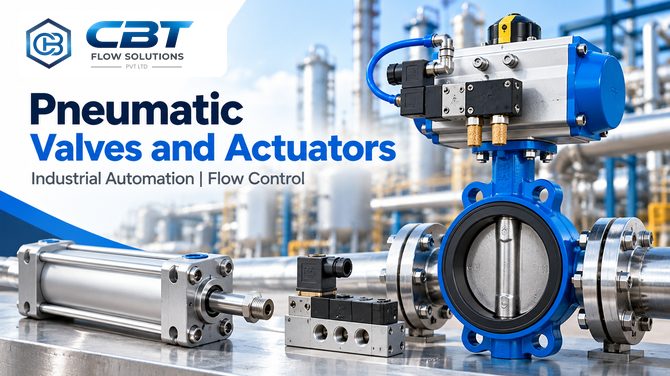
The difference is easy to understand when you look at their functions.
| Feature | Pneumatic Valve | Pneumatic Actuator |
|---|---|---|
| Main function | Controls airflow or another specified flow path | Converts compressed air into movement |
| Operating mechanism | Spool, poppet, diaphragm or another valve mechanism | Piston, rack and pinion, scotch yoke, spring or diaphragm, depending on design |
| Output | Controlled airflow or pressure path | Linear force or rotary torque |
| Common application | Directional control and pneumatic switching | Operating industrial valves or moving machine components |
| Example | 5/2-way solenoid valve | Rack and pinion actuator |
In an automated valve assembly, the solenoid valve controls the actuator’s air supply while the actuator operates the process valve.
The two components must be compatible in terms of air pressure, port arrangement, mounting and operating requirements.
Applications of Pneumatic Valves and Actuators
Pneumatic automation is used across many industries because compressed air can provide convenient mechanical movement and remote valve operation.
Oil and Gas Industry
Pneumatic actuators are used for compatible ball valves, butterfly valves and other quarter-turn valves in process and pipeline systems.
In safety-related services, the actuator must meet the required torque, fail-action and certification requirements.
Chemical and Petrochemical Plants
Pneumatic valve assemblies can operate compatible isolation valves in process pipelines and utility systems.
The valve materials, actuator design and accessories must suit the process medium, pressure, temperature and installation environment.
Water and Wastewater Treatment
Automated valves can control water distribution, treatment stages, filtration sequences and other compatible utility operations.
Actuator selection should account for valve torque, operating frequency and available compressed air.
Pharmaceutical Manufacturing
Pneumatic equipment can be used in suitable process automation, utility and auxiliary systems.
Where a valve contacts the product or a critical pharmaceutical utility, the complete valve and actuator assembly must meet the required hygienic, material and documentation requirements.
Food and Beverage Processing
Compatible pneumatic valves and actuators can support dosing, production sequences and utility control.
Material selection, cleaning compatibility and the suitability of product-contact components must be checked for the application.
General Manufacturing
Pneumatic cylinders and valves are commonly used in clamping, packaging, material handling, assembly and machine-control systems.
The required force, stroke, speed and duty cycle should guide the selection.
Benefits of Pneumatic Valve Automation
Pneumatic valves and actuators offer several advantages when correctly matched to the application.
Remote operation: Compatible actuators allow valves to be operated from a control panel or automation system.
Fast movement: Pneumatic actuators can provide rapid movement, depending on actuator size, air pressure, airflow and load.
Suitable for many industrial environments: Pneumatic systems can be useful where compressed air is readily available. Hazardous-area installations still require equipment with the appropriate certifications.
Flexible control arrangements: Solenoid valves, positioners and feedback devices can be combined with compatible actuators.
Manual intervention can be reduced: Automation can make repeated valve operations easier to manage.
These benefits depend on the system design. Air quality, suitable pressure, proper sizing and routine maintenance remain important.
How to Choose the Right Pneumatic Valve and Actuator
Before purchasing, review the following factors.
1. Identify the Valve Type
Determine whether you need to operate a ball valve, butterfly valve, plug valve, linear valve or another component.
The valve design determines whether linear movement or rotary torque is required.
2. Calculate the Required Torque or Force
Rotary actuators must supply sufficient torque throughout the valve’s operating stroke. Linear actuators must provide adequate force for the load.
Use the valve or machine manufacturer’s data rather than selecting the actuator by nominal valve size alone.
3. Check Air Pressure and Consumption
Confirm the minimum and maximum available air pressure and the required airflow.
The actuator must meet the operating demand at the lowest expected supply pressure.
4. Choose Single-Acting or Double-Acting Operation
Select a spring-return actuator when a suitable return-to-position function is required. Select double-acting operation when compressed air is needed for both movement directions.
The correct choice depends on the process and the required behaviour when air or electrical power is lost.
5. Select the Correct Solenoid Valve
Confirm whether the actuator requires a 3/2-way, 5/2-way or another compatible solenoid configuration.
Also check the mounting arrangement, coil voltage, pressure range and electrical protection.
6. Check Operating Conditions
Review temperature, humidity, vibration, corrosion and hazardous-area requirements.
The actuator body, seals, solenoid coil and accessories must be suitable for the actual installation.
7. Confirm Mounting Compatibility
Check the valve mounting interface, actuator mounting dimensions, coupling and required accessories.
For an integrated assembly, verify compatibility among all components before placing the order.
8. Consider Position Feedback
Where the control system needs to confirm valve position, include suitable limit switches, position transmitters or other specified feedback devices.
An open command alone does not prove that the valve has reached the open position.
Why Consider a Complete Automated Valve Assembly?
Buying a valve, actuator and accessories separately can create compatibility problems.
The actuator may not provide sufficient torque for the valve, the solenoid valve may have the wrong configuration, or the mounting arrangement may require modifications.
A complete automated valve assembly can simplify product selection by combining compatible components.
Depending on the application, an assembly may include:
- A ball valve or butterfly valve.
- A pneumatic actuator.
- A solenoid valve.
- A limit switch box or position indicator.
- An air filter regulator.
- Compatible mounting hardware and accessories.
CBT Flow Solutions supplies pneumatic actuators, solenoid valves and valve automation components for applicable industrial duties.
Explore the pneumatic actuator range and solenoid valve range to review available options.
Confirm the complete assembly, testing requirements, documentation and availability before finalising the specification.
Pneumatic Valves and Actuators Supplier in India
CBT Flow Solutions Pvt. Ltd. supplies industrial valves, pneumatic actuators, solenoid valves and related flow-control equipment.
Its website lists actuator products from Elomatic, Avcon and Neles, as well as Rotex solenoid valves and associated automation accessories.
Relevant product pages include:
- Pneumatic Actuators
- Solenoid Valve Range
- Linear Actuators and Pneumatic Cylinders
- Neles Easyflow Rack and Pinion Actuator
- Neles Heavy-Duty Scotch Yoke Actuator
- Pneumatic-Actuated Ball Valve
- Pneumatic-Actuated Butterfly Valve
When requesting a quotation, share the valve type, size, operating medium, pressure, temperature, required torque or force, control method and quantity.
Frequently Asked Questions
What are pneumatic valves and actuators?
Pneumatic valves control compressed-air flow, while pneumatic actuators convert compressed air into mechanical movement. They work together in many automated machines and industrial valve assemblies.
What is the difference between a pneumatic valve and a solenoid valve?
A pneumatic valve is a broad category of valve used in pneumatic systems. A solenoid valve uses an electromagnetic coil for operation and can control compressed air or another compatible medium.
Which solenoid valve is used for a pneumatic actuator?
A 3/2-way valve is commonly used with a compatible single-acting actuator, while a 5/2-way valve is commonly used with a double-acting actuator. The exact configuration depends on the actuator and control circuit.
What is the difference between single-acting and double-acting actuators?
A single-acting actuator uses compressed air for movement in one direction and a spring for the return. A double-acting actuator uses compressed air for both directions.
Which pneumatic actuator is used for ball valves and butterfly valves?
Rack and pinion actuators are commonly used for quarter-turn ball and butterfly valves. Scotch yoke actuators can be considered for applications requiring higher torque characteristics. The correct actuator must match the valve’s torque requirements.
What should I check before buying pneumatic valves and actuators?
Check the valve type, required torque or force, air pressure, solenoid configuration, voltage, mounting, environmental conditions and any required position feedback or safety certifications.
Conclusion
Pneumatic valves and actuators work together to control compressed air and convert it into useful mechanical movement.
Pneumatic valves direct airflow, while actuators operate industrial valves or move machine components. The correct combination can support reliable automation across manufacturing, water treatment, chemical processing, oil and gas, and other industrial applications.
Before selecting equipment, confirm the valve type, required torque or force, operating pressure, control arrangement, mounting compatibility and required response to air or power loss.
A properly selected assembly can simplify installation and support consistent operation throughout the system’s service life.
Need Pneumatic Valves and Actuators for Your Application?
CBT Flow Solutions Pvt. Ltd. supplies industrial pneumatic actuators, solenoid valves, automated valve assemblies and flow-control products.
Share your application, valve type, size, operating pressure, required torque and control requirements with our team to help identify a suitable configuration.
CBT Flow Solutions Pvt. Ltd.
Valves | Automation | Flow Control
Reliable Flow for a Better Tomorrow