


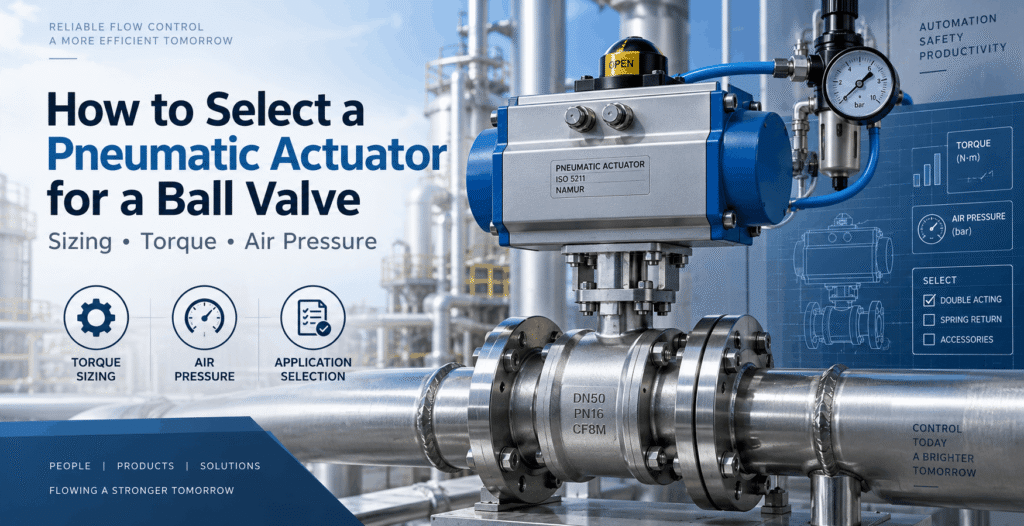
How to Select a Pneumatic Actuator for a Ball Valve
A ball valve is simple to operate by hand. Turn the handle by 90 degrees and the valve moves from open to closed.
Things become more technical when that same valve needs to operate automatically.
You now need a pneumatic actuator that can produce enough torque to move the ball valve reliably under actual operating conditions. It also needs to match the available air pressure, valve size, operating frequency, fail-safe requirement, mounting arrangement, and control system.
Choosing an actuator only because it physically fits the valve is one of the easiest ways to create problems later.
An undersized actuator may struggle to open or close the valve. An unnecessarily large actuator increases cost and can put additional mechanical stress on the valve assembly.
This guide explains how to select a pneumatic actuator for a ball valve in a practical way, including torque, air pressure, single-acting and double-acting operation, accessories, and common selection mistakes.
What Is a Pneumatic Actuator for a Ball Valve?
A pneumatic actuator uses compressed air to rotate the stem of a ball valve.
A standard ball valve normally requires a 90-degree rotation to move between fully open and fully closed positions. This makes it well suited to a quarter-turn pneumatic actuator.
Inside a typical rack-and-pinion actuator, compressed air pushes one or more pistons. The pistons move a rack, which rotates a pinion connected to the actuator output shaft.
That shaft is connected to the ball valve stem.
As the actuator rotates, the valve opens or closes.
CBT Flow Solutions offers a range of pneumatic actuators for ball valves, butterfly valves, plug valves, and other industrial valve automation applications.
The important part is not simply finding an actuator.
It is finding the right actuator for your particular ball valve and process conditions.
Why Correct Actuator Selection Matters
Imagine you have a ball valve installed on a chemical line.
The valve operates easily when the plant is stopped and there is no pressure in the pipeline.
You select an actuator based on this condition.
After commissioning, the pipeline reaches its normal operating pressure. The process fluid creates additional load on the valve seats and ball.
Suddenly, the actuator that looked powerful enough during testing struggles to move the valve.
The problem was not necessarily the actuator itself.
The actuator was selected without considering the real operating torque of the valve.
Correct actuator sizing helps ensure that the valve can:
- open reliably;
- close completely;
- provide proper shut-off;
- operate at the available air pressure;
- move at the required speed;
- return to a safe position if required;
- perform consistently over repeated cycles.
This is why actuator selection should always start with the valve and process conditions.
1. Start With the Ball Valve Type
Not every ball valve requires the same torque.
Before selecting the actuator, identify exactly what type of ball valve you are automating.
Common options include:
- 2-way ball valve;
- 3-way ball valve;
- full-port ball valve;
- reduced-port ball valve;
- floating ball valve;
- trunnion-mounted ball valve;
- soft-seated ball valve;
- metal-seated ball valve.
A small 2-way soft-seated ball valve may require relatively low torque.
A larger ball valve operating at high differential pressure may require significantly more torque.
A 3-way ball valve introduces another consideration because the valve may need to switch between different flow paths.
For example, CBT India’s 2330F/2331F pneumatic actuated ball valve is a 3/2-way full-port metal-body ball valve available in L-port and T-port arrangements.
So the first question should not be:
“Which actuator size do I need?”
It should be:
“Which valve am I trying to operate?”
2. Know the Valve Operating Torque
Torque is one of the most important numbers in actuator selection.
Torque tells you how much turning force is required to rotate the valve stem.
It is usually expressed in Newton metres, or Nm.
Ball-valve torque can be affected by several factors, including:
- valve size;
- valve design;
- seat material;
- pipeline pressure;
- differential pressure;
- process temperature;
- fluid characteristics;
- stem packing;
- frequency of operation;
- length of time the valve remains in one position.
Do not estimate valve torque only from pipe size.
Two ball valves with the same nominal size may have different torque requirements because their construction and operating conditions are different.
Whenever possible, obtain the required torque from the valve manufacturer or valve datasheet.
Breakaway Torque Is Important
A valve often requires its highest torque when it first starts moving from the closed or open position.
This is commonly called breakaway torque.
After the ball begins moving, the required running torque may reduce.
The actuator therefore needs enough output torque not only to keep the valve moving but also to overcome the initial resistance.
This is particularly important for valves that remain in the same position for long periods.
3. Add a Suitable Torque Margin
Selecting an actuator whose rated torque exactly equals the valve torque leaves very little room for changing operating conditions.
A practical selection should include a suitable safety or service margin.
As a starting point, the actuator output at the minimum available air pressure should be higher than the maximum valve torque. The exact margin should be selected according to the valve manufacturer’s data, actuator manufacturer recommendations, and the process conditions.
For many normal applications, a margin around 25 to 30 percent may be considered.
For example:
If the maximum required valve torque is:
100 Nm
A 25 percent margin would give:
100 × 1.25 = 125 Nm
You would then select an actuator that can provide at least the required output torque under the actual minimum air pressure available at the installation.
Do not automatically select the actuator using its torque at the highest possible air pressure.
That can create a false sense of security.
4. Check the Available Air Pressure
A pneumatic actuator cannot produce its rated performance without the correct air supply.
Actuator torque changes with air pressure.
If your actuator selection is based on 6 bar air pressure but the plant regularly drops to 4.5 bar, the real torque available at the valve will be lower than expected.
Always determine:
- normal air pressure;
- minimum available air pressure;
- maximum available air pressure;
- air quality;
- possibility of pressure fluctuations.
The actuator should be sized against the minimum dependable air pressure, not simply the normal pressure shown on the compressor gauge.
Clean and regulated compressed air is also important for reliable operation.
An air filter regulator can help maintain suitable pressure and remove unwanted contamination before air reaches the actuator.
5. Choose Between Single-Acting and Double-Acting Actuators
This is one of the most important decisions when choosing a pneumatic actuator for a ball valve.
Double-Acting Pneumatic Actuator
A double-acting actuator uses compressed air for both movements.
Air drives the actuator to open the valve.
Air is then supplied in the opposite direction to close it.
This arrangement is straightforward and efficient where a specific fail-safe movement is not required.
Double-acting actuators are commonly considered when:
- compressed air is continuously available;
- higher torque efficiency is desired;
- the valve does not need to automatically open or close after loss of air;
- normal ON/OFF automation is required.
Single-Acting or Spring-Return Actuator
A single-acting actuator uses compressed air for one direction and springs for the return direction.
If the air supply is lost, the springs move the actuator toward its predefined position.
This can create a fail-safe action.
Depending on the application, the valve can be configured as:
Fail Closed: Loss of air causes the valve to close.
Fail Open: Loss of air causes the valve to open.
Spring-return actuators are often considered where the process requires the valve to move to a safe position during utility failure.
CBT’s 2360F/2361F direct-mount ball valve with pneumatic actuator supports both double-acting and spring-return actuator configurations, depending on the application.
6. Decide the Required Fail Position
Do not choose fail-open or fail-close simply because one arrangement is more common.
Ask what should happen to the process if the plant loses compressed air or control power.
Imagine two different pipelines.
Application A: Fuel Supply
If the system fails, continuing fuel flow could create a safety risk.
The process may require the valve to move to the closed position.
A fail-closed arrangement may therefore be appropriate.
Application B: Cooling Water
Another process may require cooling water to continue flowing during a control failure.
In that case, fail-open may be preferred.
The correct fail position depends on the process hazard analysis and operating philosophy.
This decision should be made before final actuator sizing because spring-return actuator torque behaves differently from double-acting actuator torque.
7. Match the Actuator to the Valve Mounting
Mechanical compatibility matters just as much as torque.
The actuator must connect correctly to the ball valve.
Check:
- actuator mounting interface;
- valve mounting flange;
- stem dimensions;
- stem shape;
- coupling size;
- bracket dimensions;
- rotation direction;
- required travel.
Many industrial quarter-turn valve and actuator combinations use standardized mounting arrangements, but compatibility should still be confirmed before purchasing.
A correctly selected mounting kit keeps the actuator properly aligned with the valve stem.
Poor alignment can create unnecessary side loads, wear, and operating problems.
For applications where a compact assembly is preferred, a direct-mount design can reduce the number of intermediate components.
CBT’s 2360F/2361F is an example of a 2-way direct-mount metal ball valve supplied with a pneumatic actuator.
8. Check Ball Valve Size and Design
Valve size has a major effect on actuator selection, but size alone is not enough.
As ball-valve size increases, the required operating torque generally increases as well.
However, you should also consider:
- full-port or reduced-port design;
- 2-piece or 3-piece construction;
- floating or trunnion design;
- seat material;
- line pressure;
- temperature;
- process media.
For applications requiring a 3-piece full-port design, CBT offers the 2370F pneumatic actuated ball valve.
For larger 2-piece full-port applications, the 2390F pneumatic rotary actuated ball valve provides another configuration that can be evaluated according to the project’s pressure, size, body material, and automation requirements.
The correct product should always be matched to the actual process rather than selected from size alone.
9. Consider the Process Media
The actuator operates using compressed air, but the ball valve itself controls the process media.
That media may be:
- air;
- water;
- oil;
- gas;
- steam;
- chemicals;
- process fluids.
The valve body, ball, stem, seat, and seals must all be compatible with the fluid.
This is particularly important with corrosive chemicals, aggressive fluids, and high-temperature applications.
A correctly sized actuator cannot compensate for a wrongly selected valve material.
Before choosing the complete assembly, confirm:
Media + Pressure + Temperature + Valve Material + Seat Material + Required Torque
These conditions should be evaluated together.
10. Decide How Fast the Valve Needs to Operate
Pneumatic actuators are known for fast operation, but faster is not always better.
A valve that closes too quickly can sometimes create pressure surges in a piping system.
A valve that operates too slowly may not meet an emergency shutdown or production requirement.
Ask:
- How quickly should the valve open?
- How quickly should it close?
- Is adjustable stroking speed required?
- Could rapid closing cause water hammer?
- Is this an emergency shutdown application?
Flow-control accessories may be used in some pneumatic systems to control actuator speed.
The required opening and closing time should therefore be treated as part of actuator selection.
11. Select the Correct Solenoid Valve
A pneumatic actuator usually needs a control valve to direct compressed air.
A solenoid valve receives an electrical signal from the control system and changes the air path to the actuator.
The correct solenoid configuration depends on the actuator arrangement.
A single-acting actuator commonly uses a 3/2 pneumatic control arrangement.
A double-acting actuator commonly uses a 5/2 arrangement.
NAMUR solenoid valves can be particularly useful because compatible units can mount directly onto the actuator.
When selecting a solenoid valve, check:
- actuator type;
- supply pressure;
- required flow;
- coil voltage;
- electrical protection;
- environmental conditions;
- manual override requirement;
- hazardous-area requirements, where applicable.
The solenoid valve should be selected as part of the actuator package rather than as an afterthought.
12. Decide Whether Position Feedback Is Required
Opening or closing the valve is only one part of automation.
The control system may also need confirmation that the valve actually reached its final position.
A limit switch box can provide this feedback.
For example:
- PLC sends a close command.
- Solenoid valve changes the air path.
- Pneumatic actuator rotates.
- Ball valve closes.
- Limit switch confirms the closed position.
- PLC receives the feedback.
Without position feedback, the control system may know that it sent a command but not whether the valve completed the movement.
Position feedback can be important in interlocks, batch processes, remote operation, and safety sequences.
13. ON/OFF or Modulating Control?
Most pneumatically actuated ball valves are used for ON/OFF service.
The valve is either fully open or fully closed.
But some applications require intermediate positioning.
For example, the process may require the valve to stay:
- 25 percent open;
- 50 percent open;
- 70 percent open.
In such cases, a valve positioner and suitable control arrangement may be required.
Before selecting the actuator package, clearly define whether the application is:
ON/OFF control
or
Modulating control
Do not add a positioner when simple ON/OFF operation is all that is required.
At the same time, do not specify a basic ON/OFF package for a process that needs accurate intermediate positioning.
14. Consider Operating Frequency
How many times will the ball valve operate?
Once a week?
Ten times a day?
Hundreds of times during every production shift?
Operating frequency affects actuator selection and the complete valve assembly.
A frequently cycling valve should be selected with consideration for:
- actuator life;
- valve seat wear;
- stem seals;
- solenoid valve cycle life;
- air consumption;
- maintenance accessibility.
A valve used for emergency isolation may remain in the same position for months.
A ball valve used in a filling line may cycle thousands of times.
Both are automated ball valves, but their operating requirements are very different.
15. Check Environmental Conditions
The environment around the actuator also matters.
Consider whether the assembly will be installed:
- indoors;
- outdoors;
- near corrosive chemicals;
- in a dusty environment;
- in a humid area;
- in a washdown area;
- in a hazardous zone;
- at high or low ambient temperature.
The actuator body, solenoid valve, limit switch box, electrical enclosure, tubing, fittings, and other accessories should suit these conditions.
Do not evaluate only the process inside the pipe.
The environment outside the pipe matters too.
Rack and Pinion or Scotch Yoke for a Ball Valve?
Both designs can operate quarter-turn valves, but their torque characteristics are different.
Rack and Pinion Actuator
Rack-and-pinion actuators provide relatively uniform torque through the stroke.
They are compact and widely used for small and medium ball valves.
They are often a practical choice for general valve automation.
Scotch Yoke Actuator
Scotch-yoke actuators produce a different torque curve, with higher torque available near the beginning and end of the stroke.
This can be useful for larger valves and applications with high breakaway or seating torque.
CBT’s pneumatic actuator range includes both rack-and-pinion and scotch-yoke solutions for different valve automation requirements.
The correct design depends on the ball-valve torque profile, size, process conditions, and required safety margin.
Pneumatic Actuator Selection Example
Consider a simple example.
You have a 2-way ball valve.
The valve manufacturer gives a maximum required torque of:
80 Nm
The plant’s dependable minimum air supply is:
5 bar
You decide to use a 25 percent torque margin.
Required actuator output becomes:
80 × 1.25 = 100 Nm
You should now select an actuator that can provide at least the required torque at the actual 5 bar supply condition.
Next, you check the process requirement.
The valve must automatically close if air supply fails.
This means a spring-return fail-close arrangement is required.
You then verify:
- spring-return torque throughout the stroke;
- valve mounting compatibility;
- solenoid valve configuration;
- position feedback;
- required operating time;
- air quality;
- environmental requirements.
Only after these checks should the actuator model be finalized.
This is much safer than simply saying:
“It is a 2-inch valve, so use actuator model X.”
Quick Pneumatic Actuator Selection Checklist
Before ordering a pneumatic actuator for a ball valve, collect the following information:
| Selection Parameter | Information Required |
|---|---|
| Valve type | 2-way, 3-way, floating, trunnion, etc. |
| Valve size | DN / inch size |
| Valve torque | Breakaway and maximum operating torque |
| Process media | Air, water, oil, gas, chemical, etc. |
| Line pressure | Normal and maximum pressure |
| Temperature | Process and ambient temperature |
| Air pressure | Minimum and maximum available air pressure |
| Actuator type | Single acting or double acting |
| Fail position | Fail open, fail closed, or stay put |
| Control | ON/OFF or modulating |
| Operating speed | Required opening and closing time |
| Mounting | Valve/actuator mounting compatibility |
| Solenoid voltage | Based on control system |
| Feedback | Limit switch / position indication |
| Environment | Indoor, outdoor, corrosive, hazardous, etc. |
Having these details before asking for a quotation can make actuator selection much faster and more accurate.
Common Mistakes When Selecting a Pneumatic Actuator for a Ball Valve
Selecting by Valve Size Alone
A 2-inch valve does not automatically require one fixed actuator size.
Torque depends on much more than nominal diameter.
Ignoring Minimum Air Pressure
Sizing at 6 bar when the plant sometimes drops to 4 bar can lead to unreliable operation.
Use the minimum dependable pressure for sizing.
No Torque Margin
Selecting an actuator exactly equal to the calculated valve torque leaves little room for real operating variations.
Wrong Fail-Safe Arrangement
A fail-open actuator where the process requires fail-close can create a serious process-control problem.
Ignoring Accessories
Solenoid valves, limit switches, AFR units, positioners, fittings, brackets, and couplings are part of the automation package.
They should be considered during selection, not after installation.
Ignoring Process Media
The actuator may be correctly sized while the ball valve materials are unsuitable for the process fluid.
Always treat the valve and actuator as one system.
Selecting Too Large an Actuator
Bigger is not automatically better.
Oversizing increases cost and may place unnecessary mechanical load on the valve stem and mounting arrangement.
Complete Pneumatic Ball Valve Automation Package
For many industrial applications, buying individual components separately is not the most efficient approach.
A complete automated ball-valve package can include:
Ball Valve + Pneumatic Actuator + Solenoid Valve + Limit Switch + Air Filter Regulator + Mounting Accessories
This approach makes it easier to check compatibility between all components.
CBT Flow Solutions supplies pneumatic actuators as well as complete pneumatically actuated ball-valve configurations.
Depending on the application, relevant options include:
- 2360F/2361F 2-Way Direct Mount Metal Ball Valve with Pneumatic Actuator
- 2370F 2-Way Full-Port 3-Piece Ball Valve with Pneumatic Rotary Actuator
- 2390F 2-Way Full-Port Ball Valve with Pneumatic Rotary Actuator
- 2330F/2331F 3/2-Way Full-Port Ball Valve with Pneumatic Actuator
The best configuration depends on the valve size, media, pressure, temperature, required torque, air supply, actuation type, and control requirement.
Final Thoughts
Selecting a pneumatic actuator for a ball valve starts with understanding the valve, not the actuator catalogue.
First identify the exact ball valve.
Find its maximum operating torque.
Check the minimum available air pressure.
Add an appropriate torque margin.
Then decide whether the system requires a double-acting or spring-return actuator.
After that, confirm the fail position, mounting arrangement, operating speed, solenoid valve, position feedback, environment, and control requirements.
A simple selection sequence is:
Valve → Torque → Air Pressure → Safety Margin → Actuator Type → Fail Position → Controls → Accessories
Following this order helps avoid one of the most common automation problems: an actuator that fits the valve physically but does not operate it reliably in the real process.
If the application requires a complete automated assembly, select the ball valve, actuator, and control accessories as one system. This makes it easier to ensure that torque, mounting, solenoid configuration, and feedback devices are properly matched.
Frequently Asked Questions
How do I choose a pneumatic actuator for a ball valve?
Start with the ball valve’s maximum required torque, valve size, process pressure, and operating conditions. Check the minimum available air pressure and select an actuator that provides sufficient torque with an appropriate safety margin. Then decide whether you need single-acting or double-acting operation, fail-open or fail-close behaviour, and any required accessories.
How much actuator torque should I select for a ball valve?
The actuator output should exceed the maximum required valve torque at the minimum available air pressure. A suitable service margin should also be included. The exact margin depends on the valve, actuator manufacturer, media, pressure, temperature, and process conditions.
What is the difference between a single-acting and double-acting actuator?
A double-acting actuator uses compressed air to move in both directions. A single-acting or spring-return actuator uses air in one direction and springs for the return movement. Spring-return designs are commonly used when a fail-open or fail-close action is required.
What air pressure is required for a pneumatic ball valve actuator?
The required air pressure depends on the actuator model. Always check the manufacturer’s specified operating range and size the actuator using the minimum reliable air pressure available at the plant.
Can I use a pneumatic actuator on any ball valve?
Not automatically. The valve needs a suitable mounting arrangement, stem connection, torque requirement, and quarter-turn operation compatible with the actuator. The valve and actuator should be checked as a complete assembly.
Do I need a solenoid valve with a pneumatic actuator?
For electrically controlled pneumatic automation, a solenoid valve is commonly used to direct compressed air to the actuator. The required solenoid configuration depends on whether the actuator is single acting or double acting.
What is the best actuator for a ball valve?
There is no single actuator that is best for every ball valve. Rack-and-pinion actuators are commonly used for general quarter-turn ball-valve automation, while scotch-yoke designs can be useful where higher breakaway and seating torque are required. Final selection should be based on actual valve torque and process conditions.
Should a ball valve actuator be oversized?
The actuator should include an appropriate torque margin, but excessive oversizing is not automatically beneficial. An unnecessarily large actuator costs more and may place additional mechanical load on the valve and mounting components. Correct sizing is better than simply choosing the largest actuator available.