


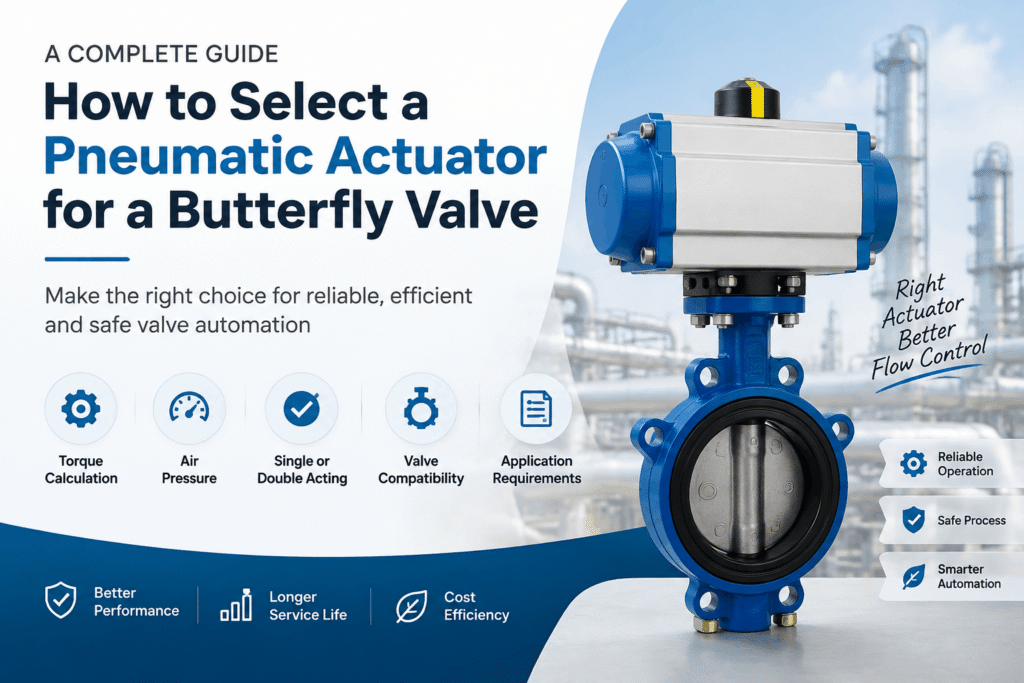
How to Select a Pneumatic Actuator for a Butterfly Valve
A butterfly valve is easy to operate manually when the valve is small and used only occasionally. But in an industrial plant, many butterfly valves need to open and close automatically, sometimes hundreds of times a day.
This is where a pneumatic actuator becomes useful.
A pneumatic actuator uses compressed air to rotate the butterfly valve disc between the open and closed positions. The basic idea is simple, but selecting the right actuator requires more than matching the actuator to the valve size.
The actuator must produce enough torque, work at the available air pressure, match the valve mounting, provide the required fail-safe action, and operate reliably under the actual process conditions.
Choosing an actuator that is too small may prevent the valve from opening or closing completely. Choosing one that is much larger than required can increase cost and place unnecessary load on the valve stem and mounting components.
This guide explains how to select a pneumatic actuator for a butterfly valve step by step.
What Is a Pneumatic Actuator for a Butterfly Valve?
A pneumatic actuator converts compressed air into rotary movement.
Most butterfly valves are quarter-turn valves. The disc rotates approximately 90 degrees from fully closed to fully open.
This makes butterfly valves suitable for rotary pneumatic actuators.
Compressed air enters the actuator and moves an internal piston or mechanical mechanism. The actuator output shaft rotates, and this rotation is transferred to the butterfly valve stem.
The disc inside the valve then opens or closes.
CBT Flow Solutions supplies pneumatic actuators for butterfly valves, ball valves, plug valves, and other industrial valve automation applications.
The actuator, however, should always be selected according to the specific butterfly valve and operating conditions.
Why Correct Actuator Selection Matters
A butterfly valve may work perfectly when someone operates it manually without process pressure.
The situation can change once the valve is installed in a working pipeline.
Pressure against the disc, seat friction, temperature, valve design, and process fluid can all increase the torque required to operate the valve.
If the pneumatic actuator cannot produce enough torque, you may see problems such as:
- valve not opening completely;
- valve stopping before reaching the closed position;
- unreliable shut-off;
- slow or inconsistent movement;
- excessive actuator cycling;
- increased maintenance;
- process interruptions.
Correct sizing helps the butterfly valve operate properly under real plant conditions, not just during workshop testing.
1. Identify the Butterfly Valve Type
The first step is understanding which butterfly valve you are automating.
Different butterfly valve designs can have very different torque requirements.
Common types include:
- concentric butterfly valves;
- resilient seated butterfly valves;
- double-offset butterfly valves;
- triple-offset butterfly valves;
- metal-seated butterfly valves;
- wafer-type butterfly valves;
- lug-type butterfly valves;
- flanged butterfly valves.
A small resilient-seated butterfly valve may require relatively low operating torque.
A large double-offset or metal-seated valve can require much higher torque.
For example, CBT India offers remote operated butterfly valve systems that can be configured with resilient-seat, double-offset, and triple-offset butterfly valves along with Elomatic actuators and automation accessories.
So before selecting the actuator, identify the exact butterfly valve construction.
2. Find the Butterfly Valve Torque Requirement
Torque is the turning force required to rotate the valve stem.
It is normally expressed in Newton metres or Nm.
This is one of the most important values in pneumatic actuator sizing.
Butterfly valve torque depends on several factors:
- valve size;
- valve design;
- seat material;
- process pressure;
- differential pressure;
- temperature;
- fluid characteristics;
- stem seal friction;
- frequency of operation.
Do not choose an actuator only because the butterfly valve is 4-inch, 6-inch, or 8-inch.
Two butterfly valves of the same nominal size can require different torque.
Whenever possible, use the valve manufacturer’s torque data.
Understand Breakaway Torque
The highest torque requirement often occurs when the butterfly valve first starts moving.
This is known as breakaway torque.
The valve disc may remain pressed against the seat for a long time. When movement begins, the actuator must overcome this initial resistance.
After the disc starts moving, the running torque may become lower.
The actuator must therefore be capable of handling the maximum torque required at any point in the valve stroke.
This is especially important for valves that remain closed or open for long periods before being operated.
3. Add a Suitable Safety Margin
Selecting an actuator that produces exactly the same torque as the butterfly valve requires is usually not a good idea.
Real operating conditions change.
Air pressure can drop.
Valve seats can become tighter.
Deposits can form.
Temperature can change.
The valve may also require more torque after being in service for some time.
A reasonable safety margin should therefore be included.
For many normal industrial applications, an actuator torque margin of approximately 25 to 30 percent above the required valve torque may be considered, depending on the valve manufacturer’s data and application conditions.
For example:
Valve maximum torque = 120 Nm
With a 25 percent margin:
120 × 1.25 = 150 Nm
The selected actuator should therefore be capable of providing at least the required torque at the minimum available air pressure.
Do not use only the actuator’s highest torque rating shown at maximum air pressure.
4. Check the Available Air Pressure
Pneumatic actuator torque depends heavily on air pressure.
An actuator may provide sufficient torque at 6 bar but may not provide enough torque at 4 bar.
This means you should know the actual plant air conditions before making the selection.
Check:
- normal air pressure;
- minimum air pressure;
- maximum air pressure;
- pressure fluctuations;
- air quality.
CBT’s pneumatic actuator range is designed for industrial compressed-air systems, with selection depending on the required torque and available supply pressure.
Always size the actuator at the lowest dependable air pressure available at the installation.
If the plant normally operates between 5 and 6 bar but occasionally drops to 4.5 bar, actuator selection should consider the 4.5 bar condition.
5. Choose Single Acting or Double Acting
Pneumatic actuators are commonly available in two configurations.
Double-Acting Pneumatic Actuator
A double-acting actuator uses compressed air to move the butterfly valve in both directions.
Air is supplied to one side of the actuator to open the valve.
Air is then supplied to the opposite side to close it.
Double-acting actuators are commonly used when:
- compressed air is reliably available;
- fail-safe movement is not required;
- efficient torque output is important;
- standard ON/OFF control is needed.
Single-Acting or Spring-Return Actuator
A spring-return actuator uses compressed air for movement in one direction and internal springs for the return movement.
When air pressure is lost, the springs automatically move the actuator toward its predetermined safe position.
This makes spring-return actuators useful where the process requires fail-safe operation.
The valve may be configured as:
Fail Closed: The valve closes when air pressure is lost.
Fail Open: The valve opens when air pressure is lost.
The correct choice depends entirely on what is safest for the process.
6. Decide the Fail-Safe Position
This decision should be made before final actuator sizing.
Ask one simple question:
What should happen to the butterfly valve if compressed air is lost?
Consider two examples.
Chemical Feed Line
If chemical flow continues during a system failure, the process may become unsafe.
A fail-closed valve may therefore be required.
Cooling Water Line
A different process may require cooling water to continue flowing even during a control failure.
In that situation, fail-open may be preferred.
There is no universal correct fail position.
It depends on the process.
Spring-return actuator sizing also needs careful attention because spring torque and air torque change through the stroke.
7. Check Rack and Pinion vs Scotch Yoke
Two common actuator designs used for butterfly valve automation are rack-and-pinion and scotch-yoke actuators.
Rack-and-Pinion Actuator
Rack-and-pinion actuators provide relatively uniform torque throughout the 90-degree stroke.
They are compact and widely used for general industrial butterfly valve automation.
They are often suitable for:
- small and medium butterfly valves;
- general process isolation;
- water systems;
- utility systems;
- HVAC;
- frequent ON/OFF operation.
Scotch-Yoke Actuator
A scotch-yoke actuator has a different torque characteristic.
It can provide higher torque near the beginning and end of the stroke, where many valves have higher breakaway and seating torque requirements.
This makes scotch-yoke actuators useful for larger or higher-torque butterfly valves.
CBT India’s pneumatic actuator range includes rack-and-pinion and scotch-yoke actuator options for different industrial valve requirements.
The best design should be selected according to the actual valve torque curve rather than actuator size alone.
8. Match the Actuator to the Butterfly Valve Mounting
The actuator must also physically connect to the butterfly valve correctly.
Check:
- valve stem dimensions;
- actuator output drive;
- mounting flange;
- bolt pattern;
- coupling dimensions;
- required bracket;
- rotation direction;
- 90-degree travel.
Many modern industrial valve assemblies follow ISO mounting standards, but compatibility should still be confirmed.
A badly aligned actuator can create side loads on the valve stem and lead to premature wear.
The actuator should sit correctly above the valve and transfer torque directly to the valve stem.
9. Consider Valve Size
Valve size is still an important factor, even though it should not be used alone.
As butterfly valve diameter increases, the forces acting on the valve disc usually increase.
A larger valve can therefore require considerably more torque.
For example, a DN50 butterfly valve may use a relatively small actuator.
A DN300 or DN600 butterfly valve may require a much larger actuator, depending on design, pressure, and seat type.
CBT’s BFV-4029A butterfly valve covers sizes from 50 mm to 600 mm and can be supplied with a quarter-turn pneumatic actuator.
This illustrates why the actuator must be matched to both valve size and actual operating conditions.
10. Check Process Pressure and Differential Pressure
Pipeline pressure can have a direct effect on butterfly valve torque.
The actuator must overcome the forces created by the fluid acting on the disc.
Differential pressure is particularly important.
A valve closing against a significant pressure difference may need more torque than the same valve operating under low differential pressure.
Before selecting the actuator, confirm:
- normal line pressure;
- maximum pressure;
- differential pressure;
- expected pressure during opening;
- expected pressure during closing.
Do not size an actuator based only on the pressure rating stamped on the valve body.
Use actual operating conditions.
11. Consider the Process Media
The type of fluid flowing through the butterfly valve can also affect selection.
Common media include:
- water;
- air;
- oil;
- gas;
- chemicals;
- low-pressure steam;
- process fluids.
The butterfly valve body, disc, shaft, seat, and seals must be suitable for the media.
For example, CBT’s BFV-4029A is designed for applications involving air, water, oil, gas, certain chemicals, and low-pressure steam, depending on the exact process conditions.
A correctly sized actuator cannot solve a material compatibility problem.
Always evaluate the valve and actuator as one complete package.
12. Check Process and Ambient Temperature
Temperature affects both the valve and actuator system.
High process temperature can influence:
- valve seat material;
- stem packing;
- required torque;
- seal life;
- actuator mounting;
- accessory selection.
Ambient temperature also matters for the pneumatic actuator, solenoid valve, limit switches, and other components.
A valve installed indoors in a clean utility area has very different environmental conditions from one installed outdoors near a hot process unit.
Temperature should therefore be confirmed before final selection.
13. Select the Correct Solenoid Valve
A pneumatic actuator usually needs a solenoid valve for electrical control.
The solenoid valve receives an electrical signal from the PLC or control system and directs compressed air to the actuator.
For a spring-return actuator, a 3/2 configuration is commonly used.
For a double-acting actuator, a 5/2 arrangement is commonly used.
NAMUR-mounted solenoid valves can simplify butterfly valve automation because compatible units can be mounted directly on the actuator.
When selecting the solenoid valve, check:
- single or double acting actuator;
- supply pressure;
- required air flow;
- coil voltage;
- electrical enclosure;
- manual override;
- hazardous-area requirements.
The solenoid should be selected at the same time as the actuator.
14. Decide Whether You Need Position Feedback
A control system may need to know whether the butterfly valve actually opened or closed.
A command alone does not confirm valve movement.
This is where a limit switch or position feedback device becomes useful.
The sequence may look like this:
- PLC sends the open command.
- Solenoid valve changes the air path.
- Pneumatic actuator rotates.
- Butterfly valve opens.
- Limit switch confirms the open position.
- PLC receives the feedback.
Position feedback is particularly useful in:
- remote valve operation;
- sequencing systems;
- interlocks;
- process automation;
- shutdown systems.
CBT’s remote operated butterfly valve systems can be supplied with control accessories such as solenoid valves, positioners, limit switch modules, position transmitters, and air filter regulators.
15. ON/OFF or Control Application?
Not every automated butterfly valve performs the same job.
ON/OFF Application
The valve normally has only two required positions:
Fully open.
Fully closed.
This is common in isolation services.
Modulating or Control Application
Some processes need the butterfly valve to remain partly open.
For example:
20% open.
40% open.
70% open.
The valve may be controlling flow, pressure, temperature, or another process condition.
A positioner is generally required for this type of control.
Before ordering, clearly define whether the application requires simple ON/OFF automation or modulating control.
This can affect the actuator and accessory package.
16. Check Required Operating Speed
Pneumatic actuators can operate quickly.
But the fastest valve movement is not always the best.
A butterfly valve closing too quickly in a water line can contribute to pressure surges or water hammer.
In other applications, fast movement may be essential.
Emergency isolation is one example.
Ask:
- How fast should the valve open?
- How fast should it close?
- Is emergency closure required?
- Does the process require controlled movement?
- Could fast closing create a pressure surge?
Flow-control accessories can sometimes be used to adjust actuator operating speed.
17. Consider the Installation Environment
The area around the butterfly valve also affects equipment selection.
Consider whether the actuator will be installed:
- indoors;
- outdoors;
- in high humidity;
- near chemicals;
- in dusty conditions;
- in washdown areas;
- in corrosive environments;
- in hazardous areas.
The actuator, solenoid valve, positioner, limit switches, tubing, and fittings should all match the environmental requirements.
Do not select the actuator separately from the accessories.
Pneumatic Actuator Selection Example for a Butterfly Valve
Consider a butterfly valve with the following requirement:
Valve maximum torque: 200 Nm
Minimum reliable air pressure: 5 bar
Required torque margin: 25%
The required actuator torque becomes:
200 × 1.25 = 250 Nm
The actuator selected should therefore produce at least the required 250 Nm under the actual 5 bar supply condition.
Now suppose the process requires the valve to close automatically if air pressure is lost.
The selection now needs:
- spring-return actuator;
- fail-closed configuration;
- adequate spring-end torque;
- correct 90-degree rotation;
- compatible mounting;
- suitable solenoid valve;
- limit switch feedback.
The actuator model should only be finalized after all of these conditions have been checked.
This is much safer than selecting an actuator simply because the valve is a particular pipe size.
Quick Pneumatic Actuator Selection Checklist
| Parameter | Information Required |
|---|---|
| Butterfly valve type | Concentric, double offset, triple offset, etc. |
| Valve size | DN / inch |
| Required torque | Breakaway and maximum torque |
| Process media | Water, air, gas, chemical, oil, etc. |
| Line pressure | Normal and maximum |
| Differential pressure | Maximum across valve |
| Temperature | Process and ambient |
| Air supply | Minimum and maximum bar |
| Actuator design | Rack and pinion or scotch yoke |
| Action | Single acting or double acting |
| Fail position | Fail open or fail closed |
| Control | ON/OFF or modulating |
| Operating speed | Required opening and closing time |
| Mounting | Valve and actuator compatibility |
| Solenoid | Correct port configuration and voltage |
| Feedback | Limit switch or transmitter |
| Environment | Indoor, outdoor, corrosive, hazardous |
Providing these details before requesting an actuator helps avoid incorrect sizing and speeds up product selection.
Common Mistakes to Avoid
Selecting the Actuator Only by Valve Size
Valve size is important, but torque is the main sizing requirement.
Using Normal Air Pressure Instead of Minimum Pressure
If your system normally operates at 6 bar but sometimes drops to 4.5 bar, calculate actuator performance at 4.5 bar.
Not Adding a Torque Margin
An actuator that exactly matches the theoretical valve torque may become unreliable as operating conditions change.
Ignoring Breakaway Torque
The initial movement can require more torque than the middle of the valve stroke.
Choosing the Wrong Fail Position
Fail-open and fail-close should be based on process safety, not convenience.
Ignoring Valve Design
A resilient-seated butterfly valve and a high-performance double-offset valve may require very different actuator sizing.
Treating Accessories as Separate Items
The solenoid valve, limit switch, positioner, AFR, coupling, and mounting bracket are all part of the complete automation package.
Complete Butterfly Valve Automation Package
For many applications, the easiest approach is to treat the valve and actuator as one complete engineered assembly.
A typical pneumatic butterfly valve automation package may include:
Butterfly Valve + Pneumatic Actuator + Solenoid Valve + Limit Switch + Air Filter Regulator + Mounting Accessories
For modulating applications, a positioner may also be included.
CBT Flow Solutions offers remote operated butterfly valve systems with resilient-seat, double-offset, or triple-offset designs coupled with Elomatic actuators and control accessories.
For applications requiring a metal-seated butterfly valve, the BFV-4029A can also be considered according to the required valve size, media, operating temperature, pressure, and automation requirements.
Selecting the valve, actuator, and accessories together reduces the risk of torque mismatch, mounting problems, and incompatible control components.
Final Thoughts
Selecting a pneumatic actuator for a butterfly valve should start with the butterfly valve itself.
Identify the exact valve type.
Find its maximum torque requirement.
Check the minimum available air pressure.
Add a suitable torque margin.
Then decide whether the actuator should be double acting or spring return.
After that, confirm:
- fail-safe position;
- rack-and-pinion or scotch-yoke design;
- mounting compatibility;
- valve size;
- line pressure;
- process media;
- temperature;
- operating speed;
- solenoid valve;
- position feedback;
- environment.
A practical selection sequence is:
Butterfly Valve → Torque → Minimum Air Pressure → Torque Margin → Actuator Type → Fail Position → Controls → Accessories
Following this process gives a much more reliable result than selecting an actuator only by valve size.
For industrial applications, CBT Flow Solutions supplies pneumatic actuators as well as complete automated butterfly valve assemblies with actuators and control accessories.
Frequently Asked Questions
How do I select a pneumatic actuator for a butterfly valve?
Start with the butterfly valve’s required operating torque, size, design, pressure, and process conditions. Check the minimum available compressed-air pressure and select an actuator that provides adequate torque with a suitable safety margin. Then confirm fail position, mounting, controls, and accessories.
How much actuator torque should I use for a butterfly valve?
The actuator output torque should exceed the butterfly valve’s maximum required torque at the minimum available air pressure. A suitable safety margin, often around 25 to 30 percent for normal applications, may be considered based on manufacturer recommendations and process conditions.
Is rack and pinion suitable for a butterfly valve?
Yes. Rack-and-pinion pneumatic actuators are widely used with quarter-turn butterfly valves, especially for small and medium sizes. Larger or higher-torque applications may benefit from a scotch-yoke design.
What is the difference between single-acting and double-acting actuators?
A double-acting actuator uses compressed air for both opening and closing. A single-acting or spring-return actuator uses compressed air in one direction and springs in the opposite direction, allowing a predefined fail-safe position.
Should a butterfly valve fail open or fail closed?
It depends on the process. A valve controlling hazardous fluid may need to fail closed, while a cooling-water valve may need to fail open. The fail position should be based on process safety requirements.
What air pressure is required for a pneumatic butterfly valve actuator?
The required pressure depends on the actuator design and torque requirement. Actuator sizing should always be based on the minimum dependable compressed-air pressure available at the installation.
Can pneumatic actuators be used for modulating butterfly valves?
Yes. A suitable pneumatic actuator combined with a valve positioner can be used for modulating control where the butterfly valve must remain at intermediate positions instead of only fully open or fully closed.
What accessories are required for an automated butterfly valve?
Depending on the application, accessories may include a solenoid valve, limit switch box, valve positioner, air filter regulator, position transmitter, proximity switch, manual override, and mounting accessories.