


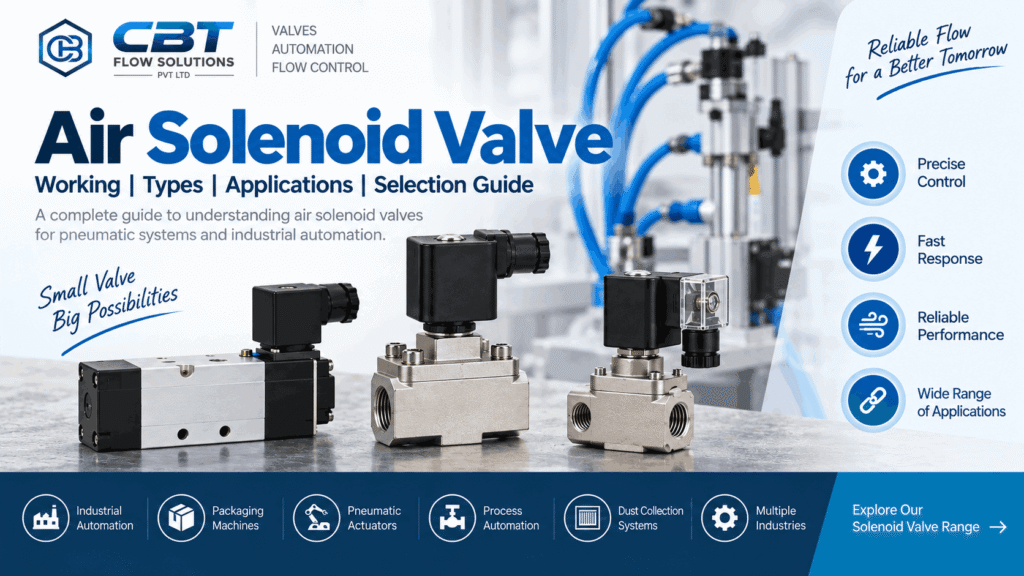
Air Solenoid Valve: Working, Types, Applications and Selection Guide
When an industrial machine needs to control compressed air automatically, a manual valve is often not enough. The system needs a valve that can respond to an electrical signal and control air flow quickly and repeatedly. This is where an air solenoid valve becomes useful.
An air solenoid valve is an electrically controlled valve used to start, stop or direct compressed air in pneumatic systems. It combines an electrical control signal with mechanical valve operation, making it possible to control pneumatic cylinders, actuators, automation equipment and other air-operated machinery.
In simple terms, an electrical signal tells the valve what to do, and the valve controls the movement of air.
For industrial applications, the correct valve depends on factors such as the number of ports, operating pressure, air flow, voltage, valve configuration, mounting method and the type of pneumatic equipment being controlled.
CBT Flow Solutions offers a range of Rotex solenoid valves covering different pneumatic and industrial applications, including NAMUR, 3-way, 3-port, 5-port and other configurations.
What Is an Air Solenoid Valve?
An air solenoid valve is an electromechanical valve designed to control compressed air.
The valve contains a solenoid coil. When an electrical current passes through the coil, it produces a magnetic field. This magnetic force moves a plunger or internal valve mechanism. Depending on the valve design, this movement opens, closes or changes the direction of the air passage.
When the electrical signal is removed, a spring or another operating mechanism can return the valve to its original position.
This makes the air solenoid valve useful where pneumatic equipment needs automatic and repeatable control.
For example, a pneumatic cylinder may need to extend when a PLC sends a signal and retract when another signal is received. A suitable solenoid valve can control the air going to the cylinder without requiring an operator to manually operate the valve.
How Does an Air Solenoid Valve Work?
The working principle is relatively simple.
First, an electrical control signal is supplied to the solenoid coil. The coil generates a magnetic field. This magnetic field moves the internal plunger or spool.
The movement changes the internal air path.
Depending on the valve configuration, compressed air may:
- Enter the actuator
- Leave the actuator
- Stop flowing
- Move from one port to another
- Exhaust to atmosphere
When the electrical signal changes or is removed, the valve moves back to its designed position.
This operation allows pneumatic machines to be controlled through PLCs, control panels, sensors, switches and other automation systems.
The exact operation depends on whether the valve is direct acting, pilot operated, normally closed, normally open, single solenoid, double solenoid, 3/2 way or 5/2 way.
Types of Air Solenoid Valves
There is no single air solenoid valve suitable for every pneumatic application. Different machines require different configurations.
1. 3/2 Way Air Solenoid Valve
A 3/2 solenoid valve has three ports and two operating positions.
It is commonly used for controlling single-acting pneumatic cylinders and actuators. Depending on the configuration, the valve can supply compressed air to the actuator and exhaust it when the signal changes.
CBT Flow Solutions lists several 3-port configurations, including direct-acting and pilot-operated solenoid valves.
A 3/2 direct-acting NAMUR solenoid valve is also available for applications involving pneumatic actuator operation.
2. 5/2 Way Air Solenoid Valve
A 5/2 solenoid valve has five ports and two positions. It is commonly used with double-acting pneumatic cylinders.
One position sends compressed air to one side of the cylinder while exhausting the opposite side. When the valve changes position, the air paths are reversed.
This allows the cylinder to move in both directions.
For industrial automation, 5/2 valves are commonly selected for applications where pneumatic cylinders or actuators need controlled forward and return movement.
CBT’s product range includes convertible 5/2 and 3/2 spool and poppet-type NAMUR solenoid valve configurations.
3. NAMUR Solenoid Valve
A NAMUR solenoid valve is designed for mounting directly onto compatible pneumatic actuators.
This arrangement can reduce external tubing and make the actuator-valve assembly more compact. NAMUR configurations are particularly relevant to automated valve applications.
For example, CBT Flow Solutions lists a 5-port, 3-position direct-acting NAMUR solenoid valve designed for single-acting actuator operation. The listed model has aluminium or SS316 body options, NBR or Viton seals, and an operating pressure range of 0–10 bar.
The 3 Port Regulating NAMUR Solenoid Valve listed by CBT is also designed for single-acting actuator operation and is specified for air and inert gases.
4. Direct Acting Solenoid Valve
In a direct-acting valve, the solenoid directly operates the valve mechanism.
One benefit is that the valve can operate without relying on a minimum pressure differential in the same way as many pilot-operated designs.
Direct-acting designs are often considered where the application requires reliable switching at relatively low or zero differential pressure, depending on the particular model.
5. Pilot Operated Solenoid Valve
A pilot-operated solenoid valve uses the pressure of the medium to assist the main valve operation.
These designs can be useful for applications requiring larger flow capacities. However, the required operating pressure and other technical conditions depend on the particular valve.
CBT’s product range includes several internal pilot-operated configurations, including large-orifice and high-pressure solenoid valves.
Air Solenoid Valve for Pneumatic Actuators
One of the most common industrial uses of an air solenoid valve is controlling a pneumatic actuator.
A pneumatic actuator converts compressed air energy into mechanical movement. The solenoid valve controls the air supplied to the actuator.
For example, in an automated industrial valve system, a control signal can operate the solenoid valve. The solenoid then directs compressed air to the actuator, which moves the process valve to the required position.
For this type of application, NAMUR solenoid valves are often considered because they can be mounted directly on compatible pneumatic actuators.
CBT Flow Solutions’ product range includes several NAMUR configurations specifically listed for actuator operation.
Where Are Air Solenoid Valves Used?
Air solenoid valves are used across many industries because pneumatic systems are common in industrial automation.
Typical applications include:
Industrial Automation
Solenoid valves can control pneumatic cylinders, clamps, presses, pick-and-place systems and automated machinery.
Packaging Machines
Packaging equipment often uses pneumatic cylinders for movement, positioning, gripping and cutting operations.
Process Automation
Solenoid valves can be used as part of automated control systems where air signals are required to operate actuators.
Pneumatic Valve Automation
An air solenoid valve can control the air supply to pneumatic actuators used for opening and closing industrial process valves.
Dust Collection Systems
Specialized pulse-jet solenoid valves are used in dust collector systems for cleaning filter bags through compressed-air pulses. CBT’s product range includes a pulse jet valve designed for dust collector applications.
Chemical and Process Industries
Depending on the valve construction and seal material, solenoid valves can be selected for different industrial gases and process applications. Material compatibility should always be checked before selection.
How to Select the Right Air Solenoid Valve
Choosing a solenoid valve only by pipe size is not enough. Several technical factors should be checked before placing an order.
1. Number of Ports
First determine whether the application requires a 2-way, 3-way, 3/2 or 5/2 configuration.
2. Operating Pressure
Check the minimum and maximum pressure required by the pneumatic system.
For example, CBT’s 3-port regulating NAMUR model is listed for 0 to 10 kg/cm², while its 5-port, 3-position NAMUR model is listed for 0–10 bar.
3. Air Flow
Flow capacity is important because an undersized valve can restrict the speed and performance of a pneumatic actuator.
Orifice size and flow characteristics should therefore be considered along with the required actuator response.
4. Voltage
Check the voltage available from the control system before selecting the solenoid coil.
Common industrial control systems may use DC or AC voltages. CBT’s product information lists standard voltage options depending on the model.
5. Body Material
The valve body should be suitable for the operating environment.
Common materials include aluminium, brass and stainless steel. CBT’s solenoid valve range includes aluminium and SS316 options for selected models.
6. Seal Material
Seal material should be compatible with the operating temperature and medium.
Depending on the model, materials such as NBR, Viton, EPDM or PTFE may be available.
7. Mounting Arrangement
For pneumatic actuator applications, check whether a standard inline installation or a NAMUR mounting arrangement is required.
Air Solenoid Valve vs Air Operated Valve
These two terms can sometimes cause confusion.
An air solenoid valve is electrically controlled through a solenoid coil. An air operated valve uses pneumatic pressure as the operating force.
In an automated system, both can work together.
For example, a solenoid valve can control compressed air that operates a larger pneumatic actuator. The actuator then moves the main industrial valve.
This arrangement is widely used in automated process control.
Why the Correct Solenoid Valve Matters
A solenoid valve may look like a small component in a pneumatic system, but its selection can directly affect machine operation.
If the valve configuration is incorrect, the actuator may not move in the required direction. If the flow capacity is too low, actuator response can be affected. If the pressure rating or seal material is unsuitable, reliability can also become an issue.
That is why it is better to select the valve based on the complete application rather than choosing only by price or appearance.
Before ordering, it is useful to provide the supplier with:
- Application details
- Air pressure
- Required flow
- Valve size
- Number of ports
- Required voltage
- Actuator type
- Mounting requirement
- Operating temperature
- Required seal material
- Quantity
Air Solenoid Valve Supplier in India
CBT Flow Solutions Pvt. Ltd. supplies a broad range of industrial solenoid valves and related flow-control products. The company states that it has been serving Indian industries since 1966 and is an authorized Rotex channel partner. Its solenoid valve range includes pneumatic, NAMUR, 2-port, 3-port, 3-way, 5-port, pilot-operated and other configurations.
If you are looking for an air solenoid valve for pneumatic automation, actuator control or industrial equipment, you can explore the complete solenoid valve range from CBT Flow Solutions. Solenoid Valve Range – CBT Flow Solutions
For actuator applications, you can also review the 3 Port Regulating NAMUR Solenoid Valve and the 5 Port 3 Position Direct Acting NAMUR Solenoid Valve. 3 Port Regulating NAMUR Solenoid Valve 5 Port 3 Position NAMUR Solenoid Valve
For applications requiring a larger orifice and different 3-way configurations, CBT also lists a 3 Way Large Orifice Solenoid Valve. 3 Way Large Orifice Solenoid Valve
Frequently Asked Questions About Air Solenoid Valves
What is an air solenoid valve?
An air solenoid valve is an electrically controlled valve used to control compressed air. It uses a solenoid coil and internal mechanism to open, close or redirect air flow.
What is a pneumatic solenoid valve used for?
A pneumatic solenoid valve is commonly used to control pneumatic cylinders, actuators and automated machinery. It can start, stop or redirect compressed air based on an electrical control signal.
What is the difference between a 3/2 and 5/2 solenoid valve?
A 3/2 valve has three ports and two positions and is commonly used for single-acting pneumatic actuators. A 5/2 valve has five ports and two positions and is commonly used for double-acting pneumatic cylinders.
What is a NAMUR solenoid valve?
A NAMUR solenoid valve is designed for mounting on compatible pneumatic actuators. It can provide a compact connection between the solenoid valve and actuator.
How do I choose an air solenoid valve?
Start with the application and check the required ports, pressure, flow, voltage, connection size, actuator type, body material, seal material and mounting arrangement.
Can an air solenoid valve be used for industrial automation?
Yes. Air solenoid valves are widely used in pneumatic automation systems for controlling cylinders, actuators and other air-operated equipment. The specific valve must be selected according to the machine and operating conditions.
Final Buying Tip
An air solenoid valve is a small but important part of a pneumatic control system. The right choice depends on more than the valve’s size. Pressure, flow, port configuration, voltage, actuator type, mounting arrangement, body material and seal compatibility all need to match the application.
If you already know your actuator model, operating pressure, voltage and required valve configuration, the selection becomes much easier. If you are unsure, sharing these details with a technical valve supplier can help you identify the appropriate model before ordering.
CBT Flow Solutions provides multiple solenoid valve configurations for pneumatic and industrial applications, including NAMUR, 3-port, 3-way and other specialized designs.