


Stainless Steel Ball Valve Supplier in India: SS304 & SS316 Guide
When a process line handles water, air, oil, gas, chemicals or other demanding fluids, valve material becomes an important part of the selection process. The valve needs to match the application, pressure, temperature, connection and service conditions.
This is why stainless steel ball valves are widely considered for industrial applications where material compatibility, strength and reliable shut-off are important.
A good stainless steel ball valve supplier should do more than simply provide a valve. The supplier should help identify the correct material grade, valve design, pressure class, end connection and size for the application.
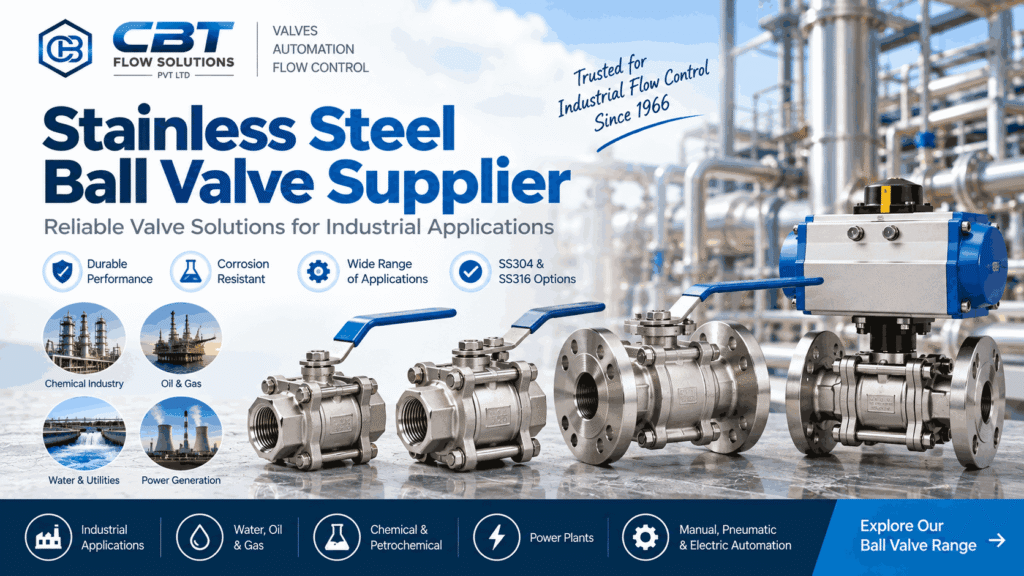
CBT Flow Solutions Pvt. Ltd. supplies industrial valves and related flow-control products in India. Its current Zoloto range includes stainless steel three-piece ball valves in SS304 and SS316, with screwed and flanged configurations.
What Is a Stainless Steel Ball Valve?
A stainless steel ball valve is a quarter-turn valve that uses a rotating ball with a bore through its centre to control fluid flow.
When the bore is aligned with the pipeline, fluid can pass through the valve. When the ball rotates 90 degrees, the passage is closed.
The simple quarter-turn operation makes ball valves suitable for on-off flow isolation in many industrial systems.
A stainless steel version uses stainless steel components in the pressure-containing and flow-control parts, depending on the particular valve design. The exact material specification should always be checked against the product datasheet.
For example, CBT’s 1080A model is listed as a three-piece SS316 ball valve with a reduced bore and screwed female connections to BSPT, NPT and socket weld options. Its body and major stainless-steel components are specified in CF8M and Type 316 materials.
Why Choose Stainless Steel for Ball Valves?
Material selection should always depend on the actual application, but stainless steel is commonly selected where the operating environment calls for a suitable combination of corrosion resistance, mechanical strength and cleanliness.
This makes stainless steel ball valves relevant to many industrial systems.
They can be considered for applications involving:
- Water and utility services
- Air systems
- Oil
- Gas
- Chemical service
- Petrochemical processes
- Power generation
- Process equipment
CBT’s automated stainless-steel ball-valve products are specifically listed for applications including air, water, oil, gas and corrosive chemicals, as well as chemical, petrochemical and power-related industries.
However, stainless steel does not automatically make a valve suitable for every chemical or process fluid. The actual fluid, concentration, temperature, pressure and material compatibility should be checked before selection.
SS304 vs SS316 Ball Valve
One of the most common questions when buying a stainless steel ball valve is whether to select SS304 or SS316.
Both grades are used in industrial equipment, but they are not interchangeable for every application.
CBT’s Zoloto range includes:
1081 / 1081A — SS304
The 1081 model is listed as a three-piece SS304 ball valve with a Class 150 design. The 1081A version is the corresponding flanged configuration. The product information specifies CF8 stainless steel construction and Type 304 stainless steel for the ball and stem.
1080A / 1080B — SS316
The 1080A model is a three-piece SS316 ball valve with screwed connections, while 1080B is the flanged version. Both are listed with CF8M / SS316 construction.
In practical terms, the choice between SS304 and SS316 should be based on the process environment and material compatibility rather than simply choosing the higher-numbered grade.
For chemical and corrosive applications, engineering teams should review the complete fluid and material compatibility requirements before placing an order.
Types of Stainless Steel Ball Valves
Stainless steel ball valves are available in different designs. The right configuration depends on the pipeline and operating requirements.
Two-Piece Ball Valve
A two-piece design consists of two main body sections. It is commonly used for general on-off isolation applications.
CBT also lists automated two-piece stainless-steel ball valves. Its 2565F model, for example, is a two-way close-couple metal ball valve with an electric actuator and a two-piece screwed-end design. The product specification lists a stainless steel AISI 316 ball and stem, with body options including SS304 and SS316.
Three-Piece Ball Valve
A three-piece design is useful where maintenance flexibility is important because the body can be separated into sections.
CBT’s Zoloto range includes both SS304 and SS316 three-piece Class 150 ball valves.
The 1080A SS316 screwed ball valve and 1080B SS316 flanged ball valve are suitable examples of this configuration.
Flanged Ball Valve
Flanged ball valves are connected using flanges and are commonly considered for industrial piping systems where a flanged connection is required.
The Zoloto 1080B and 1081A models listed by CBT use flanged configurations.
Threaded or Screwed Ball Valve
Screwed ball valves are commonly used where threaded pipe connections are required.
CBT’s 1080A and 1081 models are listed with screwed female ends and BSPT/NPT/socket-weld connection options.
Where Are Stainless Steel Ball Valves Used?
The application of a stainless steel ball valve depends on its specific construction and rating.
Chemical Industry
Chemical plants may require valves made from materials compatible with corrosive or reactive process fluids.
Stainless steel may be selected in applications where the material is appropriate, but fluid compatibility must always be verified.
Petrochemical Industry
Ball valves are often used for on-off isolation in process and utility lines.
CBT’s automated stainless-steel ball-valve products list chemical and petrochemical industries among their applications.
Oil and Gas
Ball valves can be used for isolation of gases, oils and other process fluids when the selected valve meets the required pressure, temperature and material specifications.
CBT’s 2370F range is listed for air, water, oil, steam, gas and corrosive chemicals, with stainless steel components and multiple connection options.
Water and Utility Systems
Stainless steel ball valves can also be considered for water and utility services, depending on the pressure, temperature and system requirements.
Power Plants
Industrial ball valves are used in various utility and process systems within power-generation facilities. CBT’s automated ball-valve product information specifically includes power stations and hydro-electric power generation among its listed applications.
How to Select the Right Stainless Steel Ball Valve
Choosing a valve based only on size is a common mistake. A proper selection requires looking at the complete operating condition.
1. Check the Fluid
First identify what will pass through the valve.
Is it water, air, oil, gas, steam or a chemical?
The fluid affects material compatibility, seal selection and valve design.
2. Choose the Stainless Steel Grade
SS304 and SS316 are both available in industrial ball-valve designs.
CBT’s current Zoloto range provides SS304 models 1081 and 1081A, and SS316 models 1080A and 1080B.
The process engineer should select the grade based on the actual service conditions.
3. Check the Pressure Rating
Pressure rating is critical.
For example, CBT’s 1080A and 1080B products are listed with a maximum working pressure of 21 kg/cm²g (300 psig) and a shell hydrostatic test pressure of 31 kg/cm²g (440 psig).
Never select a valve simply because its size matches the pipeline. The pressure and temperature rating also need to match the application.
4. Check the Temperature
Temperature can affect seals, seats and the overall valve design.
The CBT 1080A, 1080B, 1081 and 1081A product pages list a maximum working temperature of 220°C for those specific models.
Always confirm the latest product datasheet before specifying a valve for a high-temperature process.
5. Select the Correct Connection
You may require:
- BSPT
- NPT
- Socket weld
- Flanged connection
The connection must match the pipeline and installation requirements.
6. Decide Between Manual and Automated Operation
For a manually operated line, a hand lever may be sufficient.
For an automated process, a ball valve can be combined with a pneumatic or electric actuator.
CBT also supplies pneumatic actuators for industrial valve automation. Its current actuator information covers applications including ball valves and butterfly valves.
For example, CBT’s 2360F/2361F range combines a metal ball valve with a pneumatic actuator and includes options such as solenoid valves, position indicators and other accessories.
Manual vs Automated Stainless Steel Ball Valve
The choice between a manual and automated valve depends on how the process operates.
A manual ball valve is suitable where an operator can physically open or close the valve when required.
An automated ball valve is more suitable when the valve must be controlled remotely or as part of an automatic process sequence.
CBT lists both pneumatic and electric-actuated stainless-steel ball-valve configurations. Its 2370F product, for example, is a full-port three-piece ball valve with a pneumatic rotary actuator, while the 2570F is an equivalent automated configuration with an electric rotary actuator.
In an automated system, the actuator may work together with a solenoid valve, positioner or other control accessories depending on the application.
What Should You Ask a Stainless Steel Ball Valve Supplier?
Before requesting a quotation, keep the technical information ready.
A reliable stainless steel ball valve supplier in India will normally need details such as:
Valve size: What is the pipe size?
Fluid: What medium will flow through the valve?
Pressure: What is the normal and maximum operating pressure?
Temperature: What is the normal and maximum operating temperature?
Material: Do you require SS304 or SS316?
Connection: Is it screwed, threaded, socket weld or flanged?
Operation: Manual, pneumatic or electric?
Port: Full port or reduced port?
Quantity: How many valves are required?
Providing these details helps reduce confusion and makes it easier to identify an appropriate valve configuration.
Why Work With an Experienced Valve Supplier?
Industrial valve purchasing is not only about finding the lowest quotation.
The valve must be suitable for the application and supplied with the right specifications.
An experienced supplier can help buyers understand the difference between valve materials, connection types, operating pressure, temperature limits and actuator options.
For businesses purchasing several valve types for the same plant, working with a supplier that handles valves, actuators and related flow-control products can also simplify sourcing.
CBT Flow Solutions Pvt. Ltd. states that it has been serving the industrial market since 1966 and supplies industrial valves, actuators, pressure gauges and flow-control products.
Stainless Steel Ball Valve Supplier in India
CBT Flow Solutions offers stainless steel ball valves for industrial and process applications through its range of Zoloto products.
For SS304, the current range includes the 1081 three-piece screwed ball valve and 1081A three-piece flanged ball valve. Both are listed as Class 150 designs.
For SS316, the range includes the 1080A three-piece screwed ball valve and 1080B three-piece flanged ball valve. These models are listed with CF8M / SS316 construction and Class 150 design.
CBT also provides automated valve solutions, including pneumatic and electric actuator combinations for industrial applications.
This allows buyers to look at both manual and automated valve requirements through the same industrial flow-control supplier.
Frequently Asked Questions
What is a stainless steel ball valve?
A stainless steel ball valve is a quarter-turn valve that uses a rotating ball to start or stop fluid flow. Stainless steel construction is available in different grades and configurations depending on the application.
What is the difference between SS304 and SS316 ball valves?
SS304 and SS316 are different stainless-steel material grades. The correct choice depends on the process fluid, operating environment and required material compatibility. CBT’s current range includes both SS304 and SS316 three-piece ball valves.
Which is better for chemical applications, SS304 or SS316?
There is no single answer for every chemical application. The correct grade should be selected after checking the chemical composition, concentration, operating temperature and other service conditions.
What sizes are available?
The available size range depends on the specific product. For example, CBT’s 1081A product page lists dimensions from 1/2 inch through 4 inches for that particular model.
Can a stainless steel ball valve be automated?
Yes. Stainless steel ball valves can be supplied with pneumatic or electric actuators where the valve needs remote or automatic operation. CBT currently lists both pneumatic- and electric-actuated ball-valve products.
How do I choose a stainless steel ball valve supplier?
Check whether the supplier can provide the required material grade, pressure rating, temperature rating, connection, size and operating configuration. It is also useful to work with a supplier that can provide technical information and related automation components where required.