


Industrial Valves for Pharmaceutical Industry: Types, Applications and Selection Guide
In pharmaceutical manufacturing, every part of a process system needs careful consideration. From purified water and clean steam to chemical dosing, air handling and automated production equipment, reliable flow control is essential for maintaining consistent operations.
Valves play an important role in these systems. They control the movement of liquids, gases and steam, isolate equipment during maintenance, prevent unwanted flow and support automated process operations.
However, choosing industrial valves for the pharmaceutical industry requires more than checking the valve size and pressure rating. Material compatibility, cleanability, sealing performance, operating temperature and the risk of product contamination must also be considered.
The requirements can vary significantly depending on whether a valve handles a pharmaceutical product directly or serves a supporting utility system.
CBT Flow Solutions Pvt. Ltd. supplies industrial valves, solenoid valves, pneumatic actuators and related flow-control products. Its website lists pharmaceutical manufacturing among the industries served by its solenoid valve and actuator offerings.
In this guide, we will discuss the main types of valves used in pharmaceutical facilities, their applications and the technical factors to consider before purchasing.
Why Are Valves Important in the Pharmaceutical Industry?
Pharmaceutical plants use different types of process equipment to manufacture medicines, prepare ingredients, clean production systems and maintain controlled operating conditions.
Valves help manage the flow between this equipment.
For example, a purified-water distribution system needs suitable valves to isolate pipelines and direct water to the required location. A clean-steam system needs components rated for its pressure and temperature conditions. Automated production equipment may require electrically or pneumatically operated valves to follow a defined sequence.
The correct valve can help support:
- Controlled movement of process fluids.
- Isolation of tanks, pumps, filters and pipelines.
- Reliable operation of utility systems.
- Automated opening and closing of process valves.
- Maintenance and shutdown activities.
- Consistent operation of compatible process equipment.
The exact valve specification depends on the duty. A valve used for general plant water may have different material and hygienic requirements from one installed in a product-contact line.
Types of Industrial Valves Used in Pharmaceutical Plants
Different valve designs perform different functions. The selection depends on the process, medium, installation and required level of control.
1. Diaphragm Valve
A diaphragm valve uses a flexible diaphragm to open, close or regulate a flow passage. Depending on its design, the diaphragm also separates the operating mechanism from the process fluid.
Diaphragm valves are used in several industries where fluid handling and isolation are important.
In pharmaceutical facilities, hygienically designed diaphragm valves are commonly considered for appropriate product-contact applications because the design can support cleanability and controlled isolation.
However, not every industrial diaphragm valve is suitable for pharmaceutical product-contact service.
Buyers should verify the body construction, diaphragm material, surface finish, drainability, cleaning compatibility and required approvals.
CBT Flow Solutions lists a diaphragm valve range with different body materials, linings and diaphragm options. These products should be evaluated against the actual process specification before being considered for pharmaceutical duties.
2. Butterfly Valve
A butterfly valve uses a rotating disc to control flow. The disc turns approximately 90 degrees between the open and closed positions.
Butterfly valves are often considered for larger pipelines because their design can be compact and suitable for automated operation.
In pharmaceutical facilities, they may be used in appropriate utility-water, HVAC, compatible process and other supporting systems.
Where a butterfly valve is installed in a product-contact line, its hygienic design, disc geometry, seat material, surface finish and cleanability must be confirmed.
CBT lists the BFV-4029A butterfly valve, a metal-seated flanged design with manual, pneumatic and electric actuation options. Its published applications include pharmaceutical and other industrial process industries.
The model’s suitability should be checked against the intended pharmaceutical service rather than assumed from the industry application listing alone.
3. Ball Valve
A ball valve uses a rotating ball with a passage through its centre. When the passage aligns with the pipeline, the fluid can flow. A quarter-turn closes the passage.
Ball valves are commonly used for on-off isolation in compatible utility and process systems.
Possible applications include service-water lines, compatible chemical circuits, equipment isolation and automated utility control.
For pharmaceutical installations, material compatibility and cleanability are important. Standard industrial ball valves may contain cavities or geometries that are unsuitable for certain hygienic duties.
If the valve will contact a pharmaceutical product, confirm that the particular design meets the required hygienic specifications.
CBT offers an electric-actuated ball valve, model 2570F, with an SS316 ball, reinforced PTFE seating and different body-material options. Its listed applications include water, steam, gas and other specified services. The product should be evaluated for the particular process before use in a pharmaceutical installation.
4. Solenoid Valve
A solenoid valve uses an electromagnetic coil to operate an internal valve mechanism. An electrical signal can open, close or redirect flow.
These valves are useful when an automated system needs electrical control over a suitable liquid, gas or pneumatic circuit.
In pharmaceutical plants, solenoid valves may be considered for compatible applications such as:
- Utility-water control.
- HVAC and air-handling equipment.
- Pneumatic actuator piloting.
- Compatible clean-steam circuits.
- Auxiliary equipment and automated dosing systems.
The valve’s pressure rating, coil voltage, seal material, body construction, temperature capability and electrical protection must match the operating conditions.
CBT Flow Solutions supplies a range of solenoid valves and lists pharmaceutical manufacturing among their application areas.
For product-contact or critical utility applications, the exact model must be checked against the required cleanliness, material and validation specifications.
5. Gate Valve
A gate valve uses a movable gate to open or close a pipeline.
It is mainly used for isolation rather than continuous flow regulation. Depending on the installation, gate valves may be suitable for certain service-water, utility and supporting pipeline duties within a pharmaceutical facility.
A standard industrial gate valve should not automatically be selected for a hygienic product-contact line. The process application and equipment specification must determine the choice.
When selecting a gate valve, check the pressure rating, material, end connections, installation requirements and maintenance needs.
6. Control and Pneumatically Operated Valves
Some pharmaceutical processes require more than simple on-off isolation.
A control valve regulates the flow or another process variable according to a control signal. A pneumatically operated valve uses compressed air to change the valve position.
These designs can support automated utility and compatible process systems.
For example, a control system may operate a valve to maintain a specified flow condition or coordinate the transfer of a utility fluid.
CBT lists pneumatically operated valve products, including the 5616G / 5619G three-way straight-body valve, with pneumatic actuation and on-off or mixing/diverting applications. The particular product’s materials, temperature ratings and process compatibility must be confirmed before specifying it for pharmaceutical use.
Where Are Industrial Valves Used in Pharmaceutical Manufacturing?
The valve requirements change depending on the part of the facility where the equipment is installed.
Purified Water Systems
Purified water is used in pharmaceutical manufacturing for specified process and cleaning duties.
Valves in these systems must be compatible with the water quality and system design. Where the water has a defined pharmaceutical grade, the piping and valve arrangements must meet the applicable project requirements for cleanliness, materials, drainage and sanitisation.
Water for Injection Systems
Water for Injection, commonly called WFI, is used in applications that have specific pharmaceutical quality requirements.
The valve selection must consider the relevant system specification, including materials, hygienic design, surface finish, cleanability and the required documentation.
An ordinary industrial valve should not be assumed suitable for WFI service simply because its body is made from stainless steel.
Clean Steam and Autoclaves
Clean steam can be used in pharmaceutical facilities for sterilisation and other specified duties.
Valves must be rated for the relevant steam pressure and temperature. Seal materials, condensate management and suitability for the intended steam service should also be confirmed.
CBT Flow Solutions lists Forbes Marshall steam-system products that may be relevant to supporting steam infrastructure. The selected product must meet the clean-steam requirements of the particular installation.
HVAC and Air Handling
Pharmaceutical buildings may require controlled heating, cooling, air movement and pressure conditions.
Valves and actuators can be used in suitable heating and cooling circuits and associated equipment.
The required control method, pressure rating, temperature capability and building-management-system interface should be checked during selection.
Chemical Dosing and Transfer
Pharmaceutical plants use chemicals for cleaning, processing, dosing and supporting operations.
The valve body, seats, seals and other wetted components must be compatible with the chemical concentration and operating temperature.
For automated chemical transfer, a valve may be operated using a solenoid or an actuator, depending on the required flow and control arrangement.
Cleaning-in-Place and Sterilisation-in-Place
Cleaning-in-Place (CIP) and Sterilisation-in-Place (SIP) allow compatible equipment and piping systems to be cleaned or sterilised without dismantling the entire assembly.
Valves installed in these systems must be suitable for the cleaning chemicals, temperatures, flow conditions and cleaning or sterilisation cycles.
For product-contact duties, the design should support effective cleaning and avoid unacceptable areas where residues may accumulate.
Hygienic Valves vs Standard Industrial Valves
This distinction is particularly important when selecting valves for pharmaceutical manufacturing.
A standard industrial valve may be designed primarily for isolation, pressure containment or general process control.
A hygienic valve is designed with additional attention to product-contact surfaces, cleanability and contamination control.
Depending on the application, pharmaceutical buyers may need to check:
Wetted materials: All parts contacting the process fluid should meet the required material specifications.
Surface finish: Product-contact surfaces may have defined roughness limits.
Dead legs and cavities: The system design should minimise areas where product or cleaning fluid can become trapped.
Drainability: The arrangement should allow effective removal of liquid where required.
Cleaning compatibility: Valve materials and design should tolerate the specified CIP and SIP conditions.
Documentation: Material certificates, test records and other quality documents may be required.
Applicable standards: The project may specify standards, hygienic-design requirements or regulatory expectations for the application.
These requirements are not identical for every valve in a pharmaceutical plant. A valve used in a general HVAC circuit may have different requirements from a valve directly contacting the product.
How to Select the Right Valve for a Pharmaceutical Application
Before placing an order, define the operating conditions and quality requirements clearly.
1. Identify the Application
Determine whether the valve will be used for purified water, WFI, clean steam, HVAC, chemical dosing, compressed air or a product-contact process.
This establishes the main selection criteria.
2. Confirm the Material
Check the body, disc, ball, diaphragm, seats and seals, including every component that contacts the fluid.
Stainless steel grades such as SS316 or SS316L may be required for particular services, but the grade alone does not establish suitability for pharmaceutical use.
3. Check Pressure and Temperature
Confirm normal and maximum operating pressure, operating temperature and any cleaning or sterilisation conditions.
A valve must be suitable for the full operating cycle rather than just the normal process temperature.
4. Check Flow and Size
The valve must pass the required flow while remaining suitable for the process. Consider line size, flow rate, pressure drop and whether the valve is intended for isolation or regulation.
5. Choose Manual or Automated Operation
Manual valves may suit infrequently operated isolation points.
Automated valves are useful where the system requires remote control, repeated sequences or integration with a PLC.
CBT supplies pneumatic actuators for compatible ball, butterfly and plug valve applications. Its actuator range includes single-acting and double-acting configurations, along with automation accessories.
6. Verify Documentation and Testing
Confirm the documents required by the project, such as material certificates, pressure-test reports, product specifications and any applicable hygienic or regulatory declarations.
Do not assume that a product has a particular pharmaceutical certification unless the manufacturer can verify it for the exact model and configuration.
7. Consider Maintenance
The valve should be accessible for inspection, servicing and replacement.
For critical process systems, consider the availability of suitable spare parts and the maintenance procedure recommended by the manufacturer.
Why Valve Automation Matters in Pharmaceutical Plants
Automation can help reduce manual intervention and make repeated operations more consistent.
An automated valve arrangement typically includes a process valve, a compatible actuator and the relevant control accessories.
Depending on the application, the system may also include a solenoid valve, position feedback and a connection to the plant control system.
For example, an actuated butterfly valve may open or close according to a PLC command. A position switch can report whether the valve has reached its intended position.
CBT Flow Solutions provides pneumatic actuators and related accessories for compatible automated valve assemblies.
Explore the CBT pneumatic actuator range to review available actuator options.
For any pharmaceutical installation, verify that the complete assembly—not just the actuator—is suitable for the process, environment and required documentation.
Common Mistakes When Buying Valves for Pharmaceutical Industry
Several mistakes can create maintenance, compatibility or quality problems.
Choosing by material alone. Stainless steel construction does not automatically mean that a valve meets hygienic requirements.
Ignoring the cleaning cycle. The valve must withstand the required cleaning chemicals, temperatures and sterilisation conditions.
Using a general industrial valve in a product-contact line without checking suitability. The design must meet the actual application requirements.
Ignoring seal and seat materials. These components may contact the process fluid and must be chemically and thermally compatible.
Selecting automation components separately without checking compatibility. The valve, actuator, solenoid valve and feedback accessories must work together correctly.
Overlooking documentation. Pharmaceutical projects may require traceability, certificates and test records for critical components.
Clear technical specifications help avoid these issues and make supplier evaluation more straightforward.
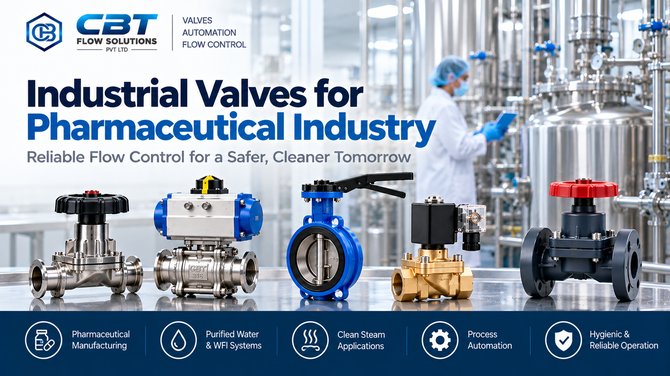
Industrial Valve Supplier for Pharmaceutical Industry in India
CBT Flow Solutions Pvt. Ltd. supplies industrial valves, solenoid valves, pneumatic actuators and related flow-control products to process industries across India.
Its current website identifies pharmaceutical manufacturing among the application areas served by its solenoid valve and actuator offerings.
Relevant product sections include:
- Solenoid Valves
- Pneumatic Actuators
- BFV-4029A Butterfly Valve
- Diaphragm Valves
- Electric-Actuated Ball Valve
- Forbes Marshall Steam-System Products
These are starting points for product evaluation. The specific valve must be checked against the pharmaceutical project’s pressure, temperature, media, hygienic design and documentation requirements.
Frequently Asked Questions
Which valves are used in the pharmaceutical industry?
Commonly considered valve types include diaphragm valves, butterfly valves, ball valves, solenoid valves and control valves. The correct choice depends on whether the valve handles product, purified water, WFI, clean steam, chemicals or a supporting utility.
Why are stainless steel valves used in pharmaceutical plants?
Stainless steel may offer suitable corrosion resistance and mechanical strength for many pharmaceutical applications. The exact grade, surface finish and overall valve design must meet the process requirements.
Are all stainless steel valves suitable for pharmaceutical applications?
No. A stainless steel valve may be appropriate for a general utility system but unsuitable for direct product contact. Hygienic design, material specifications, cleanability and required documentation must be checked.
What is the purpose of a solenoid valve in a pharmaceutical plant?
A solenoid valve uses an electrical signal to control a compatible liquid, gas or pneumatic circuit. Applications may include utility control, HVAC, dosing and actuator piloting, depending on the model and service requirements.
Can pneumatic actuators be used in pharmaceutical manufacturing?
Yes. Pneumatic actuators can operate compatible ball, butterfly and other industrial valves. The valve assembly, actuator and accessories must be selected for the process and installation.
What should I check before ordering a pharmaceutical valve?
Check the medium, pressure, temperature, valve size, body and seal materials, hygienic design requirements, cleaning method, connections, actuation and required documents or approvals.
Conclusion
Industrial valves are essential to the operation of pharmaceutical manufacturing facilities. They support flow isolation, process control, utility management and automation across different parts of a plant.
The correct valve depends on the duty it performs. A general utility line, clean-steam system, purified-water circuit and product-contact process can have very different requirements.
Before selecting a valve, confirm the fluid, material compatibility, pressure, temperature, cleaning conditions, hygienic design and required documentation. For automated applications, also verify the compatibility of the valve, actuator, control valve and feedback accessories.
Careful selection can help reduce compatibility issues and support reliable plant operation.
Need Industrial Valves for Your Pharmaceutical Facility?
CBT Flow Solutions Pvt. Ltd. supplies industrial valves, solenoid valves, pneumatic actuators and flow-control products for process industries.
Share your application, process medium, valve size, operating conditions and any required hygienic or documentation specifications with our team so that the appropriate product can be evaluated.
CBT Flow Solutions Pvt. Ltd.
Valves | Automation | Flow Control
Reliable Flow for a Better Tomorrow
Explore Solenoid Valves
Explore Pneumatic Actuators
Contact CBT Flow Solutions