


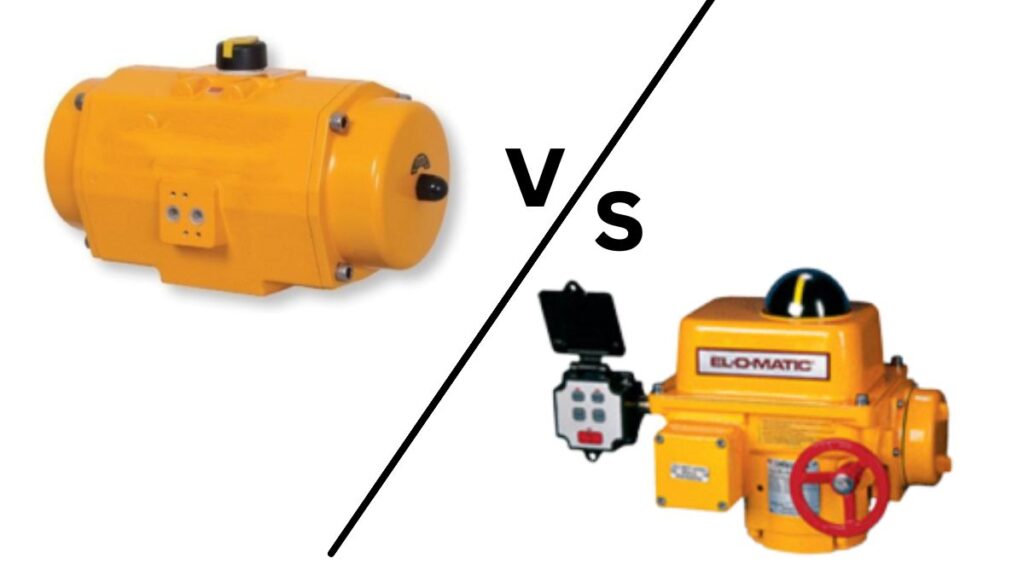
Comparing Pneumatic and Electric Actuators: Which One Should You Choose?
When a valve needs to open, close, or move automatically, the actuator is the component that makes it happen.
At first, choosing an actuator may seem simple. You normally have two common options: a pneumatic actuator or an electric actuator.
But once you start looking at operating speed, available utilities, control requirements, safety, maintenance, installation cost, and the environment around the valve, the decision becomes more interesting.
A pneumatic actuator uses compressed air to create movement. An electric actuator uses an electric motor and gears.
Both can automate industrial valves. Both can work reliably when selected correctly. However, they behave differently, and one may suit your application much better than the other.
This guide focuses on comparing pneumatic and electric actuators in simple terms so that you can understand their differences and make a better selection for your valve automation system.
What Is a Pneumatic Actuator?
A pneumatic actuator converts compressed-air energy into mechanical movement.
For a rotary valve such as a ball valve or butterfly valve, compressed air normally moves pistons inside the actuator. The movement of these pistons rotates an output shaft, which then turns the valve stem.
Pneumatic actuators are commonly available in rack-and-pinion and scotch-yoke designs.
They can also be supplied as single acting or double acting.
In a double-acting pneumatic actuator, compressed air is used to move the actuator in both directions.
In a single-acting actuator, compressed air moves the actuator in one direction while springs move it back when air pressure is removed.
That spring-return design is especially useful when a valve needs to automatically move to a defined safe position if the air supply fails.
For example, imagine a fuel line where the valve must close automatically during a system failure. A properly selected spring-return pneumatic actuator can help provide this fail-safe action.
This is one reason pneumatic actuators are widely used in process plants, oil and gas facilities, water treatment systems, chemical plants, pharmaceutical production, and many other industrial applications.
What Is an Electric Actuator?
An electric actuator uses electrical power instead of compressed air.
Inside the actuator, an electric motor drives a gear system. The gears increase torque and move the actuator’s output shaft.
That shaft then operates the connected valve.
Electric actuators are available for simple ON/OFF operation as well as modulating control.
An ON/OFF electric actuator moves the valve between fully open and fully closed positions.
A modulating actuator can move the valve to intermediate positions.
For example, instead of simply opening a valve completely, a control system may command it to move to 25%, 50%, or 75% open.
This makes electric actuators particularly useful where precise valve positioning and integration with electrical control systems are important.
They are also attractive at locations where electrical power is easily available but compressed air is not.
Pneumatic vs Electric Actuator: The Basic Difference
The biggest difference is the source of energy.
A pneumatic actuator needs compressed air.
An electric actuator needs electricity.
That sounds obvious, but this single difference affects almost everything else, including installation, infrastructure, speed, control, maintenance, safety strategy, and operating cost.
Consider two installations.
The first is inside a large chemical plant where compressed-air lines already run throughout the facility.
Installing another pneumatic actuator may be relatively straightforward.
Now imagine a remote water pipeline several kilometres away from the main plant.
Electricity may already be available at the site, but building a new compressed-air network just for one actuator may make little sense.
In that situation, an electric actuator may be much easier to install.
This is why actuator selection should start with the actual site conditions rather than simply asking which actuator technology is “better.”
Comparing Pneumatic and Electric Actuators by Operating Speed
Pneumatic actuators are generally known for fast operation.
Compressed air can move the piston and rotate the valve quickly. For ON/OFF applications where fast valve movement is important, pneumatic actuation can be a strong choice.
Emergency shutdown systems are one example where operating speed may become important.
Electric actuators often operate more slowly because the motor and reduction gearbox move the valve through a controlled mechanical process.
However, slower movement is not necessarily a disadvantage.
A water system, for example, may intentionally require slower valve closing to reduce pressure surges or water hammer.
So the question should not be:
“Which actuator is faster?”
The better question is:
“How fast should this particular valve move?”
The correct operating time depends on the process.
Control and Positioning
Electric actuators often have an advantage when precise positioning and electrical integration are major priorities.
A modulating electric actuator can receive a control signal and move the valve to different positions.
Modern electric actuator systems may also provide position feedback and other control features depending on the selected model.
Pneumatic actuators can also provide accurate modulating control, but they normally require additional components.
For example, a pneumatic control-valve package may include a positioner that controls how much air enters the actuator and adjusts the valve position according to the control signal.
For simple ON/OFF operation, a pneumatic actuator may use a solenoid valve.
So both technologies can provide automation and control.
The difference is usually in how that control is achieved.
Pneumatic Actuator Infrastructure Requirements
Before choosing a pneumatic actuator, ask one important question:
Do you already have a dependable compressed-air supply?
A pneumatic actuator needs more than the actuator itself.
The system may require an air compressor, air treatment, filters, regulators, tubing, fittings, solenoid valves, and other pneumatic accessories.
Large industrial facilities often already have this infrastructure.
In that situation, adding pneumatic actuators may be practical.
But if compressed air is not already available, building the infrastructure only to operate a few valves can significantly change the project economics.
Air quality is also important.
Moisture, dirt, rust particles, or poor lubrication conditions can reduce the reliability of pneumatic equipment.
Clean and properly regulated instrument air helps the actuator and its accessories work more consistently.
Electric Actuator Infrastructure Requirements
Electric actuators remove the need for a compressed-air network, but they introduce their own requirements.
The first requirement is the correct power supply.
Depending on the actuator, this could be AC or DC power at different voltage levels.
You also need appropriate electrical cabling, control wiring, protection, and sometimes communication connections.
The enclosure must suit the installation environment.
If the actuator will operate outdoors, in a dusty area, in a wet location, or in a hazardous environment, its electrical protection and certification become especially important.
This means an electric actuator should not be selected only by torque.
Power supply, enclosure, controls, duty cycle, operating time, feedback, and environmental conditions all matter.
Which Is Better for Fail-Safe Operation?
This is an important difference.
A spring-return pneumatic actuator can be designed so that loss of air pressure causes the valve to move automatically to a predetermined safe position.
That could mean fail-close or fail-open depending on the process requirement.
This type of behaviour is useful in safety-related applications.
For example, if cooling water must continue flowing during a control failure, the valve may need to fail open.
If a dangerous process fluid must be isolated during a failure, the valve may need to fail closed.
Electric actuators can also be designed for fail-safe operation, but the method is different.
Depending on the design, they may require spring-return mechanisms, stored energy, batteries, capacitors, or backup electrical power.
Therefore, if automatic movement during power or utility loss is important, you need to examine the exact fail-safe design rather than assuming every actuator will behave the same way.
Pneumatic vs Electric Actuator in Hazardous Areas
Pneumatic actuators are widely used in process industries where hazardous gases or vapours may be present.
The mechanical pneumatic actuator itself does not depend on an electric motor at the valve.
However, a complete automated pneumatic valve package may still include electrical equipment such as solenoid valves, limit switches, or positioners.
Those components must have the correct protection and approvals for the classified area.
Electric actuators installed in hazardous environments also need the appropriate hazardous-area construction and certification.
So pneumatic does not automatically mean that every component is safe for every hazardous location.
The entire automated valve assembly must be checked against the actual hazardous-area classification.
Energy Efficiency and Operating Cost
This comparison is not as simple as it first appears.
Electric actuators consume electricity when their motors operate. Depending on the design, additional power may also be required for electronics, heating, communication, or position-holding functions.
Pneumatic actuators use compressed air.
But compressed air is not free.
Electricity is required to run compressors, and energy can also be lost through air leakage, pressure drops, poor compressor efficiency, and unnecessary high-pressure operation.
Therefore, looking only at the actuator itself can give a misleading picture.
A plant that already has an efficient compressed-air network may find pneumatic operation economical.
A remote installation without compressed air may favour electric actuation.
For a serious lifecycle comparison, look at the complete system rather than only the purchase price of the actuator.
Installation Cost
Pneumatic actuators themselves can have relatively simple mechanical construction.
However, the complete installation may require air tubing, air filter regulators, solenoid valves, fittings, air manifolds, and control accessories.
Electric actuators mainly require electrical and control connections, but cable routes, control panels, protective equipment, and electrical installation costs need to be considered.
The best solution therefore depends heavily on what infrastructure already exists at the plant.
If compressed air is already available near the valve, pneumatic actuation may be easy to add.
If only electrical power is available, electric actuation may require fewer supporting systems.
Maintenance Requirements
Pneumatic actuators are mechanically straightforward, but the quality of the compressed-air system strongly affects maintenance.
Leaks in tubing or fittings should be corrected.
Air filters and regulators need attention.
Seals can wear over time.
Moisture and contamination should be controlled.
Solenoid valves and other pneumatic accessories also need to remain in good operating condition.
Electric actuators do not require air-system maintenance, but they contain motors, gears, switches, electronic controls, and electrical connections.
Gear wear, moisture ingress, incorrect settings, electrical faults, and excessive operating cycles can all affect reliability.
Neither actuator is maintenance-free.
The better choice is the one your plant can support properly over its full operating life.
Torque and Valve Sizing
Whether you choose pneumatic or electric actuation, correct torque sizing is essential.
The actuator must produce enough torque to operate the valve under real process conditions.
It should not be selected only from the valve’s nominal size.
A DN100 ball valve in one service may require very different torque from another DN100 valve because of pressure, seat material, valve design, media, temperature, age, and operating conditions.
For pneumatic actuators, available air pressure directly affects torque output.
For electric actuators, the selected motor and gear arrangement determine the available torque.
The actuator should also include an appropriate design margin rather than being selected exactly at the theoretical minimum torque.
Valve and actuator sizing should therefore be treated as one engineering decision.
Which Actuator Is Better for Remote Locations?
Electric actuators are often attractive for remote installations.
If electrical power is already available, an electric actuator can be installed without extending a compressed-air network across a long distance.
Remote water-treatment valves, pipelines, tank farms, and isolated utility systems are possible examples.
However, electrical reliability must still be considered.
If power disappears, what should happen to the valve?
Does it need to remain in position?
Does it need to move to a safe position?
Is backup power available?
The answer may change the actuator selection.
Which Actuator Is Better for Frequent Cycling?
For high-cycle ON/OFF applications, pneumatic actuators are frequently used because of their fast movement and relatively simple mechanism.
Automation lines and process applications can require repeated opening and closing throughout the day.
However, actuator life depends on more than whether it is pneumatic or electric.
Valve torque, cycle frequency, air quality, operating speed, actuator sizing, temperature, lubrication, duty cycle, and maintenance all affect service life.
For electric actuators, duty-cycle rating becomes particularly important.
An actuator intended for occasional ON/OFF operation should not automatically be used in an application requiring constant modulating movement.
Always match actuator duty to the actual operating frequency.
Pneumatic Actuator Applications
Pneumatic actuators are commonly found in process plants where compressed air is already available.
They are frequently paired with ball valves and butterfly valves for ON/OFF isolation or process control.
A complete pneumatic automated valve arrangement may contain the valve, pneumatic actuator, solenoid valve, limit switch box, position indicator, and air filter regulator.
CBT Flow Solutions provides pneumatic actuators for industrial valve automation, including rack-and-pinion and scotch-yoke designs for different valve and torque requirements.
Electric Actuator Applications
Electric actuators are particularly useful when electric power is readily available but instrument air is not.
They can be used for ball valves, butterfly valves, and other compatible valve types.
Electric actuators are also useful where controlled operating speed, remote electrical control, or modulating positioning is required.
CBT Flow Solutions also supplies electric valve actuators for ON/OFF and modulating applications, with selection based on factors such as valve torque, power supply, operating speed, duty cycle, control requirements, and installation environment.
Pneumatic vs Electric Actuator Comparison
The right actuator becomes clearer when the important factors are viewed together.
| Factor | Pneumatic Actuator | Electric Actuator |
|---|---|---|
| Power source | Compressed air | Electricity |
| Operating speed | Generally fast | Usually more controlled and often slower |
| Fail-safe option | Spring-return design is widely used | Requires actuator-specific fail-safe arrangement |
| Modulating control | Possible with positioner | Common in modulating electric designs |
| Infrastructure | Requires compressed-air system | Requires electrical supply and wiring |
| Remote installation | Less practical without nearby air | Often easier where electricity is available |
| Maintenance | Air system, seals and accessories | Motor, gears and electrical components |
| High-cycle use | Commonly suited to frequent operation when correctly sized | Depends strongly on actuator duty rating |
| Valve positioning | Positioner normally required for modulating service | Can be integrated into modulating actuator |
| Hazardous locations | Complete assembly must meet area requirements | Correct hazardous-area electrical certification required |
| Energy consideration | Depends on compressed-air system efficiency | Depends on electrical load and operating pattern |
| Typical use | Process plants and fast ON/OFF automation | Remote sites and electrical/modulating automation |
So, Which One Should You Choose?
There is no universal winner in the pneumatic actuator vs electric actuator comparison.
Choose based on the application.
If your plant already has reliable compressed air, requires fast operation, needs frequent cycling, or wants a straightforward spring-return fail-safe arrangement, a pneumatic actuator may be the better choice.
If compressed air is unavailable, the valve is in a remote location, electrical integration is preferred, or precise electrical positioning is important, an electric actuator may make more sense.
Sometimes the choice becomes obvious after answering only a few questions.
What valve are you operating?
How much torque does it require?
Is compressed air available?
What electrical supply is available?
Does the valve need ON/OFF or modulating operation?
What should happen during a loss of power or air?
How quickly should the valve operate?
What environment will the actuator be installed in?
Once these details are known, comparing pneumatic and electric actuators becomes much easier.
Final Thoughts
Comparing pneumatic and electric actuators is not simply about deciding whether compressed air or electricity is better.
The actuator is part of a complete valve automation system.
A pneumatic actuator can offer fast operation, simple mechanical construction, and practical spring-return fail-safe options, especially in plants where compressed air is already available.
An electric actuator can simplify installations where only electrical power is available and can provide convenient integration for ON/OFF or modulating control.
The correct actuator is the one that matches the valve torque, operating speed, duty cycle, available utilities, control philosophy, fail-safe requirement, environment, and maintenance capability of the plant.
Before selecting an actuator, start with the valve and the process rather than the actuator catalogue.
That simple approach can prevent undersizing, unnecessary equipment, poor valve performance, and expensive changes after installation.
Frequently Asked Questions
What is the main difference between pneumatic and electric actuators?
A pneumatic actuator uses compressed air to produce mechanical movement, while an electric actuator uses an electric motor and gearbox. Both can automate industrial valves, but their infrastructure, operating characteristics, control methods, and fail-safe options differ.
Is a pneumatic actuator faster than an electric actuator?
Pneumatic actuators generally provide fast opening and closing and are commonly used where quick valve movement is required. Electric actuator operating speed depends on the selected motor and gearing. The correct speed should always be based on the process requirement.
Which actuator is better for a ball valve?
Both pneumatic and electric actuators can operate ball valves. Pneumatic actuators are common in process plants with compressed air, while electric actuators may be preferable where electrical power is available but instrument air is not. Torque and control requirements should determine the final selection.
Which actuator is better for a butterfly valve?
Both technologies can operate butterfly valves when correctly sized. Valve torque, size, operating speed, available utilities, control method, and fail-safe requirements should be checked before choosing the actuator.
Can pneumatic actuators provide modulating control?
Yes. A pneumatic actuator can provide modulating valve control when combined with an appropriate positioner and control system.
Can electric actuators fail closed during a power failure?
Some electric actuator systems can provide fail-safe operation, but the method depends on the actuator design. Stored-energy systems, spring-return mechanisms, backup power, or other arrangements may be required.
Are pneumatic actuators suitable for hazardous areas?
Pneumatic actuators are commonly used in hazardous industrial locations, but the complete assembly must be evaluated. Electrical accessories such as solenoid valves, limit switches, and positioners need the correct protection and certification for the installation area.
How do I choose between a pneumatic and electric actuator?
Check valve torque, operating speed, available compressed air, electrical supply, ON/OFF or modulating control, fail-safe requirement, cycle frequency, environment, maintenance capability, and lifecycle cost. The best actuator is the one that fits the complete application rather than only the valve size.