


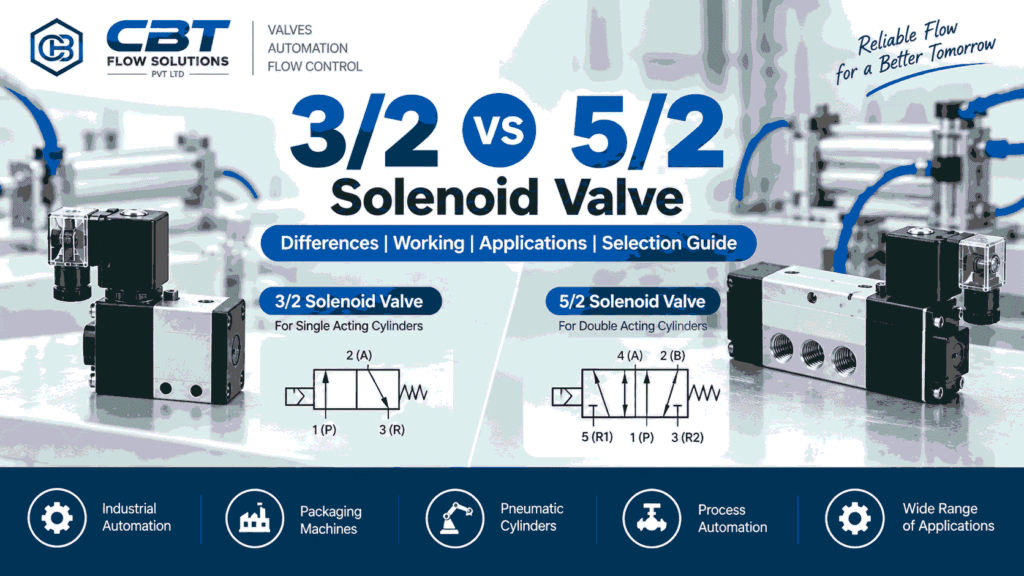
3/2 vs 5/2 Solenoid Valve: Differences, Working, Applications and Selection Guide
If you are working with pneumatic cylinders or automated valves, you have probably come across terms like 3/2 solenoid valve and 5/2 solenoid valve.
At first, the numbers can look confusing. What does 3/2 mean? Why does another valve have five ports? And more importantly, which one should you use?
The answer becomes much easier once you understand what the two numbers represent.
A 3/2 solenoid valve has three ports and two positions, while a 5/2 solenoid valve has five ports and two positions. Both are electrically controlled directional valves, but they are designed for different pneumatic control arrangements.
In practical terms, a 3/2 valve is commonly associated with single-acting cylinders or actuators, while a 5/2 valve is commonly used for double-acting cylinders and actuators.
CBT Flow Solutions Pvt. Ltd. supplies a wide range of pneumatic and industrial solenoid valves, including 3-port and 5-port configurations for automation and actuator-control applications.
Let us break down the difference properly.
What Does 3/2 Mean in a Solenoid Valve?
The name 3/2 solenoid valve tells you two things.
The first number, 3, represents the number of ports.
The second number, 2, represents the number of operating positions.
So, a 3/2 valve has:
3 ports + 2 positions
In a typical pneumatic application, the three ports are used for:
- Compressed-air supply
- Actuator or cylinder connection
- Exhaust
When the valve changes position, it changes which ports are connected internally.
This allows the valve to supply compressed air to an actuator and then exhaust that air when the electrical signal changes.
That is why 3/2 valves are commonly used with single-acting pneumatic cylinders and actuators.
CBT’s product range includes several 3-port configurations, including direct-acting, pilot-operated and NAMUR-mounted designs.
For example, the 3 Port Direct Acting Solenoid Valve listed by CBT is specified for applications including single-acting actuators, cylinders and control-valve actuation. Depending on the model, the listed body options include aluminium, brass and SS316, with different seal options and operating-pressure ranges.
What Does 5/2 Mean in a Solenoid Valve?
A 5/2 solenoid valve has:
5 ports + 2 positions
This configuration is commonly used for controlling double-acting pneumatic cylinders and actuators.
A double-acting cylinder requires compressed air on both sides of the piston.
One air connection moves the piston in one direction, while the other connection moves it in the opposite direction.
The 5/2 valve manages these two air paths.
In one position, compressed air is directed to one side of the cylinder while the other side is exhausted.
When the valve switches position, the air paths are reversed.
The cylinder then moves in the opposite direction.
This makes the 5/2 valve a standard choice for pneumatic automation where controlled movement in both directions is required.
CBT’s current solenoid-valve range includes multiple 5-port configurations, including internal pilot-operated single-solenoid and double-solenoid valves.
The 5 Port 2 Position Internal Pilot Operated Double Solenoid Valve listed by CBT is intended for operation of double-acting cylinders and actuators.
3/2 vs 5/2 Solenoid Valve: The Basic Difference
The simplest way to understand the difference is to look at the equipment being controlled.
A 3/2 solenoid valve is generally used when the pneumatic device needs one working air connection and an exhaust function.
A 5/2 solenoid valve provides two working air connections, making it suitable for controlling a double-acting cylinder or actuator.
Here is the basic comparison:
| Feature | 3/2 Solenoid Valve | 5/2 Solenoid Valve |
|---|---|---|
| Number of ports | 3 | 5 |
| Number of positions | 2 | 2 |
| Common application | Single-acting actuator | Double-acting actuator |
| Working air connections | Usually 1 | Usually 2 |
| Exhaust function | Yes | Yes |
| Pneumatic cylinder control | Single acting | Double acting |
| Typical automation use | Simple directional control | Forward and reverse cylinder movement |
| Common configurations | NC, NO, universal | Single or double solenoid |
The important thing to remember is that port count is not just a naming convention. It reflects how the valve routes compressed air through the pneumatic system.
How Does a 3/2 Solenoid Valve Work?
Imagine a single-acting pneumatic cylinder.
The cylinder has compressed-air pressure on one side, while a spring returns the cylinder when the air supply is removed.
When the 3/2 solenoid valve receives the required electrical signal, it changes its internal position.
Compressed air enters the actuator.
The actuator moves.
When the signal changes, the valve moves back to its other position and provides the required exhaust path.
The air leaves the actuator, allowing the spring to return the cylinder.
This makes the 3/2 arrangement relatively straightforward.
It is often used where only one powered direction of cylinder movement is required.
A 3/2 valve may be configured as normally closed, normally open or universal depending on its design and application.
CBT also lists 3/2 direct-acting NAMUR solenoid valves and other 3-port configurations for pneumatic automation and actuator applications.
How Does a 5/2 Solenoid Valve Work?
Now consider a double-acting cylinder.
There are two air connections:
one at the front side of the cylinder and one at the rear side.
Compressed air must be supplied alternately to these two sides.
The 5/2 valve handles this switching.
In the first position, air is sent to one side while the opposite side exhausts.
The cylinder moves forward.
When the valve changes position, the air paths are reversed.
The opposite side receives pressure, and the first side exhausts.
The cylinder then moves backward.
This gives the control system two-way pneumatic movement without requiring a return spring inside the cylinder.
This is why 5/2 solenoid valves are frequently found in:
- Automated machinery
- Packaging equipment
- Material-handling systems
- Pneumatic presses
- Clamping systems
- Production lines
- Valve automation
- Robotic pneumatic systems
CBT’s product range includes several 5-port designs for pneumatic control, including spring-return and double-solenoid configurations.
3/2 vs 5/2 Solenoid Valve for Pneumatic Cylinders
This is where the difference becomes very practical.
For a single-acting cylinder
A 3/2 solenoid valve is generally the suitable configuration because the cylinder only requires air pressure to move in one direction.
When air is removed, the internal spring returns the cylinder.
For a double-acting cylinder
A 5/2 solenoid valve is generally used because the cylinder needs controlled air pressure on both sides.
The valve alternates the pressure and exhaust connections to produce forward and reverse movement.
So when selecting between a 3/2 and 5/2 valve, start by identifying the actuator or cylinder.
Do not select the valve first and then try to make the actuator fit it.
Single Solenoid vs Double Solenoid
Another point that often causes confusion is the difference between single-solenoid and double-solenoid versions.
A single-solenoid configuration commonly uses a spring or another return mechanism to bring the valve back to its normal position when the coil is de-energized.
A double-solenoid configuration uses a second coil to shift the valve in the opposite direction.
This distinction is particularly important with 5/2 directional valves.
A single-solenoid 5/2 valve can provide a spring-return type operation.
A double-solenoid 5/2 valve can maintain its switched position according to the valve’s design until the opposite coil is energized.
CBT currently lists both 5 Port 2 Position Internal Pilot Operated Single Solenoid Poppet Valve and 5 Port 2 Position Internal Pilot Operated Double Solenoid Valve within its solenoid range.
3/2 vs 5/2 Solenoid Valve for Pneumatic Actuators
Pneumatic actuators are widely used to automate industrial process valves such as ball valves and butterfly valves.
The solenoid valve acts as the control element for the actuator.
For a single-acting actuator, a 3/2 configuration may be used because the actuator generally requires air pressure in one direction and a spring return in the other.
For a double-acting actuator, a 5/2 configuration is commonly used because the actuator needs pneumatic pressure for both directions.
CBT also offers NAMUR solenoid valve configurations designed for actuator mounting. The current range includes both 3/2 and 5/2 convertible NAMUR designs.
For actuator automation, the mounting arrangement matters as much as the port configuration.
A suitable 3 Port Regulating NAMUR Solenoid Valve can be considered for relevant single-acting actuator applications, while convertible 5/2 and 3/2 NAMUR designs can be used where the actuator and valve specifications match.
Can a 3/2 Valve Replace a 5/2 Valve?
Usually, you should not treat them as direct substitutes.
A 3/2 valve does not provide the same two working air paths as a 5/2 valve.
If your pneumatic cylinder requires pressure on both sides for controlled extension and retraction, a 3/2 valve will not provide the same function.
Similarly, using a 5/2 valve in a simple single-acting application may add unnecessary complexity.
The valve should match the actuator design.
This sounds obvious, but it is one of the most important points when ordering pneumatic directional valves.
How to Choose Between 3/2 and 5/2 Solenoid Valve
Before ordering a pneumatic solenoid valve, check these points.
1. Identify the Actuator Type
Is it single acting or double acting?
This is the first question to answer.
2. Check the Number of Ports
A 3/2 valve provides three ports and two positions.
A 5/2 valve provides five ports and two positions.
3. Check Operating Pressure
The available compressed-air pressure must fall within the valve’s specified operating range.
For example, CBT lists different pressure ranges for different 3-port and 5-port models, so the exact product specification should always be checked rather than assuming every valve has the same rating.
4. Check Air Flow
The valve needs to provide enough flow for the cylinder or actuator.
An undersized valve can affect actuator speed and overall machine performance.
5. Check Voltage
Make sure the coil voltage matches your control system.
Depending on the model, different AC and DC voltage options may be available.
6. Consider the Mounting
For actuator automation, determine whether you need inline mounting, sub-base mounting or a NAMUR-mounted valve.
7. Check the Media and Seal
Even for compressed-air systems, air quality, temperature and seal compatibility should be considered.
For other media, material compatibility becomes even more important.
3/2 vs 5/2 Solenoid Valve: Which One Should You Use?
There is no universal winner.
The right valve depends on the pneumatic device you need to control.
Choose a 3/2 solenoid valve when your application normally involves a single-acting cylinder or actuator and you need a supply and exhaust function.
Choose a 5/2 solenoid valve when your application requires a double-acting cylinder or actuator with controlled movement in both directions.
For example:
Single-acting cylinder → 3/2 valve
Double-acting cylinder → 5/2 valve
Single-acting actuator → often 3/2 or an appropriate 3-port NAMUR arrangement
Double-acting actuator → often 5/2 or an appropriate 5-port NAMUR arrangement
The exact valve still needs to be selected according to pressure, flow, voltage, mounting, media and manufacturer specifications.
Explore 3/2 and 5/2 Solenoid Valves from CBT Flow Solutions
CBT Flow Solutions Pvt. Ltd. supplies a broad range of solenoid valves for pneumatic automation, actuator control and industrial applications. The current range includes 3-port, 5-port, direct-acting, pilot-operated and NAMUR configurations.
For applications requiring three-port directional control, the 3 Port Direct Acting Solenoid Valve is designed for applications including single-acting actuators, cylinders and control-valve actuation.
For double-acting pneumatic systems, CBT offers the 5 Port 2 Position Internal Pilot Operated Double Solenoid Valve.
For actuator-mounted applications, the 5/2 and 3/2 Convertible Spool Type NAMUR Solenoid Valve provides a useful option where the actuator and application requirements match the valve specification.
CBT also lists a 3 Port Regulating NAMUR Solenoid Valve for relevant single-acting actuator applications.
Frequently Asked Questions
What is the difference between a 3/2 and 5/2 solenoid valve?
A 3/2 valve has three ports and two positions, while a 5/2 valve has five ports and two positions. A 3/2 valve is commonly used for single-acting pneumatic devices, while a 5/2 valve is commonly used for double-acting cylinders and actuators.
Can a 3/2 solenoid valve control a double-acting cylinder?
A standard 3/2 valve does not provide the same two working air connections needed for normal independent extension and retraction of a double-acting cylinder. A suitable 5/2 configuration is generally used instead.
What is a 5/2 solenoid valve used for?
A 5/2 solenoid valve is commonly used to control double-acting pneumatic cylinders and actuators by switching compressed air between two working ports while providing the required exhaust paths.
Is a 3/2 valve normally open or normally closed?
A 3/2 valve can be designed as normally open, normally closed or another configuration, depending on the specific valve. The required configuration should be selected based on the control logic and fail position of the application.
What does NAMUR mean in a solenoid valve?
NAMUR refers to an actuator-mounting arrangement used for pneumatic valve automation. NAMUR solenoid valves can mount directly to compatible pneumatic actuators, reducing the need for some external tubing.
Which solenoid valve is better for pneumatic automation?
Neither is automatically better. A 3/2 valve is appropriate for many single-acting applications, while a 5/2 valve is commonly used for double-acting cylinders and actuators. The correct choice depends on the complete system.
Need Help Selecting the Right Solenoid Valve?
CBT Flow Solutions Pvt. Ltd. provides industrial Valves | Automation | Flow Control solutions with a wide range of pneumatic and solenoid valve configurations.
Share your application requirement with our team — actuator type, pressure, voltage, connection size and quantity — and we can help identify the suitable valve configuration.
CBT Flow Solutions Pvt. Ltd.
Valves | Automation | Flow Control
Industrial Flow-Control Solutions Since 1966
Explore the CBT Solenoid Valve Range → CBT Flow Solutions – Solenoid Valve Range